Cart

Oops, your cart is still empty
Looks like you haven’t added anything yet. Start exploring our products and find what you need.

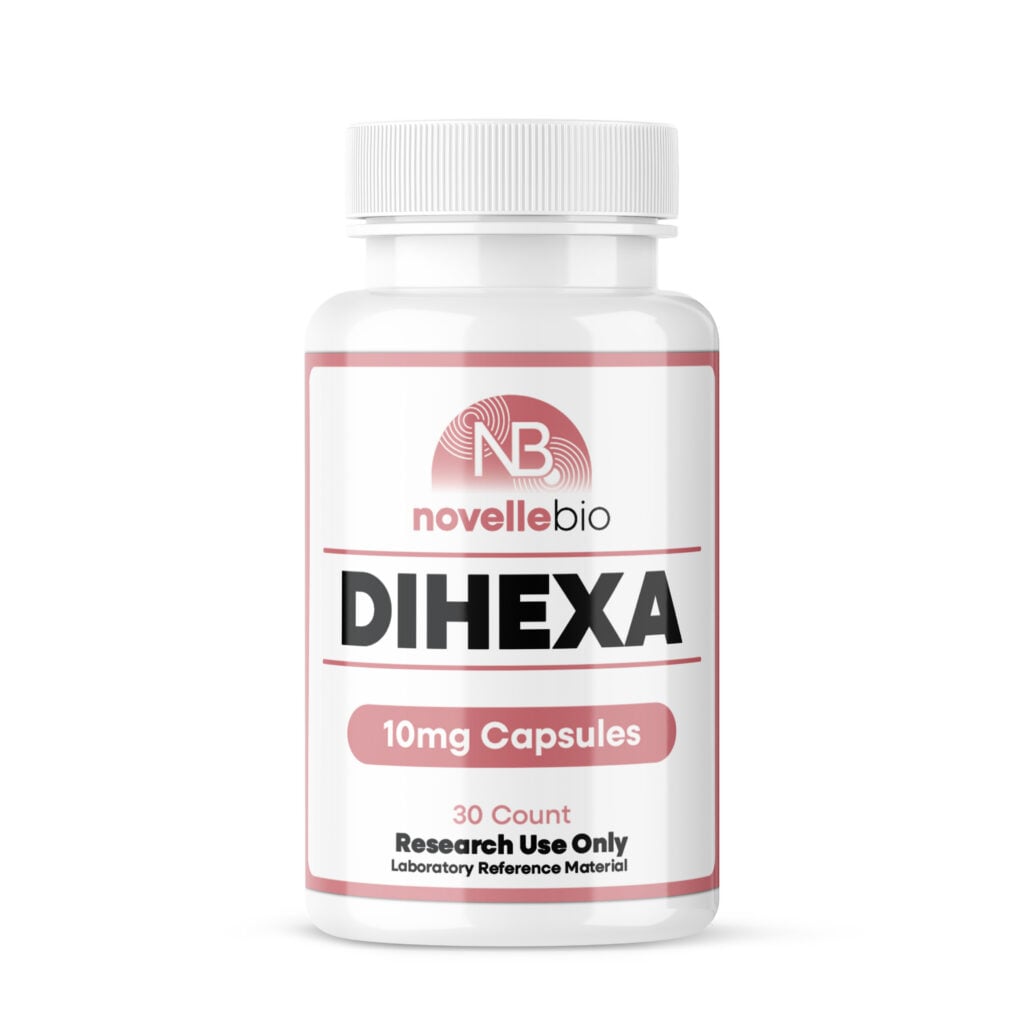
Dihexa (developmental code PNB-0408; chemical name N-hexanoic-Tyr-Ile-(6)aminohexanoic amide) is a small molecule structurally derived from angiotensin IV (Ang IV), the six-amino-acid fragment of the renin-angiotensin system (Val-Tyr-Ile-His-Pro-Phe) that had previously been shown to enhance cognitive performance in rodents. Although it is peptide-derived and built from amino-acid-like building blocks (a hexanoyl-modified tyrosine-isoleucine core capped with an aminohexanoic amide), Dihexa is more accurately classified as a small-molecule peptidomimetic rather than a true peptide, the N- and C-terminal modifications were specifically designed to increase hydrophobicity, resist enzymatic degradation, and confer blood-brain barrier penetrance, properties that native Ang IV lacks.
Dihexa was developed by Joseph Harding and colleagues at Washington State University, building on a research program (with collaborator John Wright) dating to the 1990s that investigated Ang IV’s procognitive effects via the AT4 receptor. Harding’s group subsequently proposed that Ang IV and its synthetic derivatives, including Dihexa, act not through the classical AT4/angiotensin receptor but by binding hepatocyte growth factor (HGF) and potentiating its activity at the receptor tyrosine kinase c-Met. Because c-Met/HGF signaling drives neurogenesis, dendritic branching, and synaptogenesis, and because Dihexa was reported to cross the blood-brain barrier, the compound attracted research interest as a candidate for enhancing synaptic connectivity in neurodegenerative disease and cognitive-impairment models. Washington State University’s spin-off company, M3 Biotechnology (later renamed Athira Pharma), was formed to further develop Dihexa and related HGF/c-Met-targeted molecules.
Important research-integrity note: two of the foundational papers describing the HGF/c-Met mechanism for this compound class, Kawas, McCoy, Yamamoto, Wright & Harding (2012, J Pharmacol Exp Ther) and Benoist et al. (2014, J Pharmacol Exp Ther), were formally retracted in April 2025 following a 2021 Notice of Concern regarding data integrity. A related 2013 paper reporting oral cognitive restoration in rats (McCoy et al., J Pharmacol Exp Ther) carries an active Notice of Concern but has not been retracted as of this writing. Any researcher relying on the HGF/c-Met mechanistic model for Dihexa should independently review the current status of these publications, as the retractions materially weaken the direct biochemical evidence for the proposed mechanism, even though downstream behavioural (cognitive/spine-density) findings from the same research group have not themselves been retracted.
The central mechanistic hypothesis is that Dihexa binds directly to HGF with high affinity, inhibits HGF self-dimerization, and acts synergistically with HGF to enhance c-Met receptor tyrosine kinase signaling, including downstream effects on cell scattering, motility, and proliferation in non-neuronal assays, and on dendritic spinogenesis and synaptogenesis in hippocampal neurons. In the reported studies, co-administration of an HGF antagonist (Hinge) blocked Dihexa’s procognitive effects in behavioural testing, offered as functional evidence that the pathway is HGF-dependent. As noted above, the primary biochemical papers underpinning this specific dimerization-based mechanism have since been retracted, so this mechanism should be regarded as a proposed and contested model rather than an established one.
Independent of the specific HGF-binding biochemistry, Dihexa treatment of cultured rat hippocampal neurons was reported to increase dendritic spine density roughly three-fold over 5 days (approximately 41 spines per 50 um of dendrite with Dihexa versus 15 with vehicle), with newly formed spines containing normal synaptic machinery (VGLUT1, synapsin, PSD-95) and functional AMPA-receptor-mediated activity. An acute 30-minute application was also reported to increase spine-head width, a morphological correlate of synaptic strength.
In rat hippocampal neuronal culture, Dihexa was reported to markedly increase dendritic spine number and spine-head width, with the newly formed synapses shown to be structurally and functionally mature (present synaptic markers, AMPA-mediated miniature excitatory postsynaptic currents). Dihexa has also been used, independent of the cognition research programme, as one of several small molecules supporting hepatocyte-like differentiation of human pluripotent stem cells in vitro (typically at 100 nM over roughly 10 days of maturation), reflecting its reported HGF-pathway agonism in a non-neuronal cell system.
Using [3H]-Dihexa and [14C]-inulin infusion in rats, Dihexa was shown to cross the blood-brain barrier and accumulate in brain tissue, consistent with its hydrophobic modification relative to native Ang IV. In a scopolamine-induced cognitive impairment model in rats, Dihexa administered intracerebroventricularly (0.1 to 1.0 nmol), intraperitoneally (up to 0.5 mg/kg/day), or orally (up to 2.0 mg/kg/day) significantly improved performance on the Morris water maze (reduced latency to locate the hidden platform and increased time spent in the target quadrant during probe trials) compared with scopolamine-treated, Dihexa-untreated animals, with the highest doses producing performance indistinguishable from non-impaired controls. In aged (24-month-old) rats, orally administered Dihexa (2 mg/kg/day) also improved Morris water maze performance on most testing days, although the effect was less robust and more variable than in the scopolamine model, reflecting heterogeneity in baseline cognitive decline among aged animals. Notably, Dihexa did not improve performance in rats with normal, unimpaired cognition, suggesting the compound’s effects are conditional on an existing deficit rather than representing generalized cognitive stimulation. Pharmacokinetic characterization in rats found a terminal half-life of approximately 12.7 days after intravenous administration and 8.8 days after intraperitoneal administration, with a considerably shorter half-life (approximately 335 minutes) measured in isolated rat serum.
No human clinical trials of Dihexa itself have been conducted or published. Because Dihexa lacked pharmaceutical-grade drug-like properties for clinical development, Athira Pharma instead developed fosgonimeton (ATH-1017), a phosphate prodrug that is rapidly converted to an active HGF/c-Met-potentiating metabolite following subcutaneous administration. Fosgonimeton reached Phase 2/3 testing in Alzheimer’s disease (the LIFT-AD trial, roughly 300 participants), but this trial failed to meet its primary cognitive endpoint versus placebo over 26 weeks (announced September 2024), after which the sponsor paused the programme. Because fosgonimeton is chemically and pharmacokinetically distinct from Dihexa (a prodrug versus the parent small molecule), this clinical outcome cannot be directly extrapolated to Dihexa itself, but it is a relevant data point for researchers assessing the translational strength of the underlying HGF/c-Met hypothesis in humans.
There is no published long-term safety or toxicology data for Dihexa in either animals or humans. No formal carcinogenicity, genotoxicity, or reproductive toxicology study has been identified. A theoretical safety concern specific to this compound’s proposed mechanism is that c-Met is a recognized proto-oncogene, and sustained HGF/c-Met pathway activation is mechanistically linked to tumorigenesis and metastatic progression in several cancer types; no study has directly tested whether chronic Dihexa exposure promotes tumor formation or progression, and this risk remains unresolved rather than ruled out. Short-duration preclinical studies cited in a patent application describe no observed toxicity, including no neoplastic induction, but these results have not been published in a peer-reviewed, independently reviewed format and should be treated as preliminary industry-sourced claims rather than established safety findings. Dihexa is not approved for any human or veterinary use in any jurisdiction, is not commercially available as a regulated pharmaceutical product, and, as detailed above, key mechanistic papers describing its biochemistry have been retracted, which further compounds the uncertainty around its overall risk profile.
Dihexa’s chemical modifications relative to native angiotensin IV (N-terminal hexanoylation and C-terminal amidation with 6-aminohexanoic acid) were specifically designed to resist the aminopeptidase- and carboxypeptidase-mediated degradation that limits Ang IV’s stability and prevents its blood-brain barrier penetration. In preclinical pharmacokinetic work, Dihexa exhibited a considerably longer half-life in whole-animal studies (8.8 to 12.7 days, depending on administration route) than in isolated serum (approximately 335 minutes), suggesting that tissue distribution and depot-like retention, rather than serum protein binding alone, account for its extended systemic persistence in vivo. Modeling of its physicochemical properties suggests intestinal permeability intermediate between enalapril and piroxicam, consistent with reasonable but unconfirmed oral bioavailability; no direct human pharmacokinetic or bioavailability study has been published.
Dihexa represents a scientifically interesting but still largely unproven small-molecule approach to enhancing synaptic connectivity via proposed HGF/c-Met pathway potentiation. Preclinical rodent data, improved Morris water maze performance in scopolamine-impaired and aged rats, and increased dendritic spine density and functional synapse formation in hippocampal culture, are the strongest evidence available, but a meaningful portion of the foundational biochemical literature explaining how Dihexa produces these effects has since been retracted for data-integrity concerns, and this should materially temper confidence in the specific HGF-dimerization mechanism as originally described. No human clinical data exist for Dihexa itself; the closest clinical read-through, the fosgonimeton (ATH-1017) prodrug programme, recently failed its primary endpoint in a Phase 2/3 Alzheimer’s disease trial, though this outcome applies to a chemically distinct prodrug rather than to Dihexa directly. Long-term safety and tumorigenicity risk, a theoretically relevant concern given c-Met’s role as a proto-oncogene, remain entirely uncharacterized. Dihexa has no regulatory approval anywhere and is not available as a clinical product; it should be regarded strictly as an early-stage, mechanistically contested research tool pending substantial further independent replication.
1. Wright JW, Harding JW. The Brain Hepatocyte Growth Factor/c-Met Receptor System: A New Target for the Treatment of Alzheimer’s Disease. J Alzheimers Dis. 2015;45(4):985-1000. doi: 10.3233/JAD-142814.
2. Wright JW, Kawas LH, Harding JW. The development of small molecule angiotensin IV analogs to treat Alzheimer’s and Parkinson’s diseases. Prog Neurobiol. 2015;125:26-46. doi: 10.1016/j.pneurobio.2014.11.004.
3. Benoist CC, Wright JW, Zhu M, Appleyard SM, Wayman GA, Harding JW. Facilitation of hippocampal synaptogenesis and spatial memory by C-terminal truncated Nle1-angiotensin IV analogs. J Pharmacol Exp Ther. 2011;339(1):35-44. doi: 10.1124/jpet.111.182220.
4. Benoist CC, et al. Mechanistic study of HGF/c-Met potentiation by angiotensin IV-derived peptides. J Pharmacol Exp Ther. 2014;350(2). Retracted April 2025, see Journal of Pharmacology and Experimental Therapeutics retraction notice.
5. Alzheimer’s Drug Discovery Foundation. Cognitive Vitality Report: Dihexa. Updated August 13, 2021. alzdiscovery.org.
6. Kawas C, McCoy AM, Yamamoto BK, Wright JW, Harding JW. HGF-dimerization mimetic study. J Pharmacol Exp Ther. 2012. Retracted April 2025.
7. McCoy AM, Kawas LH, Wright JW, Harding JW. Oral cognitive restoration and hippocampal spinogenesis by dihexa in scopolamine-impaired and aged rats. J Pharmacol Exp Ther. 2013. Notice of Concern issued 2021.
8. Siller R, Greenhough S, Naumovska E, Sullivan GJ. Small-molecule-driven hepatocyte differentiation of human pluripotent stem cells. Stem Cell Reports. 2015;4(5):939-952. doi: 10.1016/j.stemcr.2015.04.001. PMID: 25937370.
9. Athira Pharma. Topline results of the LIFT-AD Phase 2/3 trial of fosgonimeton in mild-to-moderate Alzheimer’s disease. Press release, September 2024.
10. Ho JK, Nation DA. Cognitive benefits of angiotensin IV and angiotensin-(1-7): A systematic review of experimental studies. Neurosci Biobehav Rev. 2018;92:209-225. doi: 10.1016/j.neubiorev.2018.05.005. PMID: 29733881.