Cart

Oops, your cart is still empty
Looks like you haven’t added anything yet. Start exploring our products and find what you need.

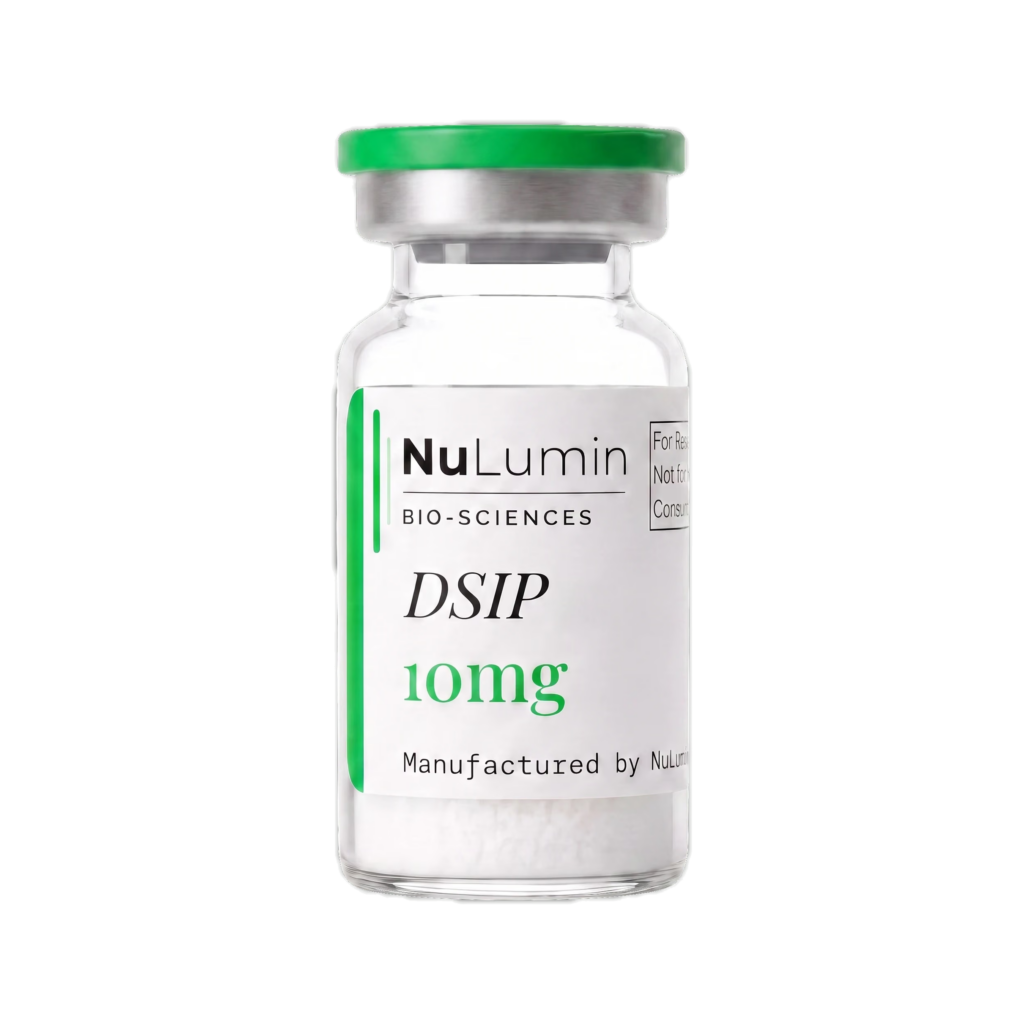
Delta sleep-inducing peptide (DSIP) is a nonapeptide with the sequence Trp-Ala-Gly-Gly-Asp-Ala-Ser-Gly-Glu. It was first isolated in 1977 by the Schoenenberger-Monnier group in Basel from the cerebral venous blood of rabbits during electrically induced sleep. The isolation itself is a landmark of mid-20th-century sleep physiology: cerebral venous blood was drawn from rabbits made to sleep by low-frequency electrical stimulation of the thalamus, dialyzed, and infused into awake recipient rabbits, which then displayed increased delta-wave and spindle activity on EEG together with reduced motor activity, findings interpreted as evidence of a blood-borne sleep-promoting factor.
DSIP does not belong to any previously described peptide family, and its primary structure remains structurally distinct from other known neuropeptides. Despite its name, DSIP has never been formally assigned a validated endogenous receptor, and the gene encoding a DSIP precursor protein has not been isolated, a gap that has led some investigators to question whether circulating DSIP-like immunoreactivity reflects a single discrete peptide or a family of related, cross-reactive fragments. Researchers nonetheless remain interested in DSIP because of the breadth of biological activities reported in the subsequent literature, spanning sleep electrophysiology, neuroendocrine regulation, stress physiology, and nociception, despite the peptide’s short circulating half-life and unresolved mechanism, making it a long-standing subject of investigation into humoral sleep-regulatory systems.
Because no dedicated DSIP receptor has been cloned, proposed mechanisms are inferred largely from pharmacological and neurochemical studies rather than direct receptor-binding data.
DSIP itself does not bind appreciably to any characterized opioid receptor subtype, yet nanomolar-to-picomolar concentrations of the peptide stimulate calcium-dependent release of immunoreactive Met-enkephalin from rat lower brainstem slices and brain synaptosomes in vitro. This has led to the hypothesis that DSIP produces antinociceptive and mood-related effects indirectly, by promoting release of endogenous opioid peptides rather than by acting as a direct opioid agonist.
DSIP has been reported to reduce basal corticotropin (ACTH) release and to blunt stress-induced corticosterone/cortisol elevations in animal models, consistent with a role in stress buffering. It has also been reported to influence secretion of luteinizing hormone, growth hormone (somatotropin) and somatoliberin, and to suppress somatostatin tone in some experimental paradigms, though these endocrine effects are inconsistent across studies and species.
Experimental work has explored DSIP’s interaction with serotonergic, dopaminergic, adrenergic and GABAergic systems. Delta sleep-inducing peptide has been reported to stimulate choline acetyltransferase activity via alpha1-adrenergic receptors in rat brain, and structural analogues of DSIP (though notably not DSIP itself in some paradigms) promote slow-wave sleep in rabbits and rats, suggesting that closely related, possibly unidentified endogenous peptides may better explain the “DSIP-like” bioactivity historically attributed to the parent nonapeptide.
In vitro work using rat brainstem slices and synaptosome preparations has shown that DSIP, at concentrations as low as 1 pM to 1 nM, stimulates calcium-dependent release of Met-enkephalin without directly occupying opioid receptor binding sites, supporting an indirect neuromodulatory mechanism rather than direct receptor agonism.
The original cross-circulation experiments in rabbits demonstrated that dialyzed cerebral venous blood from sleeping donor animals, when infused into recipients, increased EEG delta and spindle activity and reduced locomotor activity, the basis for naming the peptide. Later rodent studies examined DSIP’s role in stress physiology, reporting attenuation of stress-induced corticosterone elevation and modulation of HPA-axis tone in rats. Structural DSIP analogues (rather than native DSIP in every paradigm) have also shown slow-wave-sleep-promoting activity in rabbits and rats, and a naturally occurring dermorphin decapeptide structurally related to DSIP (sharing five of nine residues) promotes slow-wave sleep in rabbits, while its optical isomer suppresses it, observations used to argue for the existence of an as-yet-uncharacterized “DSIP-like” endogenous peptide family.
Clinical experience with DSIP is limited, decades-old, and mostly consists of small open-label studies rather than randomized controlled trials. In an open study, seven patients with severe insomnia received a series of ten DSIP injections; sleep normalized in all but one case for follow-up periods of three to seven months, with reported improvements in daytime mood and performance. A separate case report described a 47-year-old woman with chronic delayed sleep-phase insomnia and low-dose benzodiazepine dependence who was treated with DSIP under close inpatient polygraphic monitoring; treatment advanced her main sleep phase by five hours, enabled abrupt withdrawal of flunitrazepam, and restored a more normal sleep profile that was maintained during a follow-up week. In a larger open trial, intravenous DSIP was given to 67 patients experiencing withdrawal symptoms (28 from ethanol, 39 from opiates); of 49 evaluable patients, 48 showed beneficial effects on somatic withdrawal symptoms, with a more gradual resolution of anxiety over subsequent hours. These studies are informative but methodologically dated, largely unblinded, and involve very small patient numbers, so they should be regarded as preliminary rather than definitive evidence of efficacy.
Formal, modern toxicological characterization of DSIP is lacking. Older clinical reports describe the peptide as generally well tolerated over short intravenous or injection courses, with no serious adverse events reported in the small trials summarized above, though at least one report noted a background of pre-existing drug dependence as a confounding factor in interpreting tolerability. No large-scale, placebo-controlled human safety trial has been conducted, no validated pharmacokinetic profile in humans following subcutaneous administration has been published, and long-term or repeated-dose safety data are essentially absent from the literature. The peptide’s reported plasma half-life is short (on the order of minutes), which is difficult to reconcile with the multi-hour physiological effects described in some trials, and this pharmacokinetic paradox itself remains unresolved. Given the absence of a confirmed receptor and the limited, dated clinical literature, DSIP’s safety profile in humans cannot be considered well characterized by current standards, and it is not approved as a drug in any jurisdiction.
DSIP is one of the oldest named neuropeptides in sleep research, isolated nearly five decades ago from rabbit cerebral venous blood, yet it remains, in the words of one review, “a still unresolved riddle.” Cell and animal data provide plausible, if incomplete, mechanistic threads, indirect enkephalin release, HPA-axis modulation, and interactions with monoaminergic systems, but no confirmed DSIP receptor or gene has been identified, undermining confidence in any single unified mechanism. Small, dated, unblinded human trials suggest possible benefit in insomnia and withdrawal syndromes, but these studies are too limited in size and rigor to establish efficacy by contemporary evidence standards. DSIP is not approved for any therapeutic indication in humans or animals and is sold strictly for laboratory research use.
1. Schoenenberger GA, Monnier M. Characterization of a delta-electroencephalogram(-sleep)-inducing peptide. Proc Natl Acad Sci U S A. 1977;74(3):1282-1286.
2. Kovalzon VM, Strekalova TV. Delta sleep-inducing peptide (DSIP): a still unresolved riddle. J Neurochem. 2006;97(2):303-309. doi: 10.1111/j.1471-4159.2006.03693.x.
3. Nakamura A, Nakashima M, Sakai K, et al. Delta-sleep-inducing peptide (DSIP) stimulates the release of immunoreactive Met-enkephalin from rat lower brainstem slices in vitro. Brain Res. 1989;481(1):165-168. doi: 10.1016/0006-8993(89)90498-8.
4. Characterization of delta-sleep-inducing peptide-evoked release of Met-enkephalin from brain synaptosomes in rats. Neuropeptides. 1991. PMID: 1861139.
5. Kaeser HE. A clinical trial with DSIP. Eur Neurol. 1984;23(5):386-388. doi: 10.1159/000115717.
6. Schneider-Helmert D, Hermann E, Schoenenberger GA. The use of DSIP (delta sleep-inducing peptide) in the correction of phase-shifted insomnia. Dtsch Med Wochenschr. 1987;112(23):922-925. doi: 10.1055/s-2008-1068167.
7. Successful treatment of withdrawal symptoms with delta sleep-inducing peptide, a neuropeptide with potential agonistic activity on opiate receptors. PMID: 6328354.
8. Graf MV, Kastin AJ. Delta-sleep-inducing peptide (DSIP): an update. Peptides. 1986;7(6):1165-1187. PMID: 3550726.