Cart

Oops, your cart is still empty
Looks like you haven’t added anything yet. Start exploring our products and find what you need.
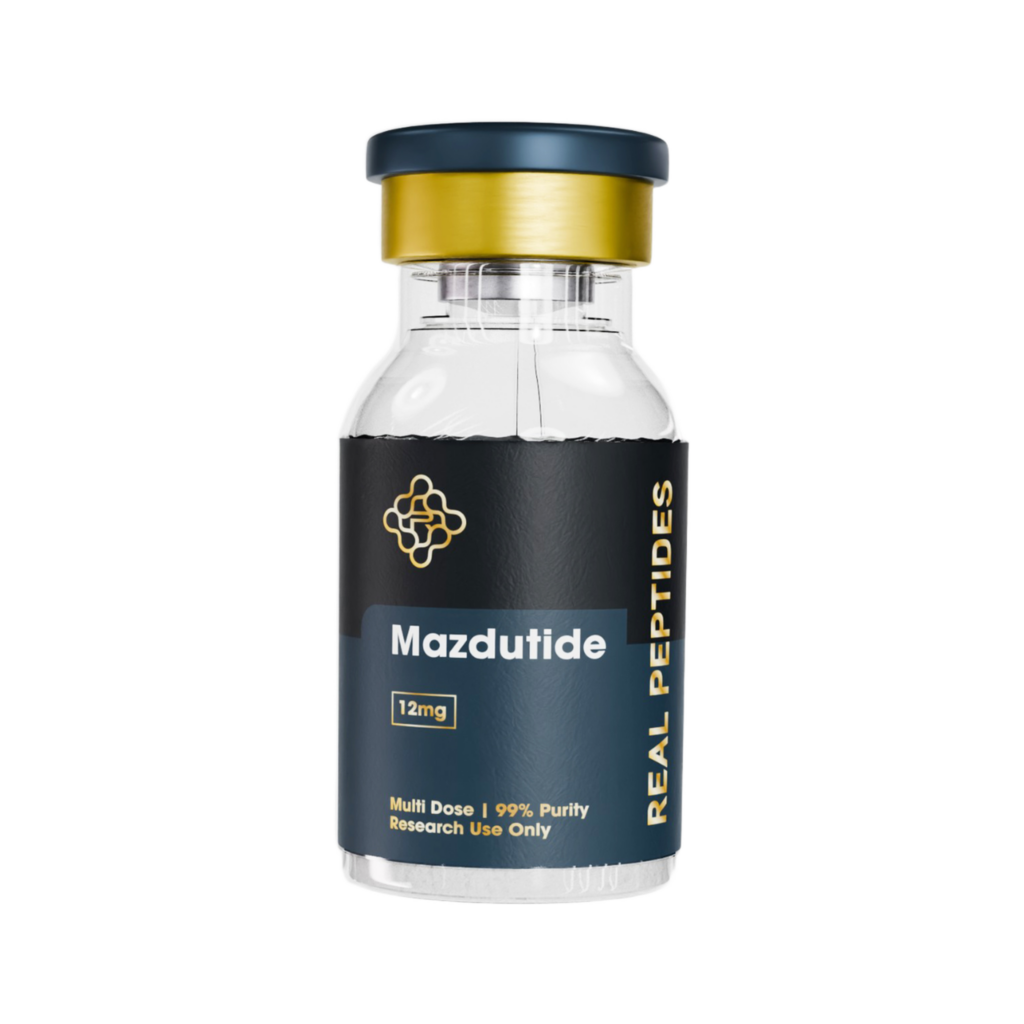
Mazdutide (also designated IBI362 and LY3305677) is a synthetic, once-weekly peptide analogue of mammalian oxyntomodulin (OXM). OXM is a native gut hormone co-secreted with GLP-1 and glucagon by intestinal L-cells after a meal. It was designed and developed by Innovent Biologics, which subsequently licensed the molecule to Eli Lilly for development and commercialisation outside China. The peptide backbone is built on the oxyntomodulin amino-acid sequence.
It is chemically modified with a fatty-acid (acyl) side chain that binds circulating albumin. This extends its plasma half-life to support once-weekly subcutaneous dosing and reduces susceptibility to enzymatic degradation relative to the native hormone.
Mazdutide is classified as a dual GLP-1 receptor (GLP-1R) and glucagon receptor (GCGR) agonist. Researchers became interested in this class because native oxyntomodulin, unlike selective GLP-1 receptor agonists, engages both receptors. The GLP-1R pathway drives the well-characterised incretin effects, including appetite suppression, slowed gastric emptying, and glucose-dependent insulin secretion. Concurrent GCGR activation is hypothesised to increase energy expenditure and improve hepatic lipid handling.
This dual-agonist strategy is being investigated as a way to produce greater weight loss and metabolic benefit than GLP-1R-selective agents alone. Mazdutide has been evaluated across a large Chinese clinical development programme (the GLORY and DREAMS trial series) in adults with obesity, overweight with comorbidities, and type 2 diabetes.
Mazdutide binds and activates the human GLP-1 receptor, replicating the core incretin actions of endogenous GLP-1. These include glucose-dependent stimulation of pancreatic insulin secretion, suppression of glucagon release from pancreatic alpha cells in the fed state, and delayed gastric emptying. It also activates hypothalamic satiety circuits that reduce food intake. These effects are the shared mechanistic basis for glycaemic control and weight reduction across the broader GLP-1 receptor agonist class.
In parallel, mazdutide activates the glucagon receptor. Unlike glucagon’s classical hyperglycaemic action, GCGR agonism in this dual-agonist context is proposed to increase resting energy expenditure and enhance hepatic fatty-acid oxidation, potentially reducing liver fat content. Preclinical work in mice indicates mazdutide lowers body weight and improves glucose control in both Gcgr-knockout and Glp1r-knockout animals. This indicates that weight-lowering activity does not depend on either receptor pathway alone, and that the two engagements act at least partially independently.
Receptor-binding and cell-based signalling assays cited in the phase 1b clinical publications describe mazdutide as a “balanced” dual agonist. It shows comparable in vitro potency at GLP-1R and GCGR relative to the native ligands. This design is intended to avoid a pharmacology skewed too heavily toward one receptor, which could increase hyperglycaemic risk (excess GCGR activity) or gastrointestinal intolerance (excess GLP-1R activity).
Published mechanistic work is largely receptor-binding and second-messenger (cAMP) signalling data, generated in cell lines expressing recombinant human and mouse GLP-1R and GCGR. These data were used to characterise mazdutide’s binding affinity and functional potency at each receptor, as part of its preclinical characterisation package. Dedicated, independently published cell-culture efficacy studies beyond receptor pharmacology are limited in the public literature.
In diet-induced obese mice, mazdutide reduced body weight, improved glycaemic control, and increased energy expenditure. Body-weight-lowering effects were partially preserved in mice lacking either the Glp1r or the Gcgr gene, supporting a dual-receptor mechanism. This finding is part of the compound’s nonclinical characterisation (cited in Ji L, et al., eClinicalMedicine 2022). Comprehensive, independently published rodent efficacy and toxicology datasets are not yet widely available in the open literature. Much of the preclinical package remains proprietary to Innovent and Lilly.
Mazdutide has one of the more extensive human clinical datasets among investigational obesity and diabetes peptides, run almost entirely in Chinese populations to date.
A phase 1b multiple-ascending-dose trial gave IBI362 at 3.0 to 6.0 mg once weekly for 12 weeks to 43 participants with type 2 diabetes. It found favourable safety, tolerability, and dose-dependent glucose lowering (Ji L, et al., Nat Commun. 2022). A phase 1b multiple-ascending-dose trial gave mazdutide 3.0 to 6.0 mg once weekly for 12 weeks to adults with overweight or obesity. It produced placebo-adjusted body-weight reductions of approximately 4.8% to 6.4% (Ji L, et al., EClinicalMedicine. 2021;39:101088). A higher-dose phase 1b trial tested mazdutide 9 mg and 10 mg once weekly in Chinese adults with overweight or obesity. It extended these findings to higher exposures (Ji L, et al., EClinicalMedicine. 2022).
A phase 2 randomised, double-blind, placebo-controlled trial gave mazdutide 4 to 6 mg once weekly for 24 weeks to Chinese patients with type 2 diabetes. It reported HbA1c reductions of up to 2.23 percentage points and body-weight reductions of up to 5.4%. The trial also showed improvements in blood lipids and liver fat (Ji L, et al., Diabetes Care. 2024;47(1):160-168). A phase 2 trial in Chinese adults with overweight or obesity without diabetes further characterised dose-response for weight loss (Nat Commun. 2023).
GLORY-1 was a phase 3 randomised trial in 610 Chinese adults with obesity or overweight with comorbidities. It tested mazdutide 4 mg and 6 mg once weekly for 32 weeks, with extension to 48 weeks, against placebo. Both doses met the primary weight-loss endpoint and multiple cardiometabolic secondary endpoints. These included reductions in liver fat content (Ji L, Jiang H, Bi Y, et al. N Engl J Med. 2025;392(22):2215-2225). GLORY-2 was a phase 3 trial of the 9 mg dose in 462 Chinese adults with obesity. It reported weight reductions of up to approximately 20% at the studied endpoint. This met its primary and key secondary endpoints (Gao L, Jiang H, Cai H, et al. JAMA. 2026). DREAMS-1 and DREAMS-2 were two phase 3 trials in Chinese adults with type 2 diabetes, comparing mazdutide against placebo and against dulaglutide respectively. Both were published back-to-back in Nature, reporting superior glycaemic and weight outcomes for mazdutide relative to comparators.
No cosmetic-dermatology studies of mazdutide have been published. Its clinical programme is confined to metabolic and endocrine endpoints, including weight, glycaemic control, liver fat, blood pressure, lipids, and uric acid.
Across the published phase 1b, phase 2, and phase 3 trials, the most consistently reported adverse events with mazdutide are gastrointestinal, including nausea, diarrhoea, and vomiting. These are typically mild-to-moderate, transient, and concentrated during dose-escalation, consistent with the broader incretin-based drug class. Trial reports describe no dose-dependent increase in the incidence of nausea, diarrhoea, or vomiting across the tested doses.
Some published cohorts also reported no gastrointestinal adverse events leading to treatment discontinuation. Modest, generally self-limiting increases in heart rate (typically under 10 beats per minute) have been observed, a class effect also reported with other GLP-1/glucagon dual agonists. No serious treatment-related adverse events have been reported in the published trials to date.
Longer-term safety data have not been comprehensively published in the peer-reviewed literature as of this writing. This includes outcomes over years of continuous use, effects in populations outside China, and reproductive and developmental toxicology. It also includes pancreatic and biliary safety, an area of ongoing interest across the incretin drug class generally.
Mazdutide has not been evaluated in any human trial for cosmetic, athletic, or non-metabolic indications. No data exist on outcomes in healthy, non-obese, or paediatric populations, outside limited case reports. Given its research-use-only status outside its approved indications, mazdutide should be treated as an investigational compound with an incomplete long-term safety record.
Mazdutide is a well-characterised, clinically advanced dual GLP-1R/GCGR agonist with a substantial and growing human evidence base. This is unusual for a compound still described as “research” in most markets outside China. Phase 1 through phase 3 data consistently show clinically meaningful weight loss and glycaemic improvement in Chinese adults with obesity, overweight, or type 2 diabetes. Weight loss reached approximately 20% in some phase 3 cohorts at the highest studied dose.
The tolerability profile is gastrointestinal-predominant and broadly similar to other incretin-based agents. The proposed mechanistic rationale is that combined GLP-1R and GCGR agonism drives both appetite suppression and energy expenditure. This is supported by rodent knockout studies and is consistent with observed clinical effects on liver fat and metabolic parameters. However, independently published preclinical mechanistic data remain relatively sparse.
Regulatory status is a key point of nuance. Mazdutide received approval from China’s National Medical Products Administration (NMPA) for chronic weight management (2025) and for glycaemic control in type 2 diabetes (2025). This makes it the first approved dual GCG/GLP-1 receptor agonist globally, marketed in China. It is not approved by the FDA or EMA, and Lilly’s global development pathway under its license remains ongoing. Data outside Chinese populations, and long-term safety data beyond roughly one year, are still limited.
Researchers should treat mazdutide as an investigational compound for non-Chinese jurisdictions. Its regulatory approval is indication- and geography-specific. When evaluating its evidence base, researchers should rely on the cited peer-reviewed trials rather than marketing claims.
1. Ji L, Jiang H, Bi Y, et al. Once-Weekly Mazdutide in Chinese Adults with Obesity or Overweight. N Engl J Med. 2025;392(22):2215-2225. doi: 10.1056/NEJMoa2411528.
2. Gao L, Jiang H, Cai H, et al. Treatment With 9-mg Mazdutide for Weight Reduction in Chinese Adults With Obesity: The GLORY-2 Randomized Clinical Trial. JAMA. 2026. doi: 10.1001/jama.2026.8142.
3. Ji L, Jiang H, Zhang X, et al. Efficacy and Safety of Mazdutide in Chinese Patients With Type 2 Diabetes: A Randomized, Double-Blind, Placebo-Controlled Phase 2 Trial. Diabetes Care. 2024;47(1):160-168. doi: 10.2337/dc23-1287.
4. Ji L, Jiang H, Cheng Z, et al. IBI362 (LY3305677), a weekly-dose GLP-1 and glucagon receptor dual agonist, in Chinese adults with overweight or obesity: a randomised, placebo-controlled, multiple ascending dose phase 1b study. EClinicalMedicine. 2021;39:101088. doi: 10.1016/j.eclinm.2021.101088.
5. Ji L, et al. Safety and efficacy of a GLP-1 and glucagon receptor dual agonist mazdutide (IBI362) 9 mg and 10 mg in Chinese adults with overweight or obesity: a randomised, placebo-controlled, multiple-ascending-dose phase 1b trial. EClinicalMedicine. 2022. doi: 10.1016/j.eclinm.2022.101691.
6. A phase 1b randomised controlled trial of a glucagon-like peptide-1 and glucagon receptor dual agonist IBI362 (LY3305677) in Chinese patients with type 2 diabetes. Nat Commun. 2022;13:3603. doi: 10.1038/s41467-022-31328-x.
7. A phase 2 randomised controlled trial of mazdutide in Chinese overweight adults or adults with obesity. Nat Commun. 2023;14:8749. doi: 10.1038/s41467-023-44067-4.
8. Zhu D, Zhao J, Qian L, et al. Mazdutide versus placebo in Chinese adults with type 2 diabetes (DREAMS-1). Nature. 2025. doi: 10.1038/s41586-025-10026-w.
9. Guo L, Zhang B, Xue X, et al. Mazdutide versus dulaglutide in Chinese adults with type 2 diabetes (DREAMS-2). Nature. 2026;652:181-188. doi: 10.1038/s41586-025-10031-z.
10. Bhattachar S, et al. Mazdutide reduces body weight in adults with overweight or obesity: a high-dose Phase 1 trial. Diabetes Obes Metab. 2025. doi: 10.1111/dom.70040.