Cart

Oops, your cart is still empty
Looks like you haven’t added anything yet. Start exploring our products and find what you need.
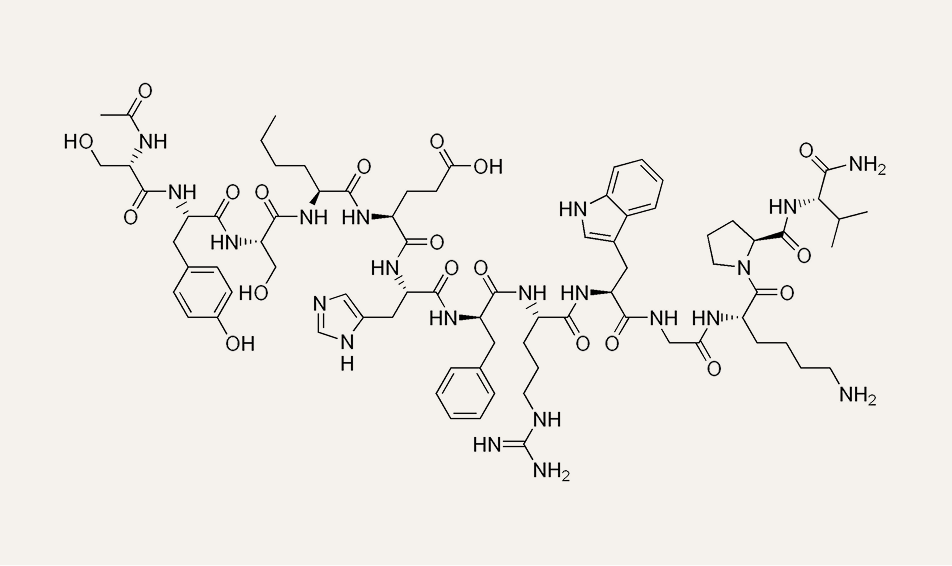
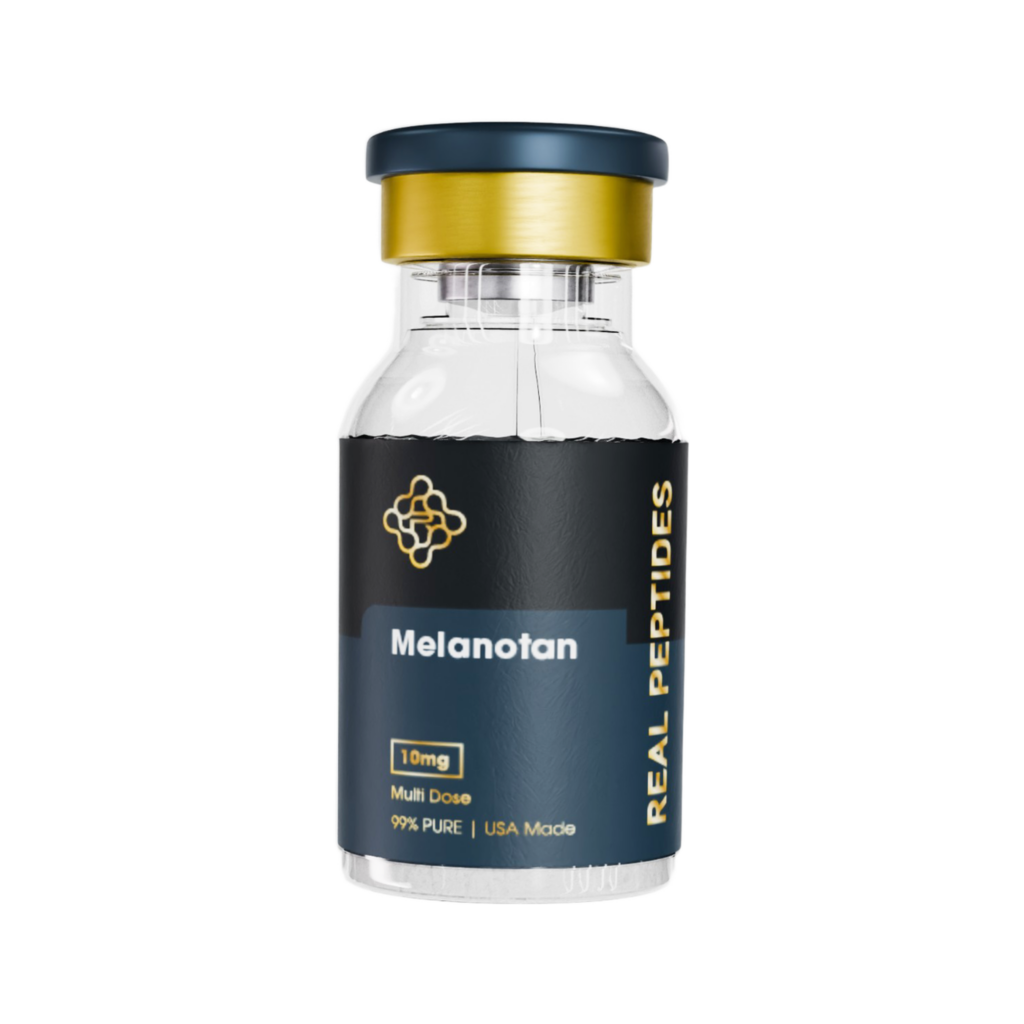
Melanotan I is a synthetic, linear 13-amino-acid analogue of alpha-melanocyte-stimulating hormone (alpha-MSH). It is also known by its International Nonproprietary Name afamelanotide, its research code CUV1647, and its original laboratory designation NDP-alpha-MSH (Nle4, D-Phe7-alpha-MSH). It was first synthesised in the early 1980s by Mac Hadley, Victor Hruby, and colleagues at the University of Arizona.
This was part of a structure-activity programme designed to overcome the very short plasma half-life (under 15 minutes) and rapid enzymatic breakdown of native alpha-MSH. Two amino-acid substitutions relative to the native hormone, norleucine at position 4 and D-phenylalanine at position 7, confer marked resistance to proteolytic degradation. They also substantially increase binding affinity and functional potency at the melanocortin-1 receptor (MC1R).
Melanotan I is distinguished from its related research analogue Melanotan II by its selectivity. Melanotan I retains strong, relatively selective activity at MC1R, the receptor expressed on melanocytes that governs pigment production. Melanotan II, by contrast, is a cyclic peptide that also engages MC3R and MC4R, receptors implicated in appetite and sexual behaviour. Because Melanotan I is largely confined pharmacologically to the melanogenic pathway, it became the analogue selected for formal drug development. It was developed first as a photoprotective agent and ultimately as an approved therapy for a rare genetic photodermatosis, under its INN afamelanotide and the brand name Scenesse.
Afamelanotide binds to and activates MC1R, a Gs-protein-coupled receptor expressed on epidermal melanocytes. Receptor activation stimulates adenylyl cyclase, raising intracellular cyclic AMP (cAMP). Elevated cAMP activates protein kinase A, which in turn upregulates microphthalmia-associated transcription factor (MITF) and downstream melanogenic enzymes. The most important of these is tyrosinase, the rate-limiting enzyme in melanin synthesis, along with tyrosinase-related protein 1 and dopachrome tautomerase.
Sustained MC1R/cAMP signalling favours the melanocyte’s synthesis of eumelanin (the brown-black, photoprotective pigment) over pheomelanin (the red-yellow pigment associated with lower intrinsic photoprotection). Increased eumelanin content, and its transfer to surrounding keratinocytes, is the proposed mechanistic basis for afamelanotide’s photoprotective effect. This increases the skin’s tolerance to visible and ultraviolet light, independent of prior sun exposure.
Because native alpha-MSH and even modified linear analogues are cleared rapidly from plasma, afamelanotide’s approved formulation uses a biodegradable subcutaneous implant designed to release the peptide slowly. Following implantation, plasma concentrations peak within roughly 24 to 72 hours, with a median Tmax of approximately 36 hours in pharmacokinetic studies. This sustains melanocortin receptor stimulation over several weeks per implant, in contrast to the minutes-scale half-life of unmodified alpha-MSH in solution.
In vitro work in human melanocyte culture systems has characterised the cAMP-dependent pathway by which MC1R agonists such as afamelanotide upregulate tyrosinase and related melanogenic enzymes. This is consistent with mechanistic studies of alpha-MSH analogues more broadly. Dedicated, afamelanotide-specific melanocyte culture efficacy papers are less numerous in the public literature than the compound’s extensive human clinical dataset. Much of the cellular mechanistic evidence is instead inferred from the shared MC1R/cAMP/tyrosinase pathway characterised across the alpha-MSH analogue class.
Early pharmacological characterisation of NDP-alpha-MSH, the compound that became afamelanotide, took place in the 1980s and 1990s. It used rodent and lizard skin darkening (melanophore) bioassays to establish its superagonist potency, reported as roughly 100 to 1,000-fold greater and longer-lasting than native alpha-MSH in these systems. These early pharmacology studies were central to selecting the compound for later human development. However, they are largely historical and were not designed as modern GLP-style efficacy or toxicology packages.
Afamelanotide has the most mature human clinical dataset of the three compounds in this review, culminating in regulatory approval. Two multicentre, randomised, double-blind, placebo-controlled phase 3 trials, one in the US and one in Europe, tested the 16 mg subcutaneous implant in patients with erythropoietic protoporphyria (EPP). Afamelanotide-treated patients had significantly longer pain-free time in direct sunlight than placebo.
In the US trial, the median was 69.4 hours versus 40.8 hours over 6 months (P=0.04). The trials also reported improved quality of life (Langendonk JG, Balwani M, Anderson KE, et al. N Engl J Med. 2015;373(1):48-59). A long-term observational study followed 115 EPP patients receiving afamelanotide implants over several years. It reported sustained reductions in phototoxic reactions and improved tolerance to light exposure (Biolcati G, et al. Br J Dermatol. 2015).
A phase 3 trial (CUV1647/NCT00472901) evaluated afamelanotide in polymorphic light eruption (PLE), a common photodermatosis, examining its effect on tolerance to UV exposure. Phase 2/3 trials have also investigated afamelanotide combined with narrowband UVB phototherapy for vitiligo repigmentation. In early studies, combination therapy showed greater repigmentation on the face and upper extremities than phototherapy alone. A larger phase 3 trial (CUV105) has since been conducted. A retrospective/cohort analysis reported a dose-dependent protective association between afamelanotide exposure and liver damage related to EPP-associated protoporphyria accumulation.
Based on this clinical programme, afamelanotide (Scenesse) received European Medicines Agency approval in 2014 and US FDA approval in October 2019. The approval is specifically to increase pain-free light exposure in adults with a history of phototoxic reactions from erythropoietic protoporphyria. This is a narrow, rare-disease indication. Afamelanotide is not approved for general cosmetic tanning. Cosmetic tanning is outside its approved use and outside the research-use framing of this article.
Afamelanotide’s safety profile is comparatively well documented because of its formal drug development and regulatory review. In pivotal trials, implantation-site reactions were more common with afamelanotide than placebo, at approximately 21% versus 10%. Nausea (approximately 19% versus 14%) and dizziness (approximately 4% versus 3%) were also more frequent. Commonly reported adverse events across the clinical programme include headache, nausea, nasopharyngitis, back pain, fatigue, and transient dizziness, most resolving within 72 hours to a week of implant insertion.
Systemic MC1R stimulation can cause darkening of pre-existing pigmented nevi (moles), due to the same eumelanogenic mechanism responsible for its therapeutic effect. Regulatory review found no evidence that afamelanotide increases melanoma risk. However, periodic skin examination is recommended in labelling, given the mechanism of action and the class-related theoretical concern with melanocortin agonists.
Because afamelanotide has gone through full regulatory review for EPP, it has one of the more complete safety databases among peptides discussed in this review. This includes data from long-term observational cohorts. However, its approved safety profile is specific to the studied population, adults with EPP receiving implants under medical supervision, and to the approved 16 mg implant regimen.
Safety data for other routes of administration, other dose regimens, or use outside its studied population and indication are not part of the reviewed regulatory dataset. This includes use as an unsupervised research or cosmetic tanning agent. This data should not be assumed to be equivalent.
Native alpha-MSH is degraded rapidly in plasma, with a circulating half-life under 15 minutes. The Nle4/D-Phe7 substitutions in afamelanotide substantially increase resistance to enzymatic proteolysis. In solution (subcutaneous bolus) pharmacokinetic studies, afamelanotide reaches peak plasma concentration within about 30 minutes. It is then cleared from immediate systemic circulation with an apparent half-life on the order of 30 to 40 minutes, still markedly longer than native alpha-MSH.
The clinically approved 16 mg implant formulation is designed to overcome this short solution half-life through sustained release. Plasma concentrations rise over roughly 24 to 72 hours post-implantation, with a median Tmax of approximately 36 hours and a mean Cmax around 3.7 ng/mL in pharmacokinetic studies of the implant. Detectable drug levels persist for multiple weeks, consistent with the approved dosing interval of one implant every two months.
Melanotan I, under its INN afamelanotide and brand name Scenesse, is the most clinically and regulatorily mature compound of the three reviewed here. Its mechanism, selective MC1R agonism driving cAMP-mediated eumelanin synthesis, is well established from decades of receptor pharmacology. Its human efficacy and safety have been confirmed in randomised, placebo-controlled phase 3 trials published in a major peer-reviewed journal.
These trials supported both EMA (2014) and FDA (2019) approval for a specific, narrow indication: increasing pain-free light tolerance in adults with erythropoietic protoporphyria. Its evidence base is unusually strong on the human side relative to typical research peptides. It is notably thinner on dedicated cell-culture mechanistic work, which is largely extrapolated from the broader alpha-MSH/MC1R pharmacology literature rather than afamelanotide-specific in vitro studies.
Investigations in vitiligo and polymorphic light eruption remain in earlier or ongoing phases and are not yet approved indications. Researchers should note that afamelanotide’s approval is indication-specific (EPP) and formulation-specific (16 mg implant). Its use in other contexts, including general cosmetic tanning, sits outside its approved regulatory profile. It also sits outside the peer-reviewed safety data summarised in its labelling.
FDA Approves SCENESSE (afamelanotide) implant for erythropoietic protoporphyria, October 2019.
SCENESSE (afamelanotide implant) prescribing information, FDA label.
Long-term observational study of afamelanotide in 115 patients with erythropoietic protoporphyria.
Phase III Trial of CUV1647 in Polymorphic Light Eruption (PLE), ClinicalTrials.gov NCT00472901.
1. Langendonk JG, Balwani M, Anderson KE, et al. Afamelanotide for Erythropoietic Protoporphyria. N Engl J Med. 2015;373(1):48-59. doi: 10.1056/NEJMoa1411481.
2. Biolcati G, Marchesini E, Sorge F, Barbieri L, Schneider-Yin X, Minder EI. Long-term observational study of afamelanotide in 115 patients with erythropoietic protoporphyria. Br J Dermatol. 2015;172(6):1601-1612. doi: 10.1111/bjd.13598.
3. US Food and Drug Administration. SCENESSE (afamelanotide implant) full prescribing information. 2019/2024.
4. European Medicines Agency. Scenesse: EPAR – Product Information. 2014.
5. Wensink D, et al. Afamelanotide Is Associated with Dose-Dependent Protective Effect from Liver Damage Related to Erythropoietic Protoporphyria. J Clin Med / Genes. 2023. PMC10143433.
6. ClinicalTrials.gov. Phase III Trial of CUV1647 in Polymorphic Light Eruption (PLE). NCT00472901.
7. ClinicalTrials.gov. Afamelanotide in Patients Suffering From Polymorphic Light Eruption (PLE). NCT04704713.
8. Sulzberger G, et al. Exploring Afamelanotide for Vitiligo: the CUV105 Phase 3 Clinical Trial. Dermatology Times, cited trial coverage. 2024-2025.
9. Fabrikant J, Touloei K, Brown SM. A review and update on melanocyte stimulating hormone therapy: afamelanotide. J Drugs Dermatol. 2013;12(7):775-779.
10. Sturm RA, Duffy DL. Human pigmentation genes under environmental selection. Genome Biol. 2012.
11. Hadley ME, Hruby VJ, Sawyer TK. Discovery and development of superpotent melanotropins, in Melanotropic Peptides, CRC Press, 1988.