
Cart

Oops, your cart is still empty
Looks like you haven’t added anything yet. Start exploring our products and find what you need.
Research use only. LL-37 is supplied as a research-grade reference compound for laboratory use only. It is not for human or veterinary use, and nothing on this page describes a route of administration or a quantity to use.
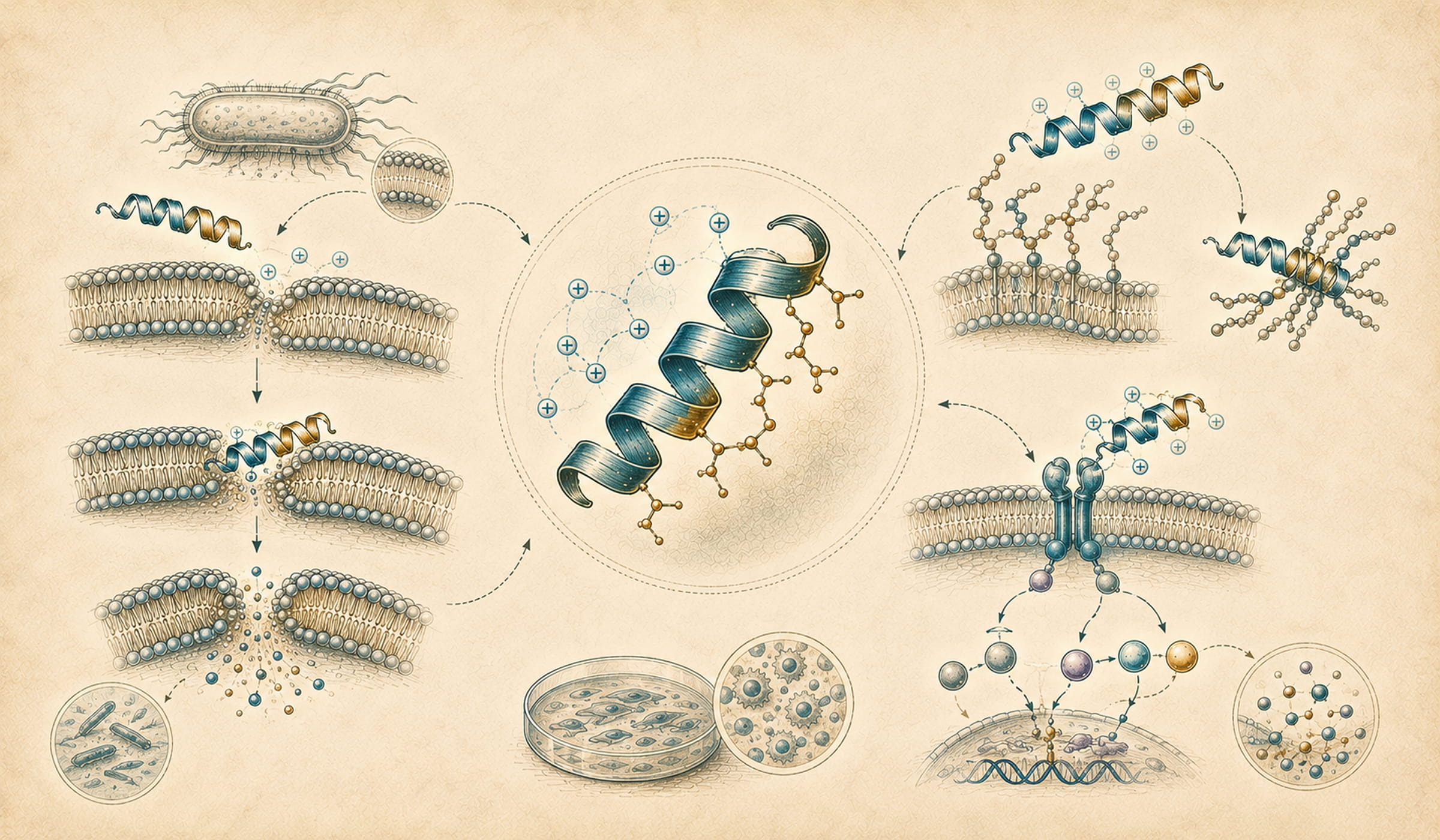
LL-37 is the only cathelicidin-derived antimicrobial peptide found in humans. It is a 37-residue, amphipathic, alpha-helical peptide released from the C-terminus of the hCAP18 precursor protein, which is encoded by the CAMP gene. In the published literature it is studied for direct membrane activity against bacteria and fungi, for binding and neutralizing bacterial lipopolysaccharide, and for signaling roles in the innate immune response.
This page covers what LL-37 is chemically, how the precursor is processed, the mechanisms described in the literature, and how identity and purity are verified on a certificate of analysis. Research quantities and experimental design are defined in the methodology of each cited study and are not restated here.
LL-37 is a cationic host-defense peptide of 37 amino acids, named for the two leucine residues at its N-terminus and its length. It is the single member of the cathelicidin family expressed in humans, in contrast to species such as cattle and pigs that express several. The peptide is produced by neutrophils, epithelial cells at barrier surfaces, and several other cell types, and it is released by proteolytic cleavage from a larger stored precursor rather than synthesized in its mature form.
Its two structural features drive most of the published research. It carries a strong net positive charge, which favors association with the anionic surfaces characteristic of bacterial membranes and with lipopolysaccharide. It also folds into an amphipathic alpha helix in membrane-mimetic and anionic environments, separating hydrophobic and charged faces along the helix, which is the arrangement most peptide membrane-interaction models depend on.
The mature peptide sequence is LLGDFFRKSKEKIGKEFKRIVQRIKDFLRNLVPRTES. Its average molecular weight is approximately 4493 Da and its net charge at physiological pH is approximately +6, arising from a high proportion of lysine and arginine residues against a small number of acidic residues.
| Property | Value | How it is confirmed |
|---|---|---|
| Length | 37 amino acid residues | Sequence confirmation by mass spectrometry or Edman degradation |
| Sequence | LLGDFFRKSKEKIGKEFKRIVQRIKDFLRNLVPRTES | Peptide mapping or full sequence confirmation |
| Average molecular weight | Approximately 4493 Da | Mass spectrometry, reported on the COA |
| Net charge at pH 7.4 | Approximately +6 | Calculated from sequence composition |
| Precursor | hCAP18, an 18 kDa protein | Not applicable to the supplied reference material |
| Secondary structure | Amphipathic alpha helix in membrane-mimetic and anionic environments; largely unstructured in dilute aqueous buffer | Circular dichroism in the published literature |
The conformational behavior matters when interpreting published work. LL-37 is substantially unstructured in dilute aqueous solution and adopts its helical fold on contact with anionic surfaces, membranes and certain buffer conditions. Studies reporting structural or aggregation behavior therefore specify the solution environment, and results are not directly comparable across different conditions. Recent membrane work has also described self-assembled multi-helix arrangements at interfaces rather than a single uniform binding mode (Langmuir, 2025; PMID 41263761). The backbone constraints behind that helical fold are covered in how peptide backbone geometry shapes helical structure.
Cathelicidins are defined by a conserved N-terminal cathelin domain attached to a variable C-terminal antimicrobial peptide. In humans the single family member is the 18 kDa precursor hCAP18, the product of the CAMP gene. The cathelin domain holds the antimicrobial portion inactive during storage; the mature peptide is generated when the precursor is cleaved, and in neutrophils that cleavage is attributed to proteinase 3.
This explains why the literature uses several names for closely related things. Cathelicidin refers to the family and, in human work, usually to the gene product as a whole. CAMP is the gene. hCAP18 is the stored precursor protein. LL-37 is the mature cleaved peptide, and it is the form supplied as a reference compound. Expression studies frequently report hCAP18 rather than LL-37 because they measure the precursor, and CAMP transcription has been described as responsive to vitamin D signaling through a response element in the gene promoter (Biochem Biophys Res Commun, 2024; PMID 38642493). Molecular identity data for the mature peptide is set out in the LL-37 chemical reference data, and the LL-37 encyclopedia entry gives the short reference view.
| Term | What it refers to |
|---|---|
| Cathelicidin | The peptide family, defined by the conserved cathelin domain. Humans express one member. |
| CAMP | The gene encoding the human cathelicidin precursor. |
| hCAP18 | The 18 kDa stored precursor protein, held in an inactive form by the cathelin domain. |
| LL-37 | The mature 37-residue peptide released by proteolytic cleavage of hCAP18. This is the reference compound. |
| Carbamylated LL-37 | A post-translationally modified form described in the literature with altered activity (Innate Immun, 2016; PMID 26878866). |
Published work on LL-37 clusters into direct antimicrobial activity, endotoxin binding, and immune signaling. The table below summarizes the mechanisms as they are described in the cited literature. Each row states the model system, because findings from cell-free membrane systems, cultured cells and animal models are not interchangeable. For a second short cationic peptide studied on the immune-signaling side, see KPV tripeptide and NF-kB signaling.
| Mechanism | Model system in the cited work | What the literature describes | Reference |
|---|---|---|---|
| Membrane perturbation | Model lipid systems and bacterial membranes | Association of the cationic helix with anionic membrane surfaces, followed by disruption of bilayer integrity. Carpet-type and pore-type models are both discussed. | Biochim Biophys Acta, 2010; PMID 20036634 |
| Lipopolysaccharide binding | Cell-free and cell-based systems | Direct binding to LPS with reduction of downstream signaling readouts, described as neutralization in the source literature. | Ann Agric Environ Med, 2007; PMID 17655171 |
| LPS handling in immune cells | Cultured human cells | Modulation of LPS uptake and presentation in host cells rather than binding alone. | J Immunol, 2016; PMID 26729811 |
| Chemotactic signaling | Cultured cells | Chemotactic responses in mast cells, part of the wider signaling literature on the peptide. | Immunology, 2002; PMID 11972628 |
| Biofilm-associated activity | In vitro biofilm systems | Activity against biofilm formation and established biofilms, reviewed across multiple organisms. | World J Microbiol Biotechnol, 2023; PMID 36781570 |
| Antifungal activity | In vitro fungal systems | Activity against fungal targets, reviewed with the current limits of the evidence. | World J Microbiol Biotechnol, 2023; PMID 38057654 |
Two qualifications apply across this literature. Activity in model membrane systems is strongly dependent on lipid composition, ionic strength and peptide concentration, so results are reported against the specific system used. And salt sensitivity is a recurring theme: the electrostatic association that drives membrane binding is attenuated at higher ionic strength, which is why in vitro conditions are specified in careful studies.
For a reference compound, identity and purity documentation is the part of the record that can be checked. A certificate of analysis for LL-37 should establish two separate things: that the material is the intended molecule, and how much of the sample is that molecule.
A purity figure without its method is not interpretable, and a figure quoted from one lot does not describe another. Purity on this page always refers to the certificate for the specific lot supplied. Reading a peptide certificate of analysis sets out each of these determinations in detail, and our published lab reports hold the certificates themselves.
Guidance below applies to the sealed vial as supplied. LL-37 is provided as a lyophilized powder in lyophilized research vials, a form chosen because removing water suppresses the hydrolysis and aggregation pathways that limit stability in solution.
Stability duration for any given lot is documented on its certificate of analysis rather than stated as a general figure. Reconstitution means returning a lyophilized compound to solution; the solvent system, concentration and handling for a given experiment are defined by the published methodology of the study being followed and by the receiving laboratory’s own validated procedures. Related compounds are indexed in the peptide reference library.
LL-37 is the only cathelicidin-derived antimicrobial peptide expressed in humans. It is a 37-residue cationic peptide released from the hCAP18 precursor protein, encoded by the CAMP gene, and it is studied for membrane activity against microorganisms, for lipopolysaccharide binding, and for signaling roles in innate immunity.
The mature LL-37 sequence is LLGDFFRKSKEKIGKEFKRIVQRIKDFLRNLVPRTES, a 37-residue peptide with an average molecular weight of approximately 4493 Da. The sequence is confirmed analytically by mass spectrometry and, where reported, by peptide mapping. Confirm the value against the certificate of analysis for the specific lot.
Cathelicidin names the peptide family, defined by a conserved cathelin domain. Humans express a single family member, stored as the precursor protein hCAP18 and encoded by the CAMP gene. LL-37 is the mature peptide released when that precursor is cleaved, so cathelicidin describes the family and the gene product while LL-37 describes the active fragment.
LL-37 contains a high proportion of lysine and arginine residues against few acidic residues, giving a net charge of approximately +6 at physiological pH. That charge favors association with anionic surfaces, which is the property most membrane-interaction studies are built around.
Purity for a research peptide is determined by reversed-phase HPLC and reported alongside the method conditions on the certificate of analysis for the lot. Identity is established separately by mass spectrometry. A purity figure only describes the lot it was measured on.
LL-37 is largely unstructured in dilute aqueous buffer and adopts an amphipathic alpha-helical conformation on contact with anionic surfaces and membrane-mimetic environments. Structural results in the literature are therefore reported against the specific solution conditions used.
Educational notice. This article is for educational and informational purposes only and is intended for licensed researchers and laboratory professionals. All scientific claims are referenced to primary peer-reviewed literature.
Research-only disclaimer. LL-37 is supplied as a research-grade reference compound for laboratory use only. It is not for human or veterinary use, and nothing on this page describes a route of administration or a quantity to use.


