
Cart

Oops, your cart is still empty
Looks like you haven’t added anything yet. Start exploring our products and find what you need.
These materials are research-grade reference compounds sold for laboratory research use only. They are not for human or veterinary use.
Half-life and stability describe how long a peptide stays intact under a given set of conditions, and both are central to interpreting and designing peptide research. A peptide that degrades quickly in a particular buffer or matrix will behave very differently in a study than one that persists. This article explains what these terms mean, the main degradation pathways, the sequence features that influence them, and how stability is documented, all in a laboratory context.
In a research setting, half-life is the time required for the intact peptide concentration to fall by half under a specified condition, such as a defined buffer, temperature, or biological matrix in a model. Crucially, half-life is a property of the peptide and the condition together, not an absolute constant: the same peptide can show very different half-lives in different matrices. This is why the literature always reports half-life alongside the conditions it was measured in.
Hydrolysis of the peptide bond, often enzyme-catalyzed by peptidases, is the most common route of peptide degradation, particularly in biological matrices.
Certain residues, notably methionine and cysteine, are susceptible to oxidation, which can alter a peptide’s mass and behavior.
Physical aggregation, where peptide molecules self-associate, is both a stability and a solubility problem and is common for sequences with hydrophobic stretches. These pathways are described in the peptide and protein stability literature (Manning et al., 2010).
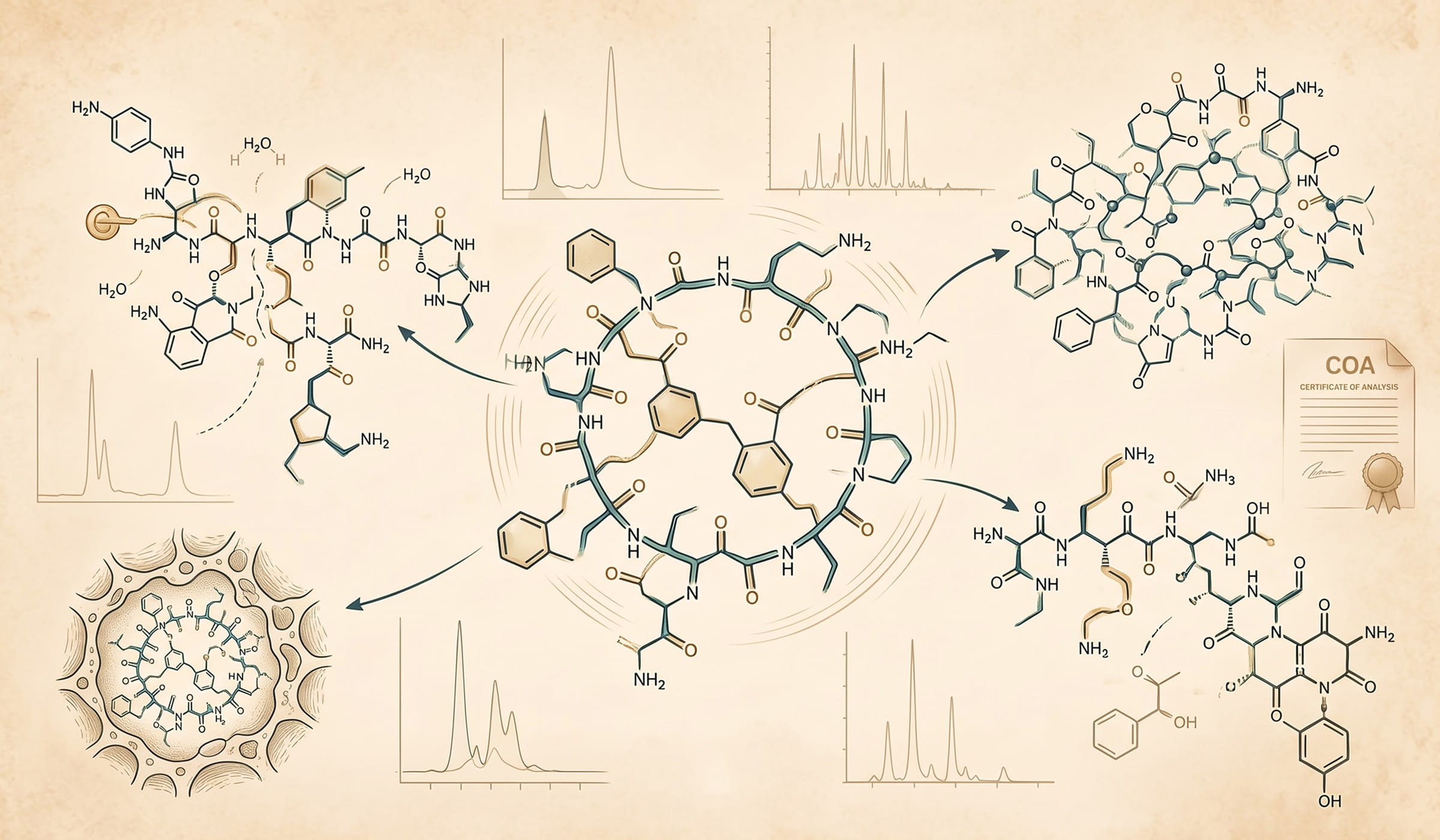
Sequence features such as oxidation-prone residues, bonds readily cleaved by common peptidases, and aggregation-prone hydrophobic motifs all influence how quickly a peptide changes. Many of the structural modifications studied in the peptide literature, such as D-amino acid substitutions, non-natural residues, cyclization, and stabilizing terminal groups, are aimed precisely at slowing these degradation routes, which is a recurring theme across peptide design.
General handling supports stability: store sealed material cold, shield it from light, and avoid repeated freeze-thaw. The lyophilized solid is generally more stable than material in solution, which is one reason peptides are supplied dry. Specific durations are not stated as a blanket rule; stability for each lot is documented on its Certificate of Analysis.
Stability for a given lot is captured in the analytical record and the COA rather than in general claims. Because stability depends on conditions, the responsible approach is to defer to lot-specific documentation and to the methodology of the study, rather than to a single blanket shelf-life figure.
Understanding half-life and stability is not academic: a study that does not account for a peptide degrading during an experiment can produce misleading results. Anticipating degradation, storing material properly, and reading the COA all support reproducible research.
The time for half of the intact peptide to be lost under a defined condition in a model; it depends on both the peptide and the condition.
Mainly hydrolysis of the peptide bond, oxidation of susceptible residues, and aggregation.
Oxidation-prone and hydrolysis-prone sites and aggregation-prone motifs reduce stability; modifications such as D-amino acids and cyclization are studied to improve it.
Sealed, cold, shielded from light, avoiding repeated freeze-thaw; the lyophilized solid is more stable than solution.
On the per-lot Certificate of Analysis, not as a blanket shelf-life figure.
No. It varies with the buffer, temperature, and matrix, so it is always reported with its conditions.
Unaccounted degradation during a study can produce misleading results, so stability planning supports reproducibility.
Research-use notice: The peptides discussed are research chemicals sold for laboratory research use only. They are not for human or veterinary use.


