
Cart

Oops, your cart is still empty
Looks like you haven’t added anything yet. Start exploring our products and find what you need.
These materials are research-grade reference compounds sold for laboratory research use only. They are not for human or veterinary use.
Whether a peptide dissolves easily, or fights you in the vial, is largely written into its sequence. Solubility is one of the most practical properties a researcher deals with, and understanding the chemistry behind it, especially hydropathy and the GRAVY score, makes handling far more predictable. This article explains what drives peptide solubility, how hydropathy is quantified, and what sequence features to watch, all in a laboratory context.
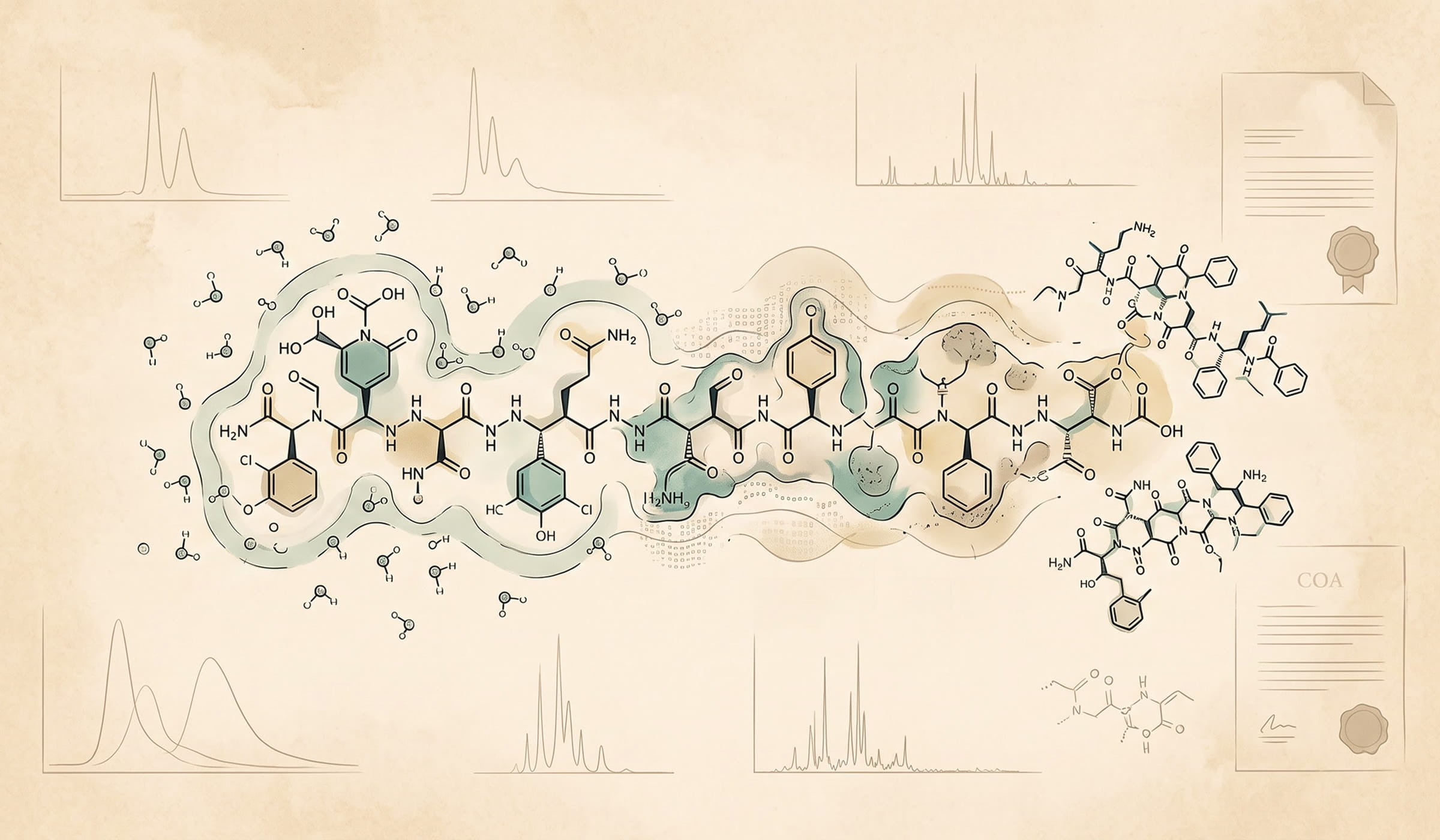
A peptide’s solubility reflects the proportion and arrangement of hydrophilic residues, meaning charged and polar amino acids, versus hydrophobic residues. Sequences rich in charged residues such as lysine, arginine, aspartate, and glutamate tend to dissolve readily in aqueous buffers, because those side chains interact favorably with water. Long hydrophobic stretches, by contrast, reduce aqueous solubility and can promote aggregation.
Hydropathy quantifies how water-attracting or water-repelling each residue is. The GRAVY score, the grand average of hydropathy, averages these values across the whole sequence using the Kyte and Doolittle hydropathy scale (Kyte and Doolittle, 1982). A more negative GRAVY value indicates a more hydrophilic peptide that generally dissolves more easily; a positive value indicates a more hydrophobic peptide that may be harder to bring into aqueous solution.
Net charge at a given pH strongly affects solubility; peptides near their isoelectric point, where net charge approaches zero, are often least soluble.
Overall length and the clustering of hydrophobic residues matter as much as average hydropathy. A peptide can have a moderate GRAVY score yet still aggregate if hydrophobic residues cluster together (Kramer et al., 2012).
Certain motifs predispose peptides to self-association, which manifests as poor solubility or cloudiness. Recognizing these features in advance helps a researcher anticipate handling behavior.
The chemistry points to general handling expectations: hydrophilic peptides typically dissolve in aqueous buffers, while more hydrophobic sequences may require approaches described in the primary methodology for that peptide. This article does not provide a specific preparation procedure; consult the product Certificate of Analysis and the relevant published methods.
Solubility and stability are related aspects of a peptide’s physical behavior. Aggregation, a solubility problem, is also one of the main degradation routes for peptides, so a sequence prone to poor solubility may also raise stability considerations. Both are documented, per lot, on the Certificate of Analysis.
Peptide identity and purity are verified by mass spectrometry and HPLC, with per-lot results on the Certificate of Analysis. Solubility behavior is interpreted alongside that documentation.
The balance of hydrophilic and hydrophobic residues, plus net charge, length, and aggregation-prone motifs.
The grand average of hydropathy across a sequence, based on the Kyte and Doolittle scale; more negative values indicate a more hydrophilic peptide.
Peptides near their isoelectric point, with net charge near zero, are often least soluble.
Yes, if hydrophobic residues cluster or aggregation-prone motifs are present.
They are related; aggregation is both a solubility issue and a degradation route. Stability for each lot is on the COA.
By mass spectrometry and HPLC, documented on the per-lot Certificate of Analysis.
No. It explains the chemistry; consult the COA and published methods for any preparation step.
Research-use notice: The peptides discussed are research chemicals sold for laboratory research use only. They are not for human or veterinary use.


