Cart

Oops, your cart is still empty
Looks like you haven’t added anything yet. Start exploring our products and find what you need.

BPC-157, also called Body Protection Compound 157, is a synthetic pentadecapeptide — a chain of 15 amino acids — that has been investigated for tissue-protective and tissue-healing effects, overwhelmingly in laboratory and animal models. It corresponds to a partial sequence of a protein originally isolated from human gastric juice, work attributed to Sikiric and colleagues in 1993 [2,9]. This review summarizes the published research, separating preclinical evidence (cell culture and rodent studies) from the small body of early human data, and closes with the compound’s regulatory status. Because nearly all of the evidence is preclinical, that distinction is emphasized throughout: findings reported in cells or rats describe biological activity under controlled experimental conditions, not established effects in people.
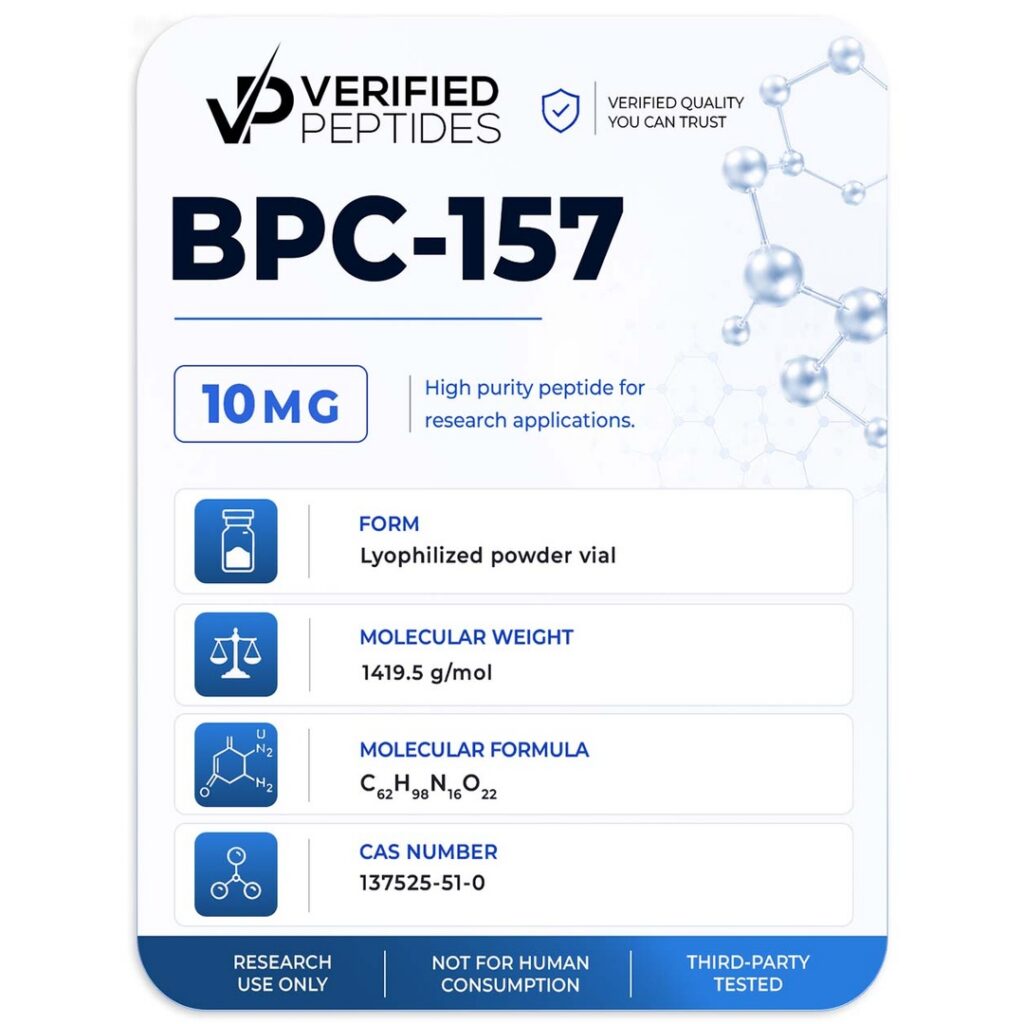
BPC-157 has the amino-acid sequence Gly-Glu-Pro-Pro-Pro-Gly-Lys-Pro-Ala-Asp-Asp-Ala-Gly-Leu-Val, a molecular formula of C62H98N16O22, and a molecular weight of approximately 1,419 Da (PubChem CID 9941957) [1]. It is produced synthetically rather than extracted from tissue. A defining feature reported in the source literature is its stability in human gastric juice: whereas many peptides are rapidly degraded there, BPC-157 has been described as comparatively resistant, a property that has been used to frame it as a candidate for studying gastrointestinal and systemic protection in experimental settings [2]. These are physicochemical and preclinical characterizations and do not, in themselves, establish clinical activity.
The mechanisms attributed to BPC-157 are derived from in vitro and animal studies. A recurring theme is promotion of angiogenesis — the growth of new blood vessels. In an independent study, Hsieh and colleagues reported that BPC-157 increased vessel formation in vivo and in vitro, accelerated blood-flow recovery in a rat hind-limb ischemia model, and up-regulated vascular endothelial growth factor receptor 2 (VEGFR2), activating a VEGFR2–Akt–eNOS signaling pathway linked to nitric oxide production [6]. Separately, Huang and colleagues found that BPC-157 up-regulated VEGF-A expression and promoted proliferation, migration, and vascular tube formation in human endothelial cells while accelerating wound closure in a rat alkali-burn model, changes the authors linked to extracellular signal-regulated kinase (ERK) signaling [5]. At the cellular level, Chang and colleagues reported that BPC-157 increased the outgrowth and migration of rat tendon fibroblasts in a dose-dependent manner and raised phosphorylation of the focal adhesion kinase (FAK)–paxillin pathway, without directly increasing cell proliferation [3]. Reviews of this work frame these angiogenic, nitric-oxide-related, and cytoprotective actions as the proposed basis for the peptide’s effects [2,8]. A further review notes that these angiogenic effects have been attributed to nitric-oxide production through both VEGF-dependent (VEGFR2–Akt–eNOS) and VEGF-independent (Src–caveolin-1–eNOS) routes, consistent with a central role for the nitric-oxide system in the proposed mechanism [9]. Underlying several of these observations is a proposed cytoprotective and endothelium-protective action, in which the peptide is reported to help maintain the lining of blood vessels and to support the formation of granulation tissue during repair [2]. These remain mechanistic hypotheses generated in laboratory systems rather than confirmed mechanisms of benefit in humans.
The largest portion of the literature examines tissue injury and repair in rodents. In musculoskeletal models, BPC-157 has been studied for healing of tendon, ligament, muscle, and bone. Chang and colleagues investigated its effect in the context of rat Achilles-tendon healing [3], and Cerovecki and colleagues reported improved medial collateral ligament healing over 90 days after surgical transection in rats, with functional, biomechanical, and histological improvements when the peptide was given by injection, orally, or topically, accompanied by changes in growth-factor generation and early extracellular-matrix markers such as the early growth response 1 (egr-1) gene [4]. A review by Gwyer and colleagues summarized this body of work as suggesting a role in accelerating musculoskeletal soft-tissue healing, while explicitly noting that most studies are preclinical and that efficacy in humans has not been confirmed [7]. Beyond musculoskeletal tissue, preclinical and patent-review summaries describe a broad, or pleiotropic, range of effects across multiple organ systems — including the gastrointestinal tract, where the peptide was first characterized, as well as liver, vascular, cardiovascular, and central-nervous-system models, which the source authors group under a shared cytoprotective and vasculature-stabilizing mechanism [2,8]. Some reports describe durable effects in injury models — for example, functional and biomechanical improvements sustained well beyond the initial treatment window in tendon and ligament studies — though these remain animal findings [9]. The breadth of reported activity, spanning many tissues and conditions, is itself a feature that reviewers have flagged as unusual for a single peptide and as warranting independent confirmation [8,9]. The earliest and most extensively studied application is gastrointestinal protection. Consistent with its origin as an anti-ulcer peptide stable in gastric juice, BPC-157 has been examined in rodent models of gastric and intestinal lesions, where it is reported to support mucosal integrity and to interact with the gut’s vascular supply and nitric-oxide signaling [2]. This gastrointestinal cytoprotection is the conceptual basis from which the broader “body protection” framing in the source literature is drawn, with later studies asking whether the same protective processes apply to other tissues [2,8].
Direct human evidence is very limited. A 2025 narrative review concluded that only three small pilot studies have examined BPC-157 in people [9]. Lee and Padgett (2021) reported a retrospective comparison of outcomes after intra-articular injection of BPC-157 in patients with several types of knee pain, rather than a prospective controlled trial [9,10]; Lee, Walker, and Ayadi (2024) described an open-label pilot of intravesical (into-the-bladder) BPC-157 in a small group of women with interstitial cystitis [11]; and Lee and Burgess (2025) reported on the short-term safety of intravenous BPC-157 in two healthy adults, a study designed to characterize tolerability and basic pharmacokinetics rather than to test a therapeutic effect [12]. These reports were small, mostly open-label, and lacked randomized control groups. Within their acknowledged limits, the interstitial-cystitis pilot reported symptom improvement in most of the small group of participants, and the intravenous-safety report described no adverse events over a short observation period [11,12]. Because none of the three included a control group, these reports can signal short-term tolerability and feasibility, but they cannot establish efficacy or long-term safety. All three reports share overlapping authorship and appeared in the same journal, which further limits independent corroboration, and together they involve only small numbers of participants. No large, well-controlled randomized clinical trials of BPC-157 have been completed, and reviewers consistently describe the rigorous human evidence base as lacking [7,9].
Two features of this literature warrant particular caution. First, a substantial share of the foundational preclinical work originates from a relatively small group of investigators, and independent replication — especially in humans — remains limited [7,9]. The independent angiogenesis studies noted above are useful precisely because they come from outside that core group [5,6]. Second, the animal studies vary widely in species, injury model, dose, and route of administration, which complicates direct comparison, and positive findings in injury models do not reliably translate into clinical benefit. None of this negates the preclinical signals; rather, it places them at the early, exploratory end of the evidence spectrum. Accordingly, claims about BPC-157 should track the specific model and endpoint of the study that supports them, and should not be generalized from rodent or cell-culture data to expected outcomes in people. The popular and commercial visibility of BPC-157 has also outpaced its clinical evidence: it is widely discussed and available in research-use contexts despite the absence of the controlled human trials that would be needed to support therapeutic use [9]. Drug regulators and anti-doping authorities have, from different starting points, reached the same practical conclusion: that the human safety and efficacy of BPC-157 have not been adequately established, which is why it remains classified as investigational and non-approved [9].
Taken together, the evidence for BPC-157 is predominantly preclinical: a synthetic pentadecapeptide derived from a gastric-juice protein fragment [1,2], associated in cell and animal studies with angiogenic, nitric-oxide-related, and tissue-healing activity across several tissues [3,4,5,6], with only three small human pilot studies reported to date [9,10,11,12]. Its regulatory status reflects this. BPC-157 is not approved as a drug for any indication by the US Food and Drug Administration or other major regulators and is considered investigational [9]. BPC-157 was placed in Category 2 of the bulk drug substances reviewed under section 503A in 2023 (substances that may present significant safety risks) [9]; however, that status has since changed. In April 2026 the FDA removed BPC-157 from Category 2 after the nominations supporting its listing were withdrawn, and referred it to the Pharmacy Compounding Advisory Committee (PCAC) for review on July 23–24, 2026 under docket FDA-2025-N-6895 [13]. Removal from Category 2 is not authorization to compound BPC-157 and does not constitute approval; the compound remains non-approved pending the outcome of that review [13]. It is also listed on the World Anti-Doping Agency Prohibited List as a non-approved substance, prohibited for athletes at all times in and out of competition [9]. In short, BPC-157 is best described as an experimental compound of preclinical interest whose use in humans remains unproven and unapproved.
1. National Center for Biotechnology Information (NIH), PubChem Compound Summary for CID 9941957, BPC-157 (C62H98N16O22). U.S. National Library of Medicine. https://pubchem.ncbi.nlm.nih.gov/compound/9941957
2. Seiwerth S, Milavić M, Vukojević J, et al. Stable gastric pentadecapeptide BPC 157 and wound healing. Front Pharmacol. 2021;12:627533.
3. Chang CH, Tsai WC, Lin MS, Hsu YH, Pang JHS. The promoting effect of pentadecapeptide BPC 157 on tendon healing involves tendon outgrowth, cell survival, and cell migration. J Appl Physiol. 2011;110(3):774–780.
4. Cerovecki T, Bojanic I, Brcic L, et al. Pentadecapeptide BPC 157 (PL 14736) improves ligament healing in the rat. J Orthop Res. 2010;28(9):1155–1161.
5. Huang T, Zhang K, Sun L, et al. Body protective compound-157 enhances alkali-burn wound healing in vivo and promotes proliferation, migration, and angiogenesis in vitro. Drug Des Devel Ther. 2015;9:2485–2499.
6. Hsieh MJ, Liu HT, Wang CN, et al. Therapeutic potential of pro-angiogenic BPC157 is associated with VEGFR2 activation and up-regulation. J Mol Med (Berl). 2017;95(3):323–333.
7. Gwyer D, Wragg NM, Wilson SL. Gastric pentadecapeptide body protection compound BPC 157 and its role in accelerating musculoskeletal soft tissue healing. Cell Tissue Res. 2019;377(2):153–159.
8. Józwiak M, Bauer M, Kamysz W, Kleczkowska P. Multifunctionality and possible medical application of the BPC 157 peptide—literature and patent review. Pharmaceuticals (Basel). 2025;18(2):185.
9. McGuire FP, Martinez R, Lenz A, Skinner L, Cushman DM. Regeneration or risk? A narrative review of BPC-157 for musculoskeletal healing. Curr Rev Musculoskelet Med. 2025;18(12):611–619.
10. Lee E, Padgett D. Intra-articular injection of BPC 157 for multiple types of knee pain. Altern Ther Health Med. 2021;27(4):8–13.
11. Lee E, Walker C, Ayadi B. Effect of BPC-157 on symptoms in patients with interstitial cystitis: a pilot study. Altern Ther Health Med. 2024;30(11):12–17.
12. Lee E, Burgess K. Safety of intravenous infusion of BPC157 in humans: a pilot study. Altern Ther Health Med. 2025. PMID 40131143.
13. U.S. Food and Drug Administration. Pharmacy Compounding Advisory Committee; Notice of Meeting; Establishment of a Public Docket; Request for Comments — Bulk Drug Substances Nominated for Inclusion on the Section 503A Bulk Drug Substances List. Federal Register, April 16, 2026 (Docket No. FDA-2025-N-6895). https://www.federalregister.gov/documents/2026/04/16/2026-07361