Cart

Oops, your cart is still empty
Looks like you haven’t added anything yet. Start exploring our products and find what you need.
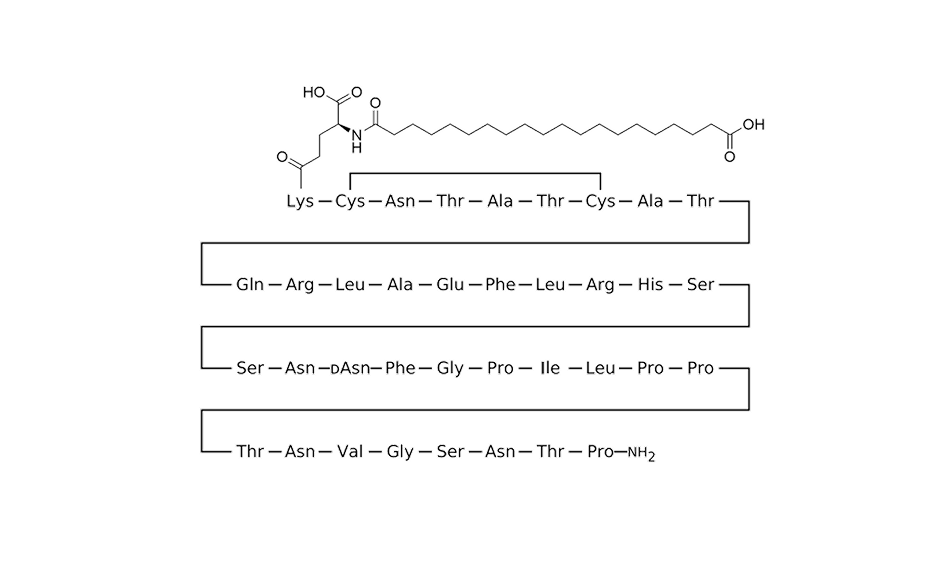
Cagrilintide is a long-acting synthetic analogue of human amylin (islet amyloid polypeptide), developed by Novo Nordisk using a fatty diacid side-chain conjugation strategy that promotes reversible binding to circulating albumin, the same general protraction chemistry underlying the extended half-life of the GLP-1 receptor agonist semaglutide. This engineering addresses a fundamental limitation of native amylin, a pancreatic beta-cell hormone co-secreted with insulin that is prone to fibrillation (aggregation) and has a circulating half-life of only minutes. The older amylin analogue pramlintide, approved as an adjunct to insulin therapy in diabetes, is a short-acting peptide requiring multiple daily injections. Cagrilintide was engineered specifically to retain agonist activity at amylin receptors while resisting fibrillation and extending its pharmacokinetic profile to support once-weekly subcutaneous dosing.
Research interest in cagrilintide stems from amylin’s established physiological role in appetite regulation, gastric emptying, and glucagon suppression, actions that are complementary to, but mechanistically distinct from, GLP-1 receptor agonism. This complementarity is the basis for combining cagrilintide with semaglutide as a fixed-dose co-formulation, developed by Novo Nordisk under the name CagriSema, which has become the most extensively studied application of cagrilintide in human trials to date.
Amylin receptors are not independent gene products but are formed by the association of the calcitonin receptor (CTR) with receptor activity-modifying proteins (RAMPs): CTR plus RAMP1 forms AMY1R, and CTR plus RAMP3 forms AMY3R (CTR plus RAMP2 forms AMY2R). This receptor complex structure was resolved structurally in a 2022 study published in Science, which showed that RAMP association reshapes the CTR peptide-binding pocket to increase affinity and potency for amylin and its analogues. Cagrilintide acts as an agonist at these amylin receptor complexes, most densely expressed in the area postrema, a circumventricular brain structure lying outside the blood-brain barrier that serves as a key sensory relay for circulating satiety signals.
A 2025 mechanistic study published in eBioMedicine used RAMP1 and RAMP3 knockout mice to directly test which amylin receptor subtypes mediate cagrilintide’s effects on body weight. In wild-type mice, cagrilintide dose-dependently reduced 24-hour food intake and, over a 21-day study in diet-induced obese mice, reduced body weight while preserving lean mass and roughly halving plasma leptin concentrations. Critically, combined RAMP1/RAMP3 knockout completely abolished cagrilintide’s weight-lowering effect, and cagrilintide-induced neuronal activation (measured via cFos expression) in the area postrema was reduced by approximately 57% in the knockout animals, directly demonstrating that cagrilintide’s effect on body weight in this model depends specifically on AMY1R and AMY3R signalling. The same study found that salmon calcitonin, a related dual receptor agonist, produced opposite effects depending on receptor genotype: it increased body weight in wild-type mice but induced weight loss in RAMP1/3 knockout mice, illustrating that receptor-specific pharmacology, not simply “amylin pathway activation” in general, determines the metabolic outcome. Downstream of area postrema activation, signalling extends to the nucleus of the solitary tract and lateral parabrachial nucleus, while amylin signalling is also reported to act on arcuate nucleus neurons independently of the area postrema, collectively slowing gastric emptying, suppressing glucagon secretion, and extending post-meal satiety.
Beyond homeostatic appetite control, amylin receptor agonism has been proposed to modulate reward-related (“hedonic”) feeding behaviour, potentially reducing the drive to consume highly palatable, calorie-dense food independently of metabolic need. This mechanism is less thoroughly characterized for cagrilintide specifically than the area postrema/homeostatic pathway described above and should be regarded as a supporting hypothesis rather than a fully established mechanism.
Cagrilintide’s development relied primarily on receptor-binding and cell-based potency assays during medicinal chemistry optimization, characterizing binding affinity and functional activity at AMY1R/AMY3R relative to native amylin, alongside confirmation of resistance to fibrillation compared with unmodified amylin. Detailed cell-based efficacy data beyond these optimization assays are not extensively published in isolation from the animal and human studies described below.
In the original development paper, Kruse and colleagues reported rat food-intake dose-response studies (doses spanning roughly 0.1 to 30 nmol/kg subcutaneously), showing sustained reductions in food intake following single dosing. The most detailed subsequent mechanistic study, described above, used mice across acute dose-response, 21-day subchronic dose-finding, and receptor-knockout comparison arms, confirming dose-dependent food intake and body-weight reduction with preserved lean mass in wild-type animals.
A 2025 study in Nature Metabolism examined CagriSema and its individual components in diet-induced obese rats. In a cagrilintide-alone treatment arm (10 nmol/kg/day), the peptide produced weight loss and body-composition changes comparable to those seen with the full CagriSema combination at the higher dose tested in that study, reducing energy intake by approximately 39% (compared with approximately 42% for semaglutide alone in the same study). Notably, total energy expenditure was preserved rather than reduced in cagrilintide-treated animals, in contrast to calorie-restricted control animals matched for the same degree of weight loss, supporting a proposed mechanism in which cagrilintide-driven weight loss avoids some of the metabolic-adaptation (energy-expenditure suppression) typically seen with simple caloric restriction.
Cagrilintide has been evaluated extensively in human trials, first as a monotherapy and subsequently in combination with semaglutide (CagriSema).
In a Phase 1b randomized, controlled trial, ascending doses of cagrilintide (0.16 to 4.5 mg weekly) were co-administered with semaglutide 2.4 mg over 20 weeks, primarily to characterize safety, tolerability, and pharmacokinetics of the combination.
A Phase 2, multicentre, randomised, double-blind, placebo- and active-controlled dose-finding trial evaluated once-weekly cagrilintide monotherapy in 706 participants with overweight or obesity across six dose arms (0.3 to 4.5 mg), compared with liraglutide 3.0 mg (99 participants) and placebo (101 participants) over 26 weeks. Cagrilintide produced dose-dependent weight loss of 6.0 to 10.8% versus 3.0% with placebo (p<0.001); the highest dose (4.5 mg) produced numerically greater weight loss than liraglutide 3.0 mg (10.8% versus 9.0%, p=0.03). Gastrointestinal adverse events (predominantly nausea) occurred in 41 to 63% of cagrilintide-treated participants compared with 32% on placebo, with approximately 4% of participants discontinuing due to adverse events.
A Phase 2 trial in people with type 2 diabetes compared co-administered cagrilintide 2.4 mg plus semaglutide 2.4 mg (CagriSema) against semaglutide alone and cagrilintide alone over 32 weeks in 92 participants. CagriSema reduced HbA1c by 2.2 percentage points, compared with 1.8 points for semaglutide alone and 0.9 points for cagrilintide alone; CagriSema produced significantly greater HbA1c reduction than cagrilintide alone (p<0.0001), though the difference versus semaglutide alone did not reach statistical significance (p=0.075). Weight loss was 15.6% with CagriSema, 8.1% with cagrilintide alone, and 5.1% with semaglutide alone, with CagriSema significantly exceeding both individual components (p<0.0001).
Two Phase 3 trials, published together in the New England Journal of Medicine in 2025, form the core evidence base for CagriSema in obesity. REDEFINE 1 enrolled 3,417 adults with overweight or obesity (without diabetes) across CagriSema, semaglutide-alone, cagrilintide-alone, and placebo arms over 68 weeks; CagriSema produced 22.7% weight loss under the trial-product estimand (evaluating the treatment effect while on treatment) versus 2.3% with placebo, with 91.9% of CagriSema-treated participants achieving at least 5% weight loss versus 31.5% on placebo. REDEFINE 2 enrolled 1,206 adults with overweight or obesity and type 2 diabetes over 68 weeks; CagriSema produced 15.7% weight loss under the trial-product estimand versus 3.1% with placebo. A subsequent head-to-head Phase 3 trial (REDEFINE 4) comparing CagriSema against tirzepatide over 84 weeks in 809 participants reported 23.0% weight loss with CagriSema versus 25.5% with tirzepatide under the efficacy estimand; CagriSema did not meet the pre-specified statistical margin for non-inferiority against tirzepatide on this endpoint.
Novo Nordisk submitted a New Drug Application to the U.S. FDA for CagriSema (cagrilintide 2.4 mg/semaglutide 2.4 mg) for chronic weight management on 18 December 2025, based on the REDEFINE 1 and REDEFINE 2 data package. As of this writing, this is a pending regulatory filing, not an approval, and no decision date has been publicly disclosed.
Across the completed clinical trials, the dominant adverse event pattern for cagrilintide, alone or combined with semaglutide, is gastrointestinal: nausea, vomiting, constipation, and diarrhoea, generally mild to moderate in severity and dose-related, consistent with the known adverse event profile of both the amylin-analogue and GLP-1-receptor-agonist drug classes. In the Phase 2 monotherapy trial, gastrointestinal adverse events occurred in 41 to 63% of cagrilintide-treated participants (dose-dependent) versus 32% on placebo, with roughly 4% of participants discontinuing due to adverse events. In the Phase 2 type 2 diabetes trial, overall adverse event rates ranged from 68 to 80% across treatment arms, again predominantly mild-to-moderate gastrointestinal symptoms, with no severe hypoglycaemia reported. In REDEFINE 1 and REDEFINE 2, discontinuation due to adverse events occurred in approximately 6% and 8.4% of CagriSema-treated participants respectively, compared with approximately 3 to 3.7% on placebo.
Because CagriSema remains an investigational combination pending FDA review, there is no long-term post-marketing safety surveillance data, and all safety information currently available derives from controlled clinical trials of limited duration (up to 68 to 84 weeks in the longest published trials to date). No data exist on use beyond these trial durations, in pregnancy, in paediatric populations, or in combination with other weight-management or diabetes therapies outside the specific combinations tested.
Cagrilintide is among the most clinically advanced compounds discussed on this site, with a substantial and rapidly growing human evidence base spanning Phase 1b through Phase 3 trials, most prominently in combination with semaglutide as CagriSema. The mechanistic case for amylin receptor-mediated appetite suppression, acting through AMY1R and AMY3R in the area postrema, is well supported by both receptor-structural studies and knockout-mouse mechanistic work. Human trial data consistently show substantial, dose-dependent weight loss for cagrilintide alone and greater weight loss for the CagriSema combination, alongside a gastrointestinal adverse event profile typical of this drug class. Nonetheless, cagrilintide and CagriSema remain investigational: the FDA has not yet approved CagriSema for any indication (a New Drug Application was filed in December 2025 and remains under review), and a recent head-to-head trial against tirzepatide (REDEFINE 4) found that CagriSema did not meet its non-inferiority margin, indicating its comparative position relative to other advanced anti-obesity therapies is not yet fully settled. Long-term safety beyond the duration of the completed trials, and safety in broader or more diverse populations, remains to be established through continued clinical development and, if approved, post-marketing surveillance.
Kruse et al. 2021, Journal of Medicinal Chemistry, development of cagrilintide.
Cao et al. 2022, Science, structural basis for amylin receptor phenotype.
Carvas et al. 2025, eBioMedicine, cagrilintide and brain amylin receptors (open access).
Lau et al. 2021, The Lancet, Phase 2 cagrilintide monotherapy trial.
Garvey et al. 2025, New England Journal of Medicine, REDEFINE 1.
1. Kruse T, Hansen JL, Dahl K, et al. Development of Cagrilintide, a Long-Acting Amylin Analogue. J Med Chem. 2021;64(15):11183-11194. doi: 10.1021/acs.jmedchem.1c00565.
2. Cao J, Belousoff MJ, Liang YL, et al. A structural basis for amylin receptor phenotype. Science. 2022;375(6587):eabm9609. doi: 10.1126/science.abm9609.
3. Le Foll C, Lutz TA. Systemic and central amylin, amylin receptor signaling, and their physiological and pathophysiological roles in metabolism. Compr Physiol. 2020;10(3):811-837. doi: 10.1002/cphy.c190034.
4. Carvas AO, Leuthardt A, Kulka P, Lommi G, Hassan S, Coester B, Lundh S, et al. Cagrilintide lowers bodyweight through brain amylin receptors 1 and 3. eBioMedicine. 2025;118:105836. doi: 10.1016/j.ebiom.2025.105836.
5. Jacobsen JM, Halling JF, Blom I, et al. CagriSema drives weight loss in rats by reducing energy intake and preserving energy expenditure. Nat Metab. 2025;7(7):1322-1329. doi: 10.1038/s42255-025-01324-8.
6. Enebo LB, Berthelsen KK, Kankam M, et al. Safety, tolerability, pharmacokinetics, and pharmacodynamics of concomitant administration of multiple doses of cagrilintide with semaglutide 2.4 mg for weight management: a randomised, controlled, phase 1b trial. Lancet. 2021;397(10286):1736-1748. doi: 10.1016/S0140-6736(21)00845-X.
7. Lau DCW, Erichsen L, Francisco AM, et al. Once-weekly cagrilintide for weight management in people with overweight and obesity: a multicentre, randomised, double-blind, placebo-controlled and active-controlled, dose-finding phase 2 trial. Lancet. 2021;398(10317):2160-2172. doi: 10.1016/S0140-6736(21)01751-7.
8. Frias JP, Deenadayalan S, Erichsen L, et al. Efficacy and safety of co-administered once-weekly cagrilintide 2.4 mg with once-weekly semaglutide 2.4 mg in type 2 diabetes: a multicentre, randomised, double-blind, active-controlled, phase 2 trial. Lancet. 2023;402(10403):720-730. doi: 10.1016/S0140-6736(23)01163-7.
9. Garvey WT, et al. Coadministered Cagrilintide and Semaglutide in Adults with Overweight or Obesity. N Engl J Med. 2025;393(7):635-647. doi: 10.1056/NEJMoa2502081.
10. Davies MJ, et al. Cagrilintide-Semaglutide in Adults with Overweight or Obesity and Type 2 Diabetes. N Engl J Med. 2025;393(7):648-659. doi: 10.1056/NEJMoa2502082.