Cart

Oops, your cart is still empty
Looks like you haven’t added anything yet. Start exploring our products and find what you need.

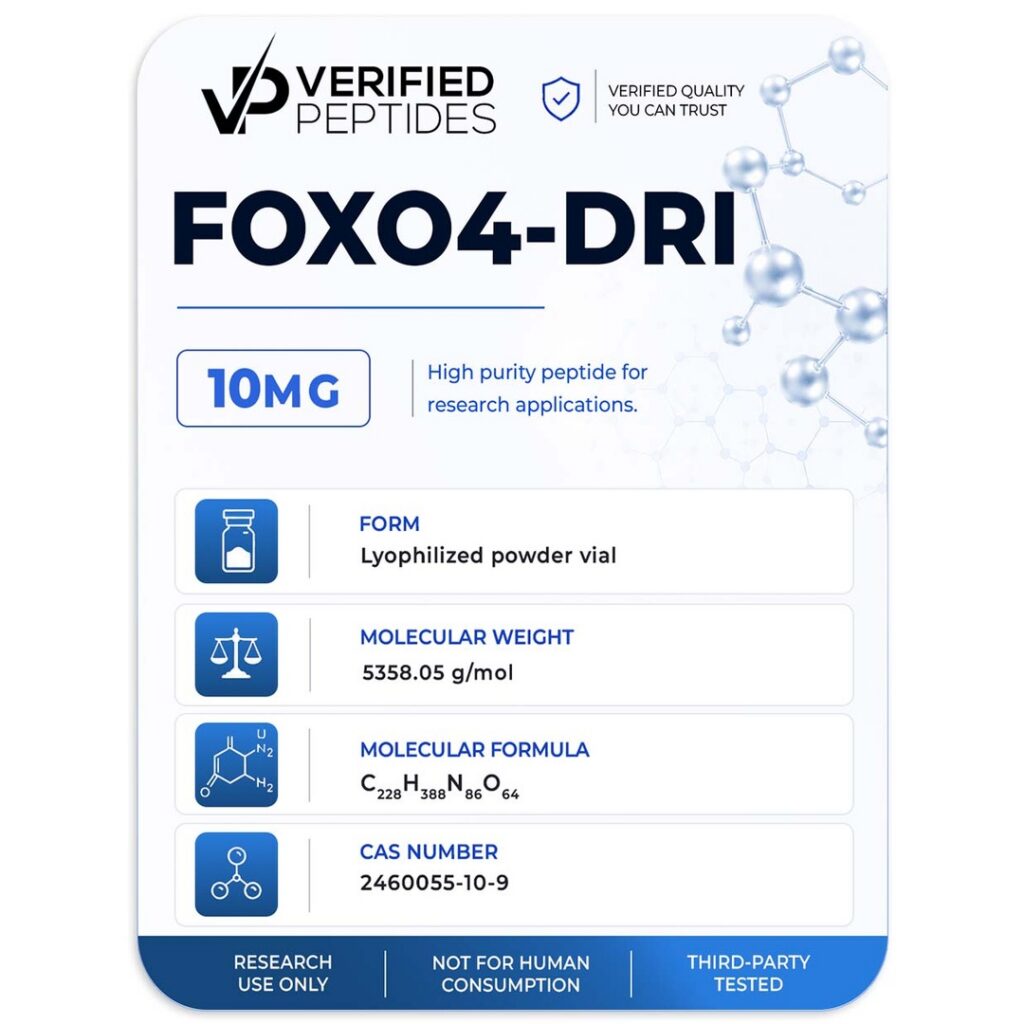
FOXO4-DRI (also referred to as Proxofim in some research contexts) is a synthetic, 27-amino-acid D-retro-inverso peptide engineered to disrupt the interaction between the transcription factor FOXO4 and the tumor-suppressor protein p53 inside senescent cells. It was designed and first characterized by Baar and colleagues, published in Cell in 2017, as part of a broader research effort into “senolytics,” compounds intended to selectively induce apoptosis in senescent cells while sparing healthy, proliferating cells.
The peptide is built using D-retro-inverso (DRI) technology: the amino acid sequence of a FOXO4 peptide fragment is reversed and constructed entirely from D-amino acids (mirror-image stereoisomers of the natural L-amino acids). This produces a molecule whose side-chain topology approximates that of the natural L-peptide closely enough to retain target-binding activity, while its reversed, D-amino-acid backbone is highly resistant to proteolytic degradation by endogenous peptidases, a common strategy used to extend the biological half-life of otherwise fragile peptide fragments. Researchers’ interest in FOXO4-DRI stems from the broader “senescent cell” hypothesis of aging: senescent cells, which accumulate with age and after genotoxic stress (such as chemotherapy), secrete a senescence-associated secretory phenotype (SASP) of inflammatory cytokines and proteases believed to contribute to tissue dysfunction, and selectively clearing them is proposed as a strategy to improve tissue homeostasis in aged or damaged tissue.
In senescent cells, FOXO4 is upregulated and binds p53, sequestering it within nuclear DNA-damage foci and preventing p53 from translocating to the mitochondria to initiate apoptosis. This sequestration is thought to be a key survival mechanism that allows senescent cells to resist cell death despite carrying substantial DNA damage. FOXO4-DRI is designed to competitively bind FOXO4 in place of p53, displacing p53 from this nuclear complex.
Once displaced from FOXO4, p53 is freed to translocate to the mitochondria, where it can trigger the intrinsic apoptotic pathway. Because this dependency on FOXO4-mediated p53 sequestration is a feature specific to senescent cells, non-senescent cells do not rely on this mechanism for survival, since their p53 is not aberrantly sequestered, disruption of the FOXO4-p53 interaction is proposed to selectively induce cell death in senescent cells while leaving healthy cells comparatively unaffected. This proposed selectivity is the central rationale for classifying FOXO4-DRI as a targeted senolytic rather than a generic cytotoxic agent.
In the original 2017 report, FOXO4-DRI induced caspase-dependent apoptosis selectively in senescent human and mouse cells (including senescent fibroblasts) in vitro, while sparing non-senescent, proliferating cells of the same type. A later study using in vitro expanded, replicatively senescent human chondrocytes similarly found that FOXO4-DRI treatment selectively reduced markers of senescence (including senescence-associated beta-galactosidase activity and p16/p21 expression) in the senescent chondrocyte population, proposed as a strategy to improve the quality of cell-based cartilage repair constructs.
The landmark Baar et al. 2017 study evaluated FOXO4-DRI, generally administered intraperitoneally, in three principal mouse contexts. First, in a chemotherapy (doxorubicin)-induced senescence model, mice treated with FOXO4-DRI following doxorubicin exposure showed reduced markers of hepatocyte senescence and more complete restoration of fur regrowth compared with vehicle-treated, doxorubicin-exposed controls, indicating accelerated recovery from chemotoxicity. Second, in a fast-aging XpdTTD/TTD progeroid mouse model, FOXO4-DRI treatment delayed the onset of age-related symptoms, including improved renal function and increased running-wheel activity relative to vehicle controls. Third, in naturally aged (chronologically old, wild-type) mice, FOXO4-DRI restored fur density, improved kidney function (assessed via serum creatinine and urea measures), and increased exploratory behavior and overall fitness relative to untreated aged controls, without evidence of toxicity to healthy tissue at the doses used. Subsequent independent groups have extended these findings to other organ systems in aged-mouse models: FOXO4-DRI treatment of aged mice has been reported to reduce senescent Leydig cell burden and partially restore age-related declines in testosterone secretion, and to improve markers of pulmonary fibrosis in a bleomycin-induced mouse lung injury model by targeting senescent myofibroblasts.
No human clinical trials of FOXO4-DRI have been conducted or published. All in vivo efficacy data currently available are derived from mouse models, and the only human-derived data are from isolated human cell cultures (e.g., ex vivo chondrocytes) rather than from living human subjects. Consequently, there is no clinical evidence regarding dosing, efficacy, or outcomes in humans, and claims extrapolating the mouse findings to human aging or disease outcomes are not supported by the current published literature.
There is no published human safety or toxicology data for FOXO4-DRI. No pharmacokinetic, dose-ranging, or adverse-event data in human subjects exist in the literature. In the mouse studies described above, FOXO4-DRI was generally reported as well tolerated at the doses and schedules used, without gross evidence of toxicity to non-senescent tissue, but rodent tolerability data of this kind do not establish human safety and should not be extrapolated to any human dosing context. Because FOXO4-DRI’s proposed mechanism involves inducing apoptosis, a theoretical concern raised in the review literature is the possibility of off-target effects on other cell populations in which p53 regulation is important, though this has not been systematically studied in long-term or multi-organ toxicology models. FOXO4-DRI is not approved by any regulatory authority for any human or veterinary therapeutic use and is manufactured and sold strictly for laboratory research purposes.
FOXO4-DRI represents one of the more mechanistically well-defined senolytic peptides reported to date, with a specific proposed molecular target (the FOXO4-p53 interaction) and a coherent rationale for cell-type selectivity. The foundational 2017 Cell paper by Baar and colleagues, along with several independent follow-up studies in aged-mouse models of testosterone decline and pulmonary fibrosis, provides a reasonably consistent picture of senolytic activity and improved tissue-level outcomes in rodents. However, the evidence base remains entirely preclinical: there is no human clinical trial data, no established human dosing, and no human safety data of any kind. The gap between promising mouse data and the complete absence of human evidence is substantial, and any inference of human benefit or safety from the current literature would be speculative. FOXO4-DRI has no regulatory approval for human or animal therapeutic use anywhere and remains, at present, strictly a research-use compound.
FOXO4 Inhibition Eliminates Senescent Cells, commentary. Nature Reviews Drug Discovery.
A FOXO4 Inhibitory Peptide Limits Chemotoxicity in Mice. Cancer Discovery.
Molecular modelling of the FOXO4-TP53 interaction to design senolytic peptides for the elimination of senescent cancer cells. eBioMedicine.00439-4/fulltext)
1. Baar MP, Brandt RMC, Putavet DA, et al. Targeted apoptosis of senescent cells restores tissue homeostasis in response to chemotoxicity and aging. Cell. 2017;169(1):132-147.e16. doi: 10.1016/j.cell.2017.02.031.
2. Huang Y, He Y, Makarcyzk MJ, Lin H. Senolytic peptide FOXO4-DRI selectively removes senescent cells from in vitro expanded human chondrocytes. Front Bioeng Biotechnol. 2021;9:677576. doi: 10.3389/fbioe.2021.677576.
3. Zhang C, Xie Y, Chen H, et al. FOXO4-DRI alleviates age-related testosterone secretion insufficiency by targeting senescent Leydig cells in aged mice. Aging (Albany NY). 2020;12(2):1272-1284. doi: 10.18632/aging.102682.
4. FOXO4 peptide targets myofibroblast, ameliorates bleomycin-induced pulmonary fibrosis in mice through ECM-receptor interaction pathway. PMC9170815.