Cart

Oops, your cart is still empty
Looks like you haven’t added anything yet. Start exploring our products and find what you need.
Kisspeptin-10 (KP-10) is the shortest bioactive fragment of kisspeptin, a family of related peptides encoded by the human KISS1 gene. The gene was originally identified in 1996 as a metastasis suppressor in melanoma (a reference to Hershey’s Kisses chocolate, coined by researchers in Hershey, Pennsylvania). The KISS1 gene product, prepro-kisspeptin, is proteolytically processed into a 54-amino-acid peptide (kisspeptin-54, also called metastin) and shorter fragments of 14, 13, and 10 residues. All of these fragments share a common C-terminal decapeptide sequence ending in an RF-amide motif (sequence YNWNSFGLRF-NH2), and they bind with similar affinity to the same receptor. Kisspeptin-10 is this minimal common fragment.
The receptor for all kisspeptin isoforms is a G-protein-coupled receptor originally called GPR54 and now more commonly known as KISS1R. It was identified as an orphan receptor before its kisspeptin ligands were characterized in 2001 (Ohtaki et al., Nature. 2001). Its physiological importance was established in 2003, when two independent groups reported that loss-of-function mutations in GPR54/KISS1R cause isolated hypogonadotropic hypogonadism.
This same mutation causes failure of pubertal onset in humans and mice (de Roux et al., Proc Natl Acad Sci USA. 2003; Seminara et al., N Engl J Med. 2003). KISS1 neurons, concentrated in the hypothalamic arcuate and anteroventral periventricular nuclei, are now understood to sit directly upstream of gonadotropin-releasing hormone (GnRH) neurons. They function as a principal gatekeeper of the hypothalamic-pituitary-gonadal (HPG) axis, integrating metabolic, steroidal, and environmental signals to regulate GnRH pulse generation.
Researchers are interested in kisspeptin-10 because it offers a way to probe and potentially pharmacologically modulate the HPG axis at its most upstream, non-redundant control point. Proposed research applications span puberty and reproductive endocrinology, fertility treatment (including as an alternative trigger for oocyte maturation in IVF), and metabolic-reproductive interactions.
Kisspeptin-10 binds KISS1R, a Gq/11-coupled receptor expressed on GnRH neurons, activating phospholipase C and downstream signaling. This signaling depolarizes GnRH neurons and triggers pulsatile GnRH release into the hypophyseal portal circulation (Messager et al., Proc Natl Acad Sci USA. 2005).
GnRH released in response to kisspeptin signaling acts on pituitary gonadotrophs to stimulate luteinizing hormone (LH) and, to a lesser extent, follicle-stimulating hormone (FSH) secretion. In men, intravenous bolus kisspeptin-10 produces a rapid, dose-dependent rise in serum LH, with maximal stimulation observed around 1 microgram/kg (George et al., J Clin Endocrinol Metab. 2011).
The gonadotropin response to kisspeptin-10 in women depends on menstrual cycle phase and background estradiol. Women in the follicular phase show minimal gonadotropin change even at high doses. Women in the preovulatory phase, when estradiol is high, respond with clear LH and FSH elevation. This indicates that estrogen milieu gates the sensitivity of the KISS1R-GnRH pathway (Jayasena et al., J Clin Endocrinol Metab. 2011).
Kisspeptin-10 and KISS1R signaling were characterized in heterologous expression systems and hypothalamic explant cultures, where kisspeptin-10 directly depolarized GnRH neurons and stimulated GnRH release. This work established the peptide as a direct, receptor-mediated secretagogue rather than an indirect modulator (Messager et al., Proc Natl Acad Sci USA. 2005). Separately, kisspeptin-10 has been shown in vitro to inhibit the invasive migration of primary human trophoblast cells, a mechanism proposed to be relevant to placental biology rather than reproductive endocrinology.
In rodents, sheep, cattle, and non-human primates, intravenous or central kisspeptin administration stimulates GnRH discharge and LH secretion. Repetitive kisspeptin pulses in juvenile male rhesus monkeys elicited a sustained train of GnRH pulses, supporting a role in the neuroendocrine initiation of puberty. Chronic, continuous kisspeptin-54 administration in adult male rats has also been reported to cause testicular degeneration, an important finding for interpreting continuous-exposure protocols.
Kisspeptin has one of the more extensive human physiology datasets of any investigational peptide, generated almost entirely by a single research group at Imperial College London. Intravenous bolus kisspeptin-10 in healthy men produced dose-dependent rises in LH, with the most potent effect at 1 microgram/kg. Continuous infusion produced an approximately three-fold increase in LH pulse frequency (George et al., J Clin Endocrinol Metab. 2011).
A direct comparison of kisspeptin-10, kisspeptin-54, and GnRH in healthy men found broadly comparable gonadotropin stimulation. In women, the response is sexually dimorphic and cycle-dependent. No gonadotropin change was seen in the follicular phase even at high doses, while preovulatory-phase women responded with clear LH and FSH rises (Jayasena et al., J Clin Endocrinol Metab. 2011). Kisspeptin-54, the longer isoform with a longer plasma half-life, has been used in a Phase 2, multi-dose, open-label, randomized trial as a trigger for oocyte maturation.
This trial enrolled 53 to 60 women undergoing IVF at high risk of ovarian hyperstimulation syndrome (OHSS). No woman in these trials developed moderate, severe, or critical OHSS, and kisspeptin-54 was reported to be well tolerated (Jayasena et al., J Clin Invest. 2014; Abbara et al., J Clin Endocrinol Metab. 2015). These IVF-trigger studies used kisspeptin-54, not kisspeptin-10, reflecting the shorter isoform’s markedly briefer plasma half-life.
Human studies of intravenous kisspeptin-10 and kisspeptin-54 in small numbers of healthy volunteers and IVF patients have generally reported the peptides as well tolerated over short dosing periods. No serious adverse events were reported in the published trials cited above. However, formal toxicology studies, large-scale safety trials, and long-term human safety data for kisspeptin-10 specifically do not exist.
All published human work involves single or short-course administration under research protocols, not repeated or chronic dosing. Animal data raise a specific caution: chronic, continuous kisspeptin-54 administration caused testicular degeneration in adult male rats. This is a tachyphylaxis-related finding, also observed as a blunted response with repeated dosing in women with hypothalamic amenorrhea.
Kisspeptin-10 itself is cleared extremely rapidly, with a reported plasma half-life of roughly 4 minutes in humans, due to rapid proteolytic degradation and renal filtration. This limits both its practical utility and the duration of any exposure in the studies conducted so far. No data address kisspeptin-10 safety in pregnancy, in children, or with repeated long-term dosing.
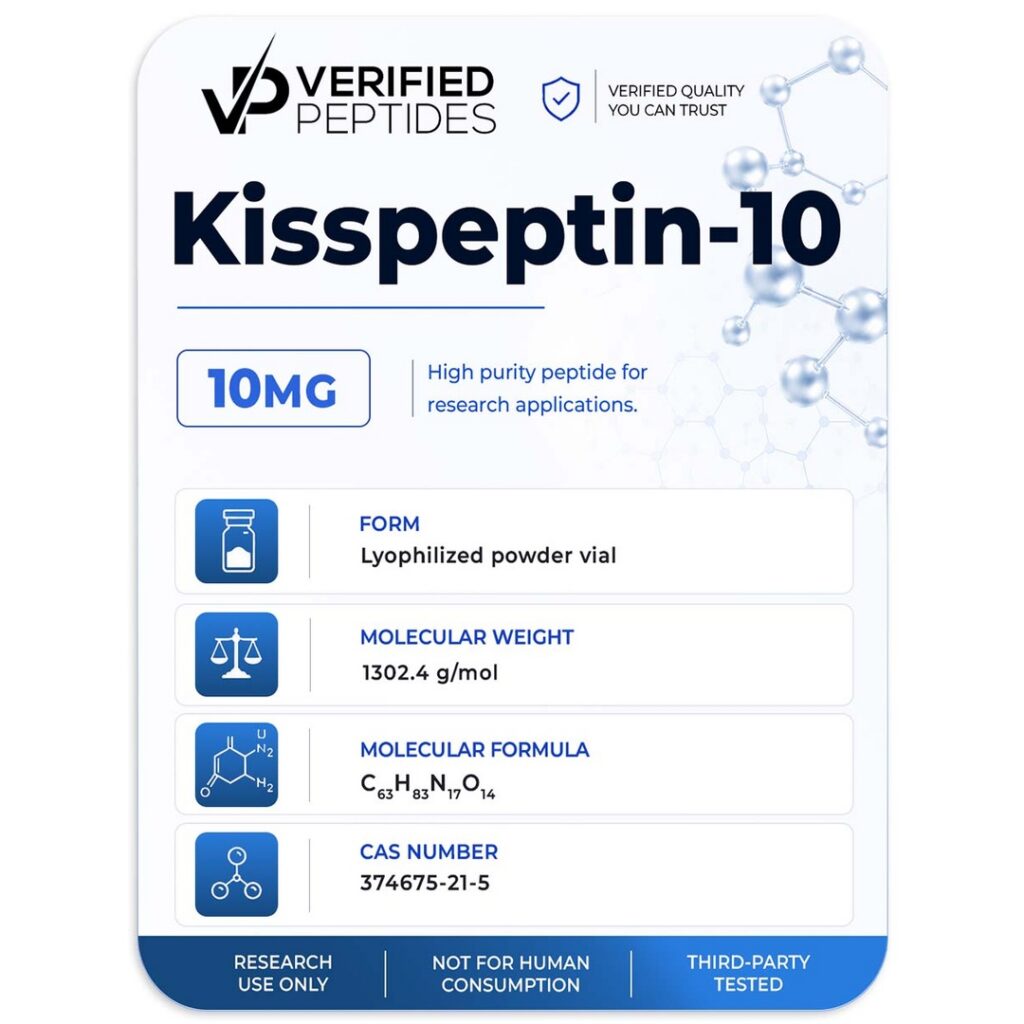
Kisspeptin-10 is a small, ten-residue peptide (molecular weight approximately 1302.5 Da) that is degraded very rapidly in circulation. Its reported human plasma half-life is about 3.8 to 4.1 minutes, compared with roughly 28 minutes for the longer kisspeptin-54 isoform. Degradation occurs through a combination of renal filtration, given the peptide’s small size, and proteolytic cleavage by plasma peptidases, including matrix metalloproteinases MMP-2 and MMP-9.
The principal characterized decomposition product is an N-terminal tyrosine-truncated fragment. This short half-life is the main reason that kisspeptin-54, not kisspeptin-10, has been carried into IVF-trigger clinical development. A brief, self-limiting hormonal pulse is desirable in that specific application.
Kisspeptin-10 sits at a genuinely well-validated node of human reproductive physiology. Loss-of-function mutations in its receptor cause hypogonadotropic hypogonadism in humans, and exogenous kisspeptin-10 reliably stimulates LH release in men and in preovulatory-phase women. This has been shown in multiple independent human studies from a single, methodologically consistent research group.
This makes its core mechanism among the better human-validated of any investigational peptide discussed in this class. At the same time, the evidence base is narrow. Nearly all human data derive from short-term intravenous or subcutaneous dosing in small numbers of research volunteers and infertility patients. Chronic administration data are limited to animal models, where continuous exposure produced testicular degeneration and tachyphylaxis. Kisspeptin-10 itself, owing to its several-minute plasma half-life, has been largely superseded in applied human research, such as IVF oocyte-maturation triggering, by the longer-acting kisspeptin-54 isoform. No kisspeptin-based product currently holds regulatory approval for any indication. No data exist on repeated, long-term, or non-clinical-protocol use of kisspeptin-10 in humans.
Metastasis suppressor gene KiSS-1 encodes peptide ligand of a G-protein-coupled receptor (Nature)
The GPR54 Gene as a Regulator of Puberty (New England Journal of Medicine)
Kisspeptin-10 Is a Potent Stimulator of LH and Increases Pulse Frequency in Men (JCEM)
The Effects of Kisspeptin-10 on Reproductive Hormone Release Show Sexual Dimorphism in Humans (JCEM)
1. Ohtaki T, Shintani Y, Honda S, et al. Metastasis suppressor gene KiSS-1 encodes peptide ligand of a G-protein-coupled receptor. Nature. 2001;411(6837):613-617. doi: 10.1038/35079135.
2. de Roux N, Genin E, Carel JC, Matsuda F, Chaussain JL, Milgrom E. Hypogonadotropic hypogonadism due to loss of function of the KiSS1-derived peptide receptor GPR54. Proc Natl Acad Sci USA. 2003;100(19):10972-10976. doi: 10.1073/pnas.1834399100.
3. Seminara SB, Messager S, Chatzidaki EE, et al. The GPR54 gene as a regulator of puberty. N Engl J Med. 2003;349(17):1614-1627. doi: 10.1056/NEJMoa035322.
4. Messager S, Chatzidaki EE, Ma D, et al. Kisspeptin directly stimulates gonadotropin-releasing hormone release via G protein-coupled receptor 54. Proc Natl Acad Sci USA. 2005;102(5):1761-1766. doi: 10.1073/pnas.0409330102.
5. Dhillo WS, Chaudhri OB, Patterson M, et al. Kisspeptin-54 stimulates the hypothalamic-pituitary gonadal axis in human males. J Clin Endocrinol Metab. 2005;90(12):6609-6615. doi: 10.1210/jc.2005-1468.
6. George JT, Veldhuis JD, Roseweir AK, et al. Kisspeptin-10 is a potent stimulator of LH and increases pulse frequency in men. J Clin Endocrinol Metab. 2011;96(8):E1228-E1236. doi: 10.1210/jc.2011-0089.
7. Jayasena CN, Nijher GMK, Comninos AN, et al. The effects of kisspeptin-10 on reproductive hormone release show sexual dimorphism in humans. J Clin Endocrinol Metab. 2011;96(12):E1963-E1972. doi: 10.1210/jc.2011-1408.
8. Jayasena CN, Abbara A, Comninos AN, et al. Kisspeptin-54 triggers egg maturation in women undergoing in vitro fertilization. J Clin Invest. 2014;124(8):3667-3677. doi: 10.1172/JCI75730.