Cart

Oops, your cart is still empty
Looks like you haven’t added anything yet. Start exploring our products and find what you need.
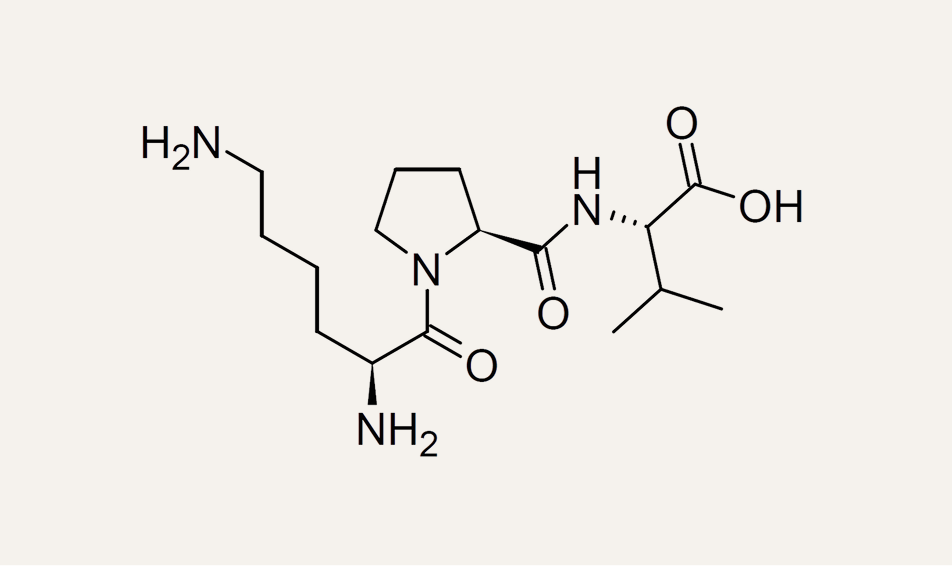
KPV is a tripeptide composed of lysine, proline, and valine (Lys-Pro-Val). It corresponds to the C-terminal fragment (residues 11-13) of alpha-melanocyte-stimulating hormone (alpha-MSH), a 13-amino-acid neuropeptide cleaved from the proopiomelanocortin (POMC) precursor. Alpha-MSH is produced in the pituitary gland, skin, and various peripheral immune tissues. Alpha-MSH itself has long been studied for pigmentation effects, via melanocortin-1 receptor activation on melanocytes. It has also been studied for broader anti-inflammatory and immunomodulatory actions, mediated through melanocortin receptors expressed on immune cells.
Interest in KPV specifically began with an observation first reported by Hiltz and Lipton in 1989. They found that this small C-terminal tripeptide retained substantial anti-inflammatory activity in vitro, despite lacking the His-Phe-Arg-Trp core sequence required for classical melanocortin receptor binding. This was a notable finding because it implied that KPV’s anti-inflammatory effects are largely independent of the canonical melanocortin receptor pathway.
This distinguishes it mechanistically from full-length alpha-MSH and from receptor-selective melanocortin agonists. Because it lacks the melanocortin receptor-binding motif, KPV also lacks alpha-MSH’s pigmentation-inducing effect, which researchers have found useful for isolating anti-inflammatory activity from pigmentary activity in experimental models. Subsequent work extended interest in KPV to gut mucosal inflammation, skin inflammation, and antimicrobial activity. This positioned it as a minimal, receptor-independent anti-inflammatory peptide of interest for inflammatory bowel disease and dermatological research. KPV is an investigational, non-approved research compound. It has not been evaluated in registered human clinical trials, and no clinical dosing exists for it.
Unlike full-length alpha-MSH, KPV appears to act intracellularly rather than through cell-surface melanocortin receptor engagement. Reported mechanisms include direct entry into cells and inhibition of IκB kinase activity, reducing NF-κB nuclear translocation and downstream transcription of pro-inflammatory cytokines and enzymes. A comprehensive review by Brzoska and colleagues in Endocrine Reviews summarized evidence that KPV lacks the sequence motif required to bind any known melanocortin receptor. Yet it retains nearly all of alpha-MSH’s anti-inflammatory capacity while lacking pigmentary action, supporting a receptor-independent intracellular mechanism (Brzoska T, et al. Endocr Rev. 2008).
In intestinal epithelium, KPV is a substrate for the peptide transporter PepT1. PepT1 is normally expressed in the small intestine and becomes upregulated in colonic epithelium during intestinal inflammation. Dalmasso and colleagues demonstrated that PepT1-mediated uptake of KPV into colonic epithelial cells is required for its anti-inflammatory effect in the gut. This provides a plausible explanation for why oral KPV shows regional efficacy specifically in inflamed colonic tissue, where PepT1 expression is induced (Dalmasso G, et al. Gastroenterology. 2008).
Independent of its anti-inflammatory signalling effects, alpha-MSH and its C-terminal tripeptide KPV have demonstrated direct antimicrobial activity against Staphylococcus aureus and Candida albicans at low, physiologically relevant concentrations. More recent structure-activity work attributes this action to the peptide’s cationic charge, which promotes selective affinity for microbial membrane lipids (Cutuli M, et al. J Leukoc Biol. 2000).
In vitro work has shown KPV inhibits NF-κB nuclear translocation in cultured cells and reduces pro-inflammatory cytokine output, consistent with its proposed intracellular mechanism. Separately, in vitro antimicrobial assays found alpha-MSH and KPV significantly inhibited Staphylococcus aureus colony formation and reduced Candida albicans viability and germ-tube formation at picomolar-to-nanomolar concentrations (Cutuli M, et al. J Leukoc Biol. 2000).
Dalmasso and colleagues showed that orally administered KPV reduced the severity of dextran sodium sulfate (DSS)- and TNBS-induced colitis in mice, with reduced pro-inflammatory cytokine expression in colonic tissue. They also identified the PepT1 transporter as necessary for this effect (Dalmasso G, et al. Gastroenterology. 2008;134:166-178). Independently, Kannengiesser and colleagues tested KPV in two distinct murine colitis models, DSS colitis and CD45RBhi T-cell transfer colitis. With KPV treatment, they reported earlier recovery and significantly stronger regain of body weight, reduced histological inflammatory infiltrates, and reduced myeloperoxidase activity in colonic tissue.
Notably, KPV rescued melanocortin-1 receptor-deficient (MC1Re/e) mice from DSS-colitis-associated death, reinforcing that its effect does not require intact melanocortin receptor signalling (Kannengiesser K, et al. Inflamm Bowel Dis. 2008;14(3):324-331). A related study in a murine model of colitis-associated colorectal cancer found that PepT1 promoted tumourigenesis, and that KPV treatment conferred therapeutic benefit in this model. This was published in Cellular and Molecular Gastroenterology and Hepatology.
In a drug-delivery-focused study, Xiao and colleagues encapsulated KPV in hyaluronic acid-functionalized nanoparticles (approximately 272 nm) to target colonic epithelial cells and macrophages. This targeted formulation alleviated ulcerative colitis in a mouse model at substantially lower KPV doses than free peptide, with improved mucosal healing (Xiao B, et al. Mol Ther. 2017;25:1628-1640).
No completed, registered human clinical trials of KPV as a standalone investigational agent have been identified in the published literature. Reviews and secondary sources consistently note that KPV’s evidence base is limited to in vitro and animal (largely murine) studies. There is no human pharmacokinetic, efficacy, or safety dataset for KPV, and it has not been evaluated as a cosmetic ingredient in any controlled human trial. Any claims of human efficacy or cosmetic benefit circulating in commercial or informal sources are not supported by the peer-reviewed literature currently available.
There is no published human safety, tolerability, or pharmacokinetic data for KPV. Animal studies to date have focused on efficacy endpoints in colitis models, rather than systematic toxicology. No dedicated acute or chronic toxicology, genotoxicity, reproductive toxicology, or carcinogenicity study of KPV has been identified in the literature reviewed here.
The reviewed animal studies did not report overt adverse effects at the doses used. However, the absence of reported harm in efficacy-focused studies should not be interpreted as evidence of safety, since these studies were not designed or powered to detect toxicity. Given the total absence of human data, no statement can be made about safety, appropriate dosing, or risk in humans or animals. This applies outside the specific experimental conditions of the cited studies. KPV is sold on peptides.com strictly for in vitro and laboratory research use, not for human or animal administration.
KPV is a mechanistically distinct, minimal anti-inflammatory peptide derived from the C-terminus of alpha-MSH. It is of interest specifically because it appears to act independently of classical melanocortin receptor binding. Instead, it works through intracellular NF-κB inhibition and, in the gut, PepT1-mediated cellular uptake. The strongest evidence for KPV comes from a small but consistent set of murine colitis studies (Dalmasso et al. 2008; Kannengiesser et al. 2008; Xiao et al. 2017). These studies show reduced inflammation and improved outcomes in DSS- and TNBS-induced colitis models. Older in vitro data also suggest direct antimicrobial activity against Staphylococcus aureus and Candida albicans.
However, this evidence base is entirely preclinical. There are no completed human trials, no human safety data, and no validated human dose. Claims about KPV’s effects in humans, whether for gut health, skin, or any other application, should be treated as extrapolation from rodent and cell-culture data. They are not established fact. KPV remains a legitimate subject of ongoing laboratory research into receptor-independent anti-inflammatory peptide mechanisms, but is not a clinically validated compound.
1. Hiltz ME, Lipton JM. Anti-inflammatory activity of a COOH-terminal fragment of the neuropeptide alpha-MSH. FASEB J. 1989;3(9):2282-2284.
2. Brzoska T, Luger TA, Maaser C, Abels C, Böhm M. Alpha-melanocyte-stimulating hormone and related tripeptides: biochemistry, antiinflammatory and protective effects in vitro and in vivo, and future perspectives for the treatment of immune-mediated inflammatory diseases. Endocr Rev. 2008;29(5):581-602. doi: 10.1210/er.2007-0027.
3. Dalmasso G, Charrier-Hisamuddin L, Nguyen HT, Yan Y, Sitaraman S, Merlin D. PepT1-mediated tripeptide KPV uptake reduces intestinal inflammation. Gastroenterology. 2008;134(1):166-178. doi: 10.1053/j.gastro.2007.10.026.
4. Kannengiesser K, Maaser C, Heidemann J, Luegering A, Ross M, Brzoska T, Böhm M, Luger TA, Domschke W, Kucharzik T. Melanocortin-derived tripeptide KPV has anti-inflammatory potential in murine models of inflammatory bowel disease. Inflamm Bowel Dis. 2008;14(3):324-331. doi: 10.1002/ibd.20334.
5. Xiao B, Xu Z, Viennois E, et al. Orally targeted delivery of tripeptide KPV via hyaluronic acid-functionalized nanoparticles efficiently alleviates ulcerative colitis. Mol Ther. 2017;25(7):1628-1640. doi: 10.1016/j.ymthe.2016.11.020.
6. Cutuli M, Cristiani S, Lipton JM, Catania A. Antimicrobial effects of alpha-MSH peptides. J Leukoc Biol. 2000;67(2):233-239. doi: 10.1002/jlb.67.2.233.
7. Catania A, Gatti S, Colombo G, Lipton JM. Targeting melanocortin receptors as a novel strategy to control inflammation. Pharmacol Rev. 2004;56(1):1-29.