Cart

Oops, your cart is still empty
Looks like you haven’t added anything yet. Start exploring our products and find what you need.
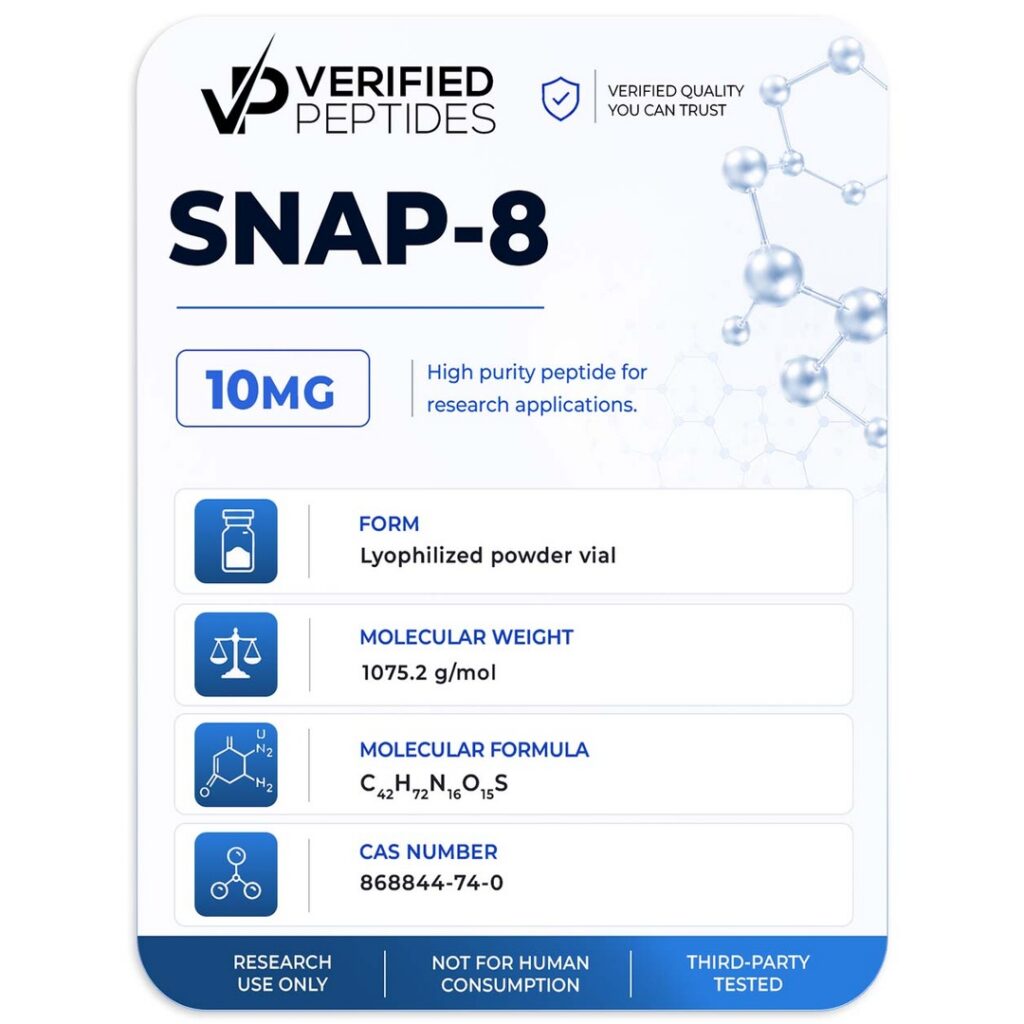
SNAP-8 is the trade name for a synthetic octapeptide with the INCI designation Acetyl Glutamyl Heptapeptide-1 (also cited as Acetyl Octapeptide-3) and CAS number 868844-74-0. Its sequence is Ac-Glu-Glu-Met-Gln-Arg-Arg-Ala-Asp-NH2, with a molecular formula of approximately C41-42H70-72N16O15-16S and a molecular weight of roughly 1111 Da. It was developed by the Spanish cosmetic-ingredient company Lipotec (now part of Lubrizol Life Science) as a second-generation successor to Acetyl Hexapeptide-8. Acetyl Hexapeptide-8 is better known by its trade name Argireline.
Both peptides are synthetic fragments modeled on the N-terminal region of SNAP-25 (synaptosomal-associated protein of 25 kDa). SNAP-25 is a core component of the SNARE (soluble NSF attachment protein receptor) complex, which mediates docking and fusion of neurotransmitter-containing vesicles at nerve terminals. SNAP-25 is the same protein cleaved enzymatically by botulinum neurotoxin type A. SNAP-8 was designed as a longer, extended-sequence analogue intended to interact with a broader stretch of the SNARE-assembly interface than the shorter hexapeptide. The premise was that this could produce a comparable or improved topical anti-wrinkle effect without the enzymatic, irreversible cleavage mechanism of botulinum toxin.
Researchers’ interest in SNAP-8 sits within the broader cosmeceutical category of “neurotransmitter-release-affecting” or “Botox-alternative” peptides. These are ingredients formulated into topical anti-aging products on the premise that dampening acetylcholine-driven muscle micro-contractions at the neuromuscular junction can reduce the appearance of dynamic (expression) wrinkles. SNAP-8 is sold and used almost exclusively as a topical cosmetic ingredient at low percentages in serums and creams. It is not an injectable and should not be confused with botulinum toxin products.
SNAP-8’s octapeptide sequence corresponds to a region of SNAP-25 involved in forming the ternary SNARE complex (with syntaxin and VAMP/synaptobrevin) required for vesicle docking. The peptide is proposed to compete with native SNAP-25 for this protein-protein interaction, thereby interfering with productive SNARE complex assembly without cleaving SNAP-25 itself. This distinguishes its proposed action from botulinum toxin, which acts enzymatically and irreversibly.
Manufacturer in vitro assays using chromaffin-cell or synaptosome-type exocytosis models have reported dose-dependent reduction of catecholamine and glutamate release with SNAP-8 treatment. One commonly cited internal figure describes roughly 43% inhibition of glutamate release at 1.5 mM peptide concentration. These figures come from technical/manufacturer literature rather than an independently published, peer-reviewed primary paper, and should be treated as preliminary industry data pending independent replication.
The proposed end effect is a modest, reversible reduction in the frequency or amplitude of the muscle fiber contractions that produce dynamic expression lines around the eyes and forehead. This is proposed by analogy with the mechanism described for the shorter, better-characterized Argireline peptide. A peer-reviewed study on Argireline reported inhibition of neurotransmitter release with a potency described as similar to (though far less efficacious than) botulinum toxin A, in an in vitro/ex vivo model (Blanes-Mira et al., 2002).
Beyond the manufacturer’s in vitro glutamate-release inhibition data described above, no independently published, peer-reviewed cell-based mechanistic study of SNAP-8 specifically was identified in this search. The parent compound class (SNAP-25-derived hexapeptides) has more substantial independent in vitro and ex vivo electrophysiological support, including work on isolated neuromuscular preparations. However, this literature was developed for Acetyl Hexapeptide-8 (Argireline), not for SNAP-8 itself, and the two peptides are structurally distinct.
No dedicated animal efficacy study of SNAP-8 was identified in the literature search. This is a notable evidence gap for a compound marketed on a specific proposed neuromuscular mechanism.
The primary human data available for SNAP-8 come from manufacturer-sponsored technical/product literature rather than an independently peer-reviewed clinical trial indexed in PubMed. The commonly cited study design compared a 10% SNAP-8 solution (equivalent to 0.005% pure peptide) against a matched 10% Argireline (Acetyl Hexapeptide-8) solution, applied twice daily for 28 days in 17 women. Wrinkle depth was assessed by skin-replica profilometry.
SNAP-8 was reported to reduce wrinkle depth by approximately 34.98%, compared with 27.05% for Argireline in the same protocol. No placebo arm, blinding methodology, or statistical analysis for this comparison appears in an independently published, peer-reviewed source identified in this search. The figure should therefore be treated as preliminary, industry-generated data pending independent replication, not as confirmed clinical-trial evidence.
By contrast, the shorter, related Argireline peptide has an independently published peer-reviewed clinical study (Blanes-Mira et al., Int J Cosmet Sci, 2002). This study reported up to 30% wrinkle-depth reduction after 30 days of topical use in a small cohort of women, alongside supporting in vitro neurotransmitter-release data. Argireline remains the more rigorously documented member of this peptide class.
No dedicated, independently published dermal irritation, sensitization, systemic toxicology, or pharmacokinetic study of SNAP-8 was identified in this search. It is used commercially as a cosmetic ingredient at low concentrations in numerous marketed skin-care formulations, which implies a history of use consistent with cosmetic-ingredient safety assessment processes.
This is not equivalent to a published toxicology dataset. No data on oral, injectable, or systemic administration exist. SNAP-8 has only been evaluated, informally, as a topical cosmetic ingredient. Researchers should not assume dermal-use safety translates to any other route of administration. SNAP-8 should be treated as an unvalidated research compound outside its narrow cosmetic-ingredient history.
Analytical chemistry work has been published on quantifying acetyl octapeptide-3 in cosmetic formulations by liquid chromatography-tandem mass spectrometry (Paik et al., J Anal Sci Technol, 2020). This reflects the practical need to verify peptide content and monitor degradation in complex topical matrices such as emulsions and serums. SNAP-8 is an octapeptide with a free amide-capped terminus and an internal methionine residue. Based on general peptide chemistry principles, it would be expected to undergo oxidation at methionine and hydrolytic degradation outside controlled pH and temperature ranges. However, no dedicated peer-reviewed stability or shelf-life study specific to SNAP-8 was identified.
SNAP-8 is a rationally designed, SNAP-25-derived octapeptide marketed as a topical alternative to botulinum toxin for reducing dynamic facial wrinkles. It extends the design logic of the earlier, better-studied Argireline (Acetyl Hexapeptide-8) peptide. Its proposed mechanism is competitive interference with SNARE complex assembly and consequent reduction of neurotransmitter release at the neuromuscular junction. This is mechanistically plausible and consistent with the general biology of SNAP-25 and the SNARE fusion apparatus, and it is supported by manufacturer in vitro data. However, independently published, peer-reviewed cell, animal, and human efficacy data specific to SNAP-8 are sparse to absent.
The most frequently cited clinical figures originate from manufacturer technical literature rather than an independently verifiable peer-reviewed trial. No formal toxicology dataset for SNAP-8 was identified. Overall, SNAP-8 should be regarded as a commercially established cosmetic ingredient with a biologically plausible but thinly and non-independently documented evidence base. It remains distinct from the more rigorously published Argireline peptide it was designed to improve upon.
1. Blanes-Mira C, Clemente J, Jodas G, et al. A synthetic hexapeptide (Argireline) with antiwrinkle activity. Int J Cosmet Sci. 2002;24(5):303-310. doi: 10.1046/j.1467-2494.2002.00153.x.
2. Paik MJ, et al. Method development for acetyl octapeptide-3 analysis by liquid chromatography-tandem mass spectrometry. J Anal Sci Technol. 2020;11:34. doi: 10.1186/s40543-020-00232-8.
3. Lupo MP, Cole AL. Cosmeceutical peptides. Dermatol Ther. 2007;20(5):343-349.
4. Zhang L, Falla TJ. Cosmeceuticals and peptides. Clin Dermatol. 2009;27(5):485-494.
5. Draelos ZD. The cosmeceutical realm. Clin Dermatol. 2008;26(6):627-632.