Cart

Oops, your cart is still empty
Looks like you haven’t added anything yet. Start exploring our products and find what you need.
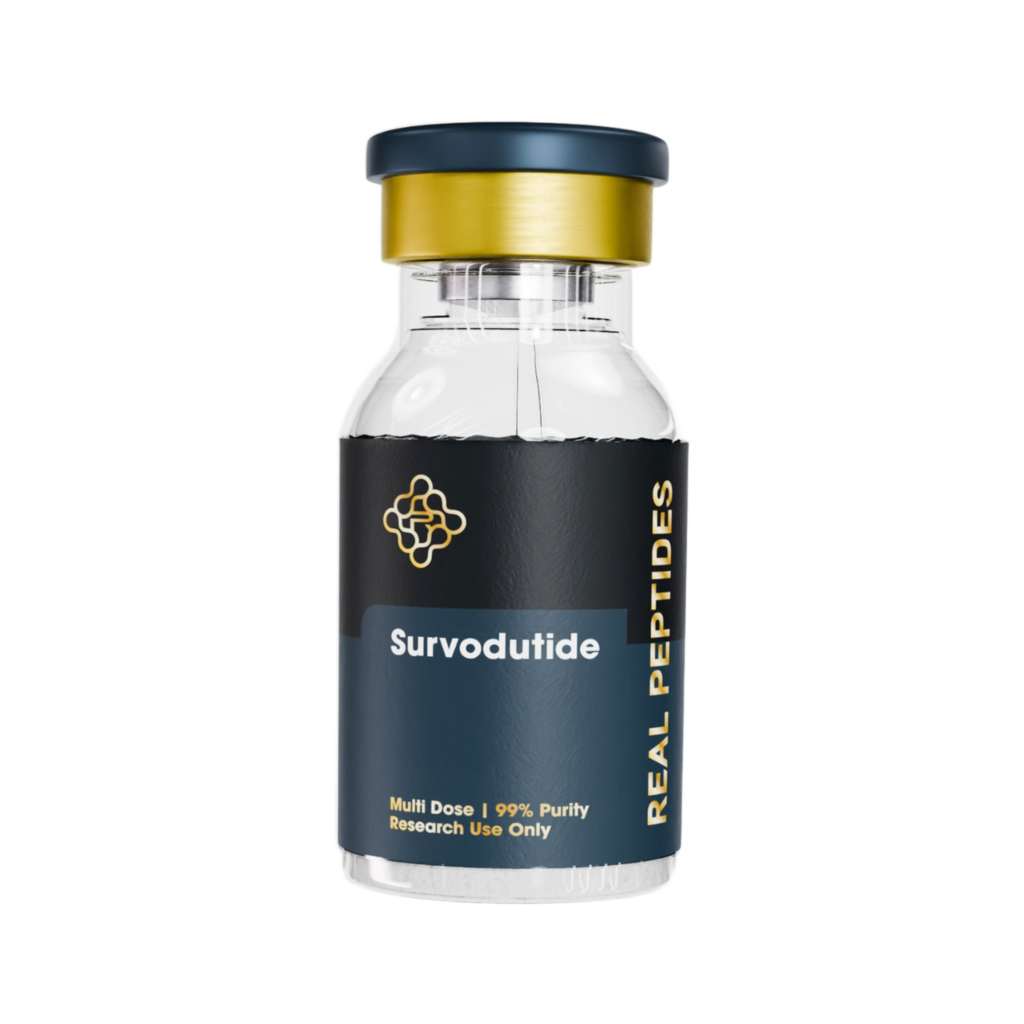
Survodutide, also known by its development code BI 456906, is a synthetic 29-amino-acid peptide. It is engineered as a dual agonist of the glucagon receptor (GCGR) and the glucagon-like peptide-1 receptor (GLP-1R). It was developed jointly by Boehringer Ingelheim and Zealand Pharma, building on Zealand’s glucagon/GLP-1 dual-agonist peptide chemistry platform. The molecule is derived structurally from native glucagon, modified with amino acid substitutions to confer balanced activity at both receptors. It is also conjugated to a C18 fatty diacid moiety through a linker. This conjugation promotes albumin binding, extends plasma half-life, and permits once-weekly subcutaneous dosing (Zimmermann T, et al. Mol Metab. 2022).
Glucagon and GLP-1 are both derived from the proglucagon gene and act on closely related class B G-protein-coupled receptors. However, they have historically been viewed as functionally opposed. GLP-1R agonism lowers blood glucose and suppresses appetite, whereas glucagon raises blood glucose through hepatic gluconeogenesis and glycogenolysis. Research interest in dual agonism grew from the observation that glucagon receptor activation also increases energy expenditure and lipid oxidation.
Researchers theorized that pairing it with GLP-1R activity could offset the glucose-raising liability of glucagon while retaining its calorie-burning effect. Survodutide was engineered to achieve full activation of GLP-1R alongside only partial agonism of GCGR, a balance intended to maximize weight loss without provoking hyperglycemia. It is currently an investigational compound, studied in Phase 2 and Phase 3 clinical programs for obesity and for metabolic dysfunction-associated steatohepatitis (MASH, formerly NASH). It is not approved for any indication in any jurisdiction. As a research chemical it is sold strictly for laboratory and in vitro/in vivo research use, not for human or animal administration.
Survodutide binds and activates GLP-1R on pancreatic beta cells and in the central nervous system. This stimulates glucose-dependent insulin secretion and slows gastric emptying. It also acts on hypothalamic and brainstem appetite centres to reduce food intake. A 2026 study using Fos immunohistochemistry in rodents reported that survodutide activates neuronal populations in circumventricular organs implicated in appetite regulation. This is consistent with a central mechanism contributing to reduced energy intake (PMC12925197).
Concurrent partial activation of GCGR in the liver and adipose tissue stimulates hepatic gluconeogenesis, glycogenolysis, and lipolysis, increasing whole-body energy expenditure and fat oxidation. Preclinical work in diet-induced obese mice found that a structurally related GCGR/GLP-1R dual agonist analogue required intact hepatic GCGR signalling. This was necessary to achieve superior weight loss and metabolic improvement relative to GLP-1R agonism alone. The finding supports a genuine mechanistic contribution from glucagon receptor engagement, rather than from GLP-1R activity alone (Long AL, et al. Diabetes Obes Metab. 2026).
Because unopposed glucagon receptor agonism would be expected to raise blood glucose, survodutide was optimized for balance. GLP-1R activation is proportionally greater than GCGR activation at anticipated therapeutic exposures. In preclinical pharmacology studies, this balance produced glucose-lowering and insulin-sensitizing effects overall. These effects were attributed to enhanced insulin secretion, reduced hepatic fat, and reduced insulin resistance. Net weight loss outweighed the direct hyperglycaemic potential of glucagon signalling (Zimmermann T, et al. Mol Metab. 2022).
In vitro receptor pharmacology assays characterized survodutide’s binding affinity and functional potency at human GCGR and GLP-1R. These assays confirmed activation of both receptors with a deliberately skewed potency ratio favouring GLP-1R. This was reported at the American Diabetes Association 2023 meeting and in the accompanying Zimmermann et al. preclinical pharmacology paper.
In diet-induced obese mice, survodutide and related dual-agonist analogues produced body weight reductions in the range of 25-27% relative to vehicle. This was attributed to increased energy expenditure and lipid oxidation alongside reduced food intake, together with improvements in glucose tolerance (Zimmermann T, et al. Mol Metab. 2022). A follow-up mechanistic study using liver-specific GCGR knockout mice demonstrated that hepatic GCGR signalling is required for the superior weight-loss and metabolic benefit of the dual agonist, compared with GLP-1R agonism alone. This isolated the specific contribution of the glucagon receptor arm (Long AL, et al. Diabetes Obes Metab. 2026).
Survodutide has been evaluated in several completed and ongoing human trials, none of which support any cosmetic or consumer use. All data below relate to prescription-only investigational drug trials, cited here strictly as research background.
A 46-week, randomized, double-blind, placebo-controlled Phase 2 dose-finding trial enrolled adults with overweight or obesity (n=387). Mean body weight change from baseline was -6.2% (0.6 mg), -12.5% (2.4 mg), -13.2% (3.6 mg), and -14.9% (4.8 mg), compared with -2.8% for placebo. Weight loss did not plateau by week 46 (le Roux CW, et al. Lancet Diabetes Endocrinol. 2024).
In a 16-week Phase 2 trial in adults with type 2 diabetes, survodutide produced dose-dependent reductions in HbA1c and body weight. This weight loss exceeded that seen with open-label semaglutide comparator arms at matched dose escalation schedules (Blüher M, et al. Diabetologia. 2024).
A 48-week Phase 2 trial enrolled adults with biopsy-confirmed MASH and fibrosis stage F1-F3 (n=293). MASH resolution without worsening of fibrosis occurred in 47% (2.4 mg), 62% (4.8 mg), and 43% (6.0 mg) of participants receiving survodutide, versus 14% with placebo. A liver fat content reduction of at least 30% occurred in 63%, 67%, and 57% of the respective dose groups, versus 14% with placebo. Fibrosis improved by at least one stage in 34%, 36%, and 34% of participants, versus 22% with placebo (Sanyal AJ, Bedossa P, Fraessdorf M, et al. N Engl J Med. 2024).
Phase 3 trials, known as the SYNCHRONIZE program, include SYNCHRONIZE-1, SYNCHRONIZE-MASLD, and the ongoing SYNCHRONIZE-CVOT cardiovascular outcomes trial. These trials have since reported, or are reporting, further efficacy and long-term safety data in larger populations with obesity and metabolic dysfunction-associated steatotic liver disease.
Across Phase 2 trials, gastrointestinal adverse events (nausea, vomiting, diarrhoea, constipation) were the most commonly reported adverse events. These were generally mild to moderate in severity and concentrated during dose escalation, consistent with the known class effect of GLP-1 receptor agonists. In the obesity dose-finding trial, gastrointestinal events occurred in a substantial majority of survodutide-treated participants versus placebo.
No unexpected safety signals distinct from other incretin-based therapies have been reported in published data to date. Long-term human safety over multiple years, carcinogenicity risk, reproductive and developmental toxicology data in humans, and safety in vulnerable populations have not been established in the public literature. As an investigational compound never approved for clinical use, survodutide has no established human dosing guidance, and no data support any use outside of registered clinical trials. All information here pertains strictly to laboratory and preclinical research. Survodutide is not intended for human or animal administration.
Survodutide is a well-characterized investigational GCGR/GLP-1R dual-agonist peptide with a plausible, mechanistically supported rationale. GLP-1R activation drives appetite suppression and glycaemic control, paired with partial GCGR activation for increased energy expenditure. Preclinical rodent data and an increasingly substantial human clinical trial record support this rationale. This record includes Phase 2 obesity, type 2 diabetes, and MASH trials, with Phase 3 SYNCHRONIZE trials ongoing or recently reported.
Together, these data show consistent, dose-dependent weight loss and improvements in liver histology that exceed what is typically seen with single GLP-1R agonists in cross-trial comparisons. However, cross-trial comparisons are not head-to-head evidence, and the compound remains unapproved by any regulatory authority. Gastrointestinal tolerability appears to be the principal limiting factor, mirroring other incretin-based therapies. Longer-term cardiovascular outcome data, real-world safety, and full Phase 3 datasets are still pending. Researchers should treat survodutide as a promising but still-investigational tool for studying dual incretin/glucagon receptor pharmacology, not as a validated therapeutic.
Boehringer Ingelheim: Survodutide (BI 456906) clinical pipeline overview
A Phase 2 Randomized Trial of Survodutide in MASH and Fibrosis (NEJM, 2024)
Glucagon and GLP-1 receptor dual agonist survodutide for obesity: Phase 2 dose-finding trial (Lancet Diabetes & Endocrinology)00356-X/abstract)
ClinicalTrials.gov: Phase 2 dose-finding study of BI 456906 in overweight/obesity (NCT04667377)
1. Zimmermann T, Thomas L, Baader-Pagler T, et al. BI 456906: Discovery and preclinical pharmacology of a novel GCGR/GLP-1R dual agonist with robust anti-obesity efficacy. Mol Metab. 2022;66:101633. doi: 10.1016/j.molmet.2022.101633.
2. le Roux CW, Steen O, Lucas KJ, Startseva E, Unseld A, Hennige AM. Glucagon and GLP-1 receptor dual agonist survodutide for obesity: a randomised, double-blind, placebo-controlled, dose-finding phase 2 trial. Lancet Diabetes Endocrinol. 2024;12(3):162-173. doi: 10.1016/S2213-8587(23)00356-X.
3. Blüher M, Rosenstock J, Hoefler J, Manuel R, Hennige AM. Dose-response effects on HbA1c and bodyweight reduction of survodutide, a dual glucagon/GLP-1 receptor agonist, compared with placebo and open-label semaglutide in people with type 2 diabetes: a randomised clinical trial. Diabetologia. 2024;67(3):470-482. doi: 10.1007/s00125-023-06053-9.
4. Sanyal AJ, Bedossa P, Fraessdorf M, et al. A Phase 2 Randomized Trial of Survodutide in MASH and Fibrosis. N Engl J Med. 2024;391:311-319. doi: 10.1056/NEJMoa2401755.
5. Long AL, et al. Hepatic GCGR is required for the superior weight loss and metabolic effects of a structurally related analogue of the dual GCGR/GLP-1R agonist survodutide in mice. Diabetes Obes Metab. 2026. doi: 10.1111/dom.70359.
6. Roux, et al. Survodutide, a glucagon receptor/glucagon-like peptide-1 receptor dual agonist, improves blood pressure in adults with obesity: a post hoc analysis from a randomized, placebo-controlled, dose-finding, phase 2 trial. Diabetes Obes Metab. 2025. doi: 10.1111/dom.16052.
7. Wharton S, et al. Survodutide for treatment of obesity: rationale and design of two randomized phase 3 clinical trials (SYNCHRONIZE-1 and -2). Obesity (Silver Spring). 2025. doi: 10.1002/oby.24184.
8. Effect of survodutide, a glucagon and GLP-1 receptor dual agonist, on weight loss: a meta-analysis of randomized controlled trials. Diabetol Metab Syndr. 2024. doi: 10.1186/s13098-024-01501-x.