Cart

Oops, your cart is still empty
Looks like you haven’t added anything yet. Start exploring our products and find what you need.

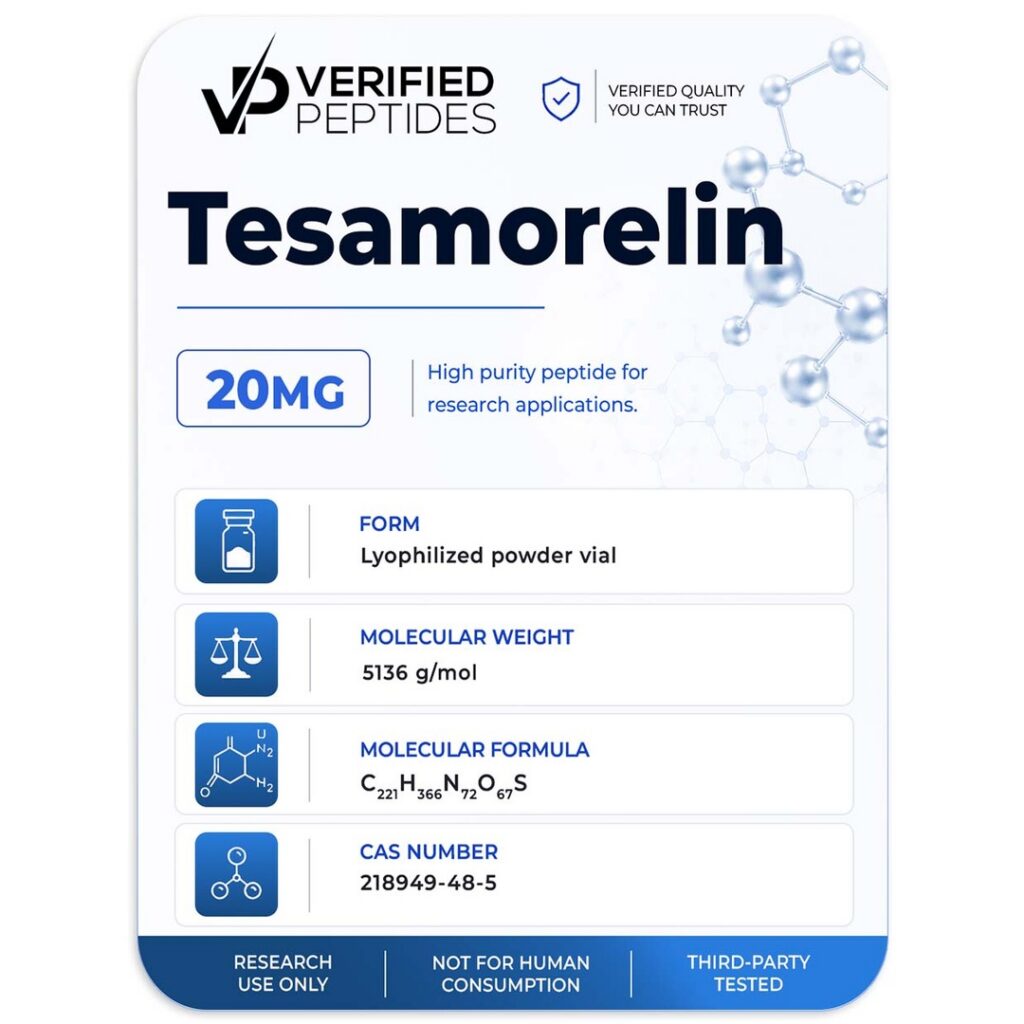
Tesamorelin (TH9507, Egrifta®) is a synthetic analog of human growth hormone-releasing hormone (GHRH) comprising the full 44-amino-acid sequence of the native peptide.1 It differs from native GHRH by the addition of a trans-3-hexenoyl group to the N-terminal tyrosine (Tyr1) residue. This single structural modification increases resistance to enzymatic degradation in plasma by dipeptidyl peptidase-IV (DPP-IV), which rapidly inactivates endogenous GHRH.2 Prior to the development of tesamorelin, the rapid degradation of native GHRH limited its potential as a therapeutic agent.1
Tesamorelin was developed for the management of HIV-associated lipodystrophy, a side effect of antiretroviral therapy. HIV-associated lipodystrophy encompasses both peripheral fat loss (lipoatrophy) and central fat accumulation (lipohypertrophy). These body changes are clinically significant and may adversely affect patient adherence to long-term antiretroviral therapy. In addition, lipohypertrophy is associated with increased waist circumference and visceral adipose tissue (VAT), both of which are established cardiovascular risk factors.1
Efforts to control visceral adipose tissue (VAT) through surgical approaches or insulin sensitizers such as metformin and rosiglitazone have had limited success, stimulating research into alternative treatments for lipohypertrophy. Fat metabolism is regulated by a complex network of hormones and other signaling molecules. Growth hormone (GH) is an important anabolic and lipolytic hormone produced in a pulsatile manner by somatotrophs of the anterior pituitary gland. GH is associated with increased muscle and bone mass and decreased body fat.1 In one study, GH levels were evaluated in HIV-infected men receiving antiretroviral therapy who exhibited body-fat changes, and compared with HIV-infected men without body-fat changes and healthy control subjects. The men with body-fat changes exhibited reduced mean GH levels, lower basal GH concentrations, and decreased GH pulse amplitude.3
Treatment with recombinant human growth hormone (r-hGH) has been investigated in both non-HIV and HIV populations with increased visceral adipose tissue (VAT). In both groups, r-hGH administration was associated with reductions in abdominal fat and improvements in lipid profiles, supporting its lipolytic and metabolic benefits. However, these benefits required sustained high-dose regimens (2–4 mg/day) which were associated with adverse effects including peripheral edema, arthralgia, and hyperglycemia.1
A separate longer-term study evaluated lower-dose GH administration, individually titrated to achieve a GH-mediated increase in insulin-like growth factor 1 (IGF-1). IGF-1 levels are augmented by growth hormone and thus an indirect measure of its activity. Over an 18-month period, this approach produced reductions in visceral fat and truncal obesity, accompanied by decreases in triglyceride levels and improvements in diastolic blood pressure. Nevertheless, other adverse effects were observed, including elevated 2-hour glucose levels during oral glucose tolerance testing.4 Importantly, no significant improvements were observed in carotid intima-media thickness (CIMT), indicating that the treatment had not led to decreased cardiovascular risk.1 Taken together, these findings underscore the challenge of achieving sustained metabolic benefit with GH-based therapies without introducing adverse effects.
Researchers began to examine the hypothalamic–pituitary axis as a whole in order to identify strategies that preserve the metabolic benefits of growth hormone (GH) augmentation while minimizing the adverse effects associated with supraphysiological dosing. The effects of GH are largely mediated through stimulation of insulin-like growth factor 1 (IGF-1) production in various tissues. GH secretion from somatotrophs in the anterior pituitary is regulated by multiple hypothalamic and peripheral peptides. Growth hormone-releasing hormone (GHRH), produced in the hypothalamus, and ghrelin, produced primarily in the gastrointestinal tract and also in the hypothalamus, both stimulate GH synthesis and release. In contrast, somatostatin acts as an inhibitory regulator, suppressing GH secretion in response to IGF-1 levels.1 This coordinated interplay of stimulatory and inhibitory signals produces the characteristic pulsatile pattern of GH secretion. It was hypothesized that administration of GHRH would result in more physiological levels of growth hormone in contrast to the supraphysiological level resulting from direct administration.1
The effect of subcutaneously administered GHRH was studied in HIV-infected men with increased abdominal girth in a randomized, placebo-controlled trial. 1 mg of GHRH or placebo was administered twice daily for 12 weeks. Administration of GHRH resulted in a significant increase in IGF-1 concentrations. The mean increase in IGF-1 was 104 ng/mL in the GHRH-treated group compared with 6 ng/mL in the placebo group. Increased IGF-1 levels are a phenomenon associated with enhanced GH activity. Increased lean body mass and reduced abdominal visceral fat were also observed. Levels of glucose, insulin, and lipids were not significantly altered.5
The rapid degradation of growth hormone-releasing hormone (GHRH) in plasma by dipeptidyl peptidase-IV (DPP-IV) limited its clinical utility as a therapeutic agent. To address this limitation, synthetic GHRH analogs were developed in which hydrophobic acyl modifications were introduced to increase resistance to enzymatic hydrolysis. Tesamorelin with its N-terminal trans-3-hexenoyl group was one of the GHRH analogs developed.1 Preclinical studies demonstrated that tesamorelin is degraded more slowly in vitro than unmodified GHRH in serum samples. This modification also prolonged in vivo plasma elimination kinetics of immunoreactive tesamorelin. In animal models, including pigs, rats, and dogs, daily intravenous or subcutaneous administration of TH9507 at doses up to 600 μg/kg increased circulating levels of growth hormone (GH) and insulin-like growth factor 1 (IGF-1).2
An early randomized, placebo-controlled study evaluated the effects of tesamorelin on abdominal fat accumulation and metabolic parameters in HIV-infected patients with central adiposity. Participants received either 1 mg, 2 mg, or placebo for 12 weeks. The study demonstrated dose-dependent increases in insulin-like growth factor 1 (IGF-1) relative to placebo. Reductions in trunk fat and visceral adipose tissue (VAT) were greatest in the 2 mg group; however, these changes did not reach statistical significance compared with placebo. In contrast, triglyceride levels and the total cholesterol to high-density lipoprotein (HDL) ratio were significantly reduced in the 2 mg group, without significant effects on glucose levels.6
A subsequent randomized, placebo-controlled clinical study evaluated the effects of 26 weeks of tesamorelin treatment in 412 HIV-infected patients with excess abdominal fat. Participants received daily subcutaneous injections of either 2 mg of tesamorelin or placebo for 26 weeks. Computed tomography demonstrated a 15.2% reduction in visceral adipose tissue (VAT) in the tesamorelin group, compared with a 5.0% increase in the placebo group. Tesamorelin treatment also improved lipid parameters, with triglyceride levels decreasing by 50 mg/dL compared with a 9 mg/dL increase in the placebo group. Similarly, the ratio of total cholesterol to high-density lipoprotein (HDL) cholesterol decreased by 0.31 in the tesamorelin group but increased by 0.21 in the placebo group. No significant changes in glycemic parameters were observed in either treatment group. Serum insulin-like growth factor 1 (IGF-1) levels increased by 81.0% in the tesamorelin group and decreased by 5.0% in the placebo group.7 This final result is consistent with tesamorelin mediating an activation of the growth hormone axis.
The efficacy of tesamorelin was further evaluated in a 12-month clinical study of 404 HIV-infected patients who had developed excess abdominal fat during antiretroviral therapy. Participants received daily subcutaneous injections of 2 mg of tesamorelin. After 6 months of treatment, visceral adipose tissue (VAT) had decreased by 10.9%, and after 12 months the reduction approached 18%. Treatment also produced sustained increases in insulin-like growth factor 1 (IGF-1) without significant effects on glucose levels. In addition, patients reported significant reductions in body image distress.8
The Phase III clinical trials confirmed that tesamorelin treatment reduces visceral adipose tissue (VAT) while improving lipid profiles and patients’ perceptions of body image. Reductions in VAT were maintained throughout the 52-week treatment period. Treatment was generally well tolerated, and no meaningful differences were observed between the groups in glucose parameters at weeks 26 and 52.9 These pivotal studies provided the primary clinical evidence supporting FDA approval of tesamorelin (as Egrifta®) on November 10, 2010 for the reduction of abdominal fat in HIV-infected patients with lipodystrophy. The FDA labeling states that tesamorelin is not indicated for weight loss as no such effect was observed in patients who received the drug in clinical trials. Theratechnologies of Canada, the developer of the drug released it to the public under the brand name Egrifta®.10 Subsequent formulation updates include Egrifta SV® (FDA-approved in 2019)11 and Egrifta WR® (FDA-approved in 2025).12
Growth hormone is a fundamental regulator of human metabolism, body composition, and tissue maintenance. Beyond its well-known role in promoting growth during childhood, growth hormone continues to influence lipid metabolism, protein synthesis, muscle mass, bone remodeling, and glucose homeostasis throughout adult life. Many of these effects are mediated through insulin-like growth factor 1 (IGF-1).
There has been interest in examining the use of tesamorelin in the treatment of other conditions involving dysregulation of the growth hormone axis. Preliminary clinical and mechanistic studies have explored the effects of tesamorelin beyond HIV-associated lipodystrophy, including investigations in individuals with obesity-related reductions in growth hormone secretion,13 HIV-associated nonalcoholic fatty liver disease,14 and age-related cognitive decline.15 In addition, growth hormone secretion declines with aging, a process that is associated with adverse changes in body composition and metabolic function. Preliminary investigations suggest that tesamorelin may ameliorate these age-related changes.16 The available studies exploring expanded clinical indications for tesamorelin remain preliminary, often involve small patient numbers, and produce mixed results.
Recent reviews in sports medicine have highlighted increasing interest in peptide-based therapies for musculoskeletal injury and performance enhancement. Tesamorelin has been among the candidate agents discussed in this context. However, these analyses emphasize that while growth hormone–related peptides, including GHRH analogs such as tesamorelin, have strong biological plausibility for influencing tissue repair pathways, there is currently insufficient clinical evidence to support their use in sports-related injuries. Although patient enthusiasm for agents that may accelerate recovery remains substantial, rigorous safety data are lacking. The authors caution that there is the potential for serious harm to patients.17 Also, it should be noted that tesamorelin, as a growth hormone–releasing hormone (GHRH) analog, is prohibited in sport under the World Anti-Doping Agency (WADA) Prohibited List, falling under peptide hormones and growth factors, and is banned both in-competition and out-of-competition.18 Beyond its FDA-approved indication, tesamorelin has been investigated as a potential therapeutic agent for other disorders involving dysregulation of the growth hormone–IGF-1 axis. However, these investigations remain preliminary and limited in scope. Future research should focus on long-term outcomes, broader disease populations, and rigorous evaluation of safety in proposed expansion settings. Until such data are available, tesamorelin remains best characterized as an effective therapy for HIV-associated visceral adiposity, with additional applications remaining investigational.
1. Bedimo, R. Growth hormone and tesamorelin in the management of HIV-associated lipodystrophy. HIV/AIDS – Research and Palliative Care. 2011;3:69–79.
2. Ferdinandi ES, Brazeau P, High K, Procter B, Fennell S, Dubreuil P. Non-clinical pharmacology and safety evaluation of TH9507, a human growth hormone-releasing factor analogue. Basic & Clinical Pharmacology & Toxicology. 2007;100(1): 49–58.
3. Rietschel P, Hadigan C, Corcoran C, T Stanley T., Neubauer G, J Gertner J, et al. Assessment of growth hormone dynamics in human immunodeficiency virus-related lipodystrophy. J Clin Endocrinol Metab. 2001;86(2):504–510.
4. Lo J, You SM, Canavan B, Liebau J, Beltrani G, Koutkia P, et al. Low-dose physiological growth hormone in patients with HIV and abdominal fat accumulation: a randomized controlled trial. JAMA. 2008;300(5):509-519.
5. Koutkia P, Canavan B, Breu J, Torriani M, Kissko J, Grinspoon S, et al. Growth hormone-releasing hormone in HIV-infected men with lipodystrophy: a randomized controlled trial. J Clin Endocrinol Metab. 2004;89(7):3479-3485
6. Falutz J, Allas S, Kotler DP, Thompson M, Koutkia P, Albu J, et al. A placebo-controlled, dose-ranging study of a growth hormone releasing factor in HIV-infected patients with abdominal fat accumulation. AIDS. 2005;19(14):1419-1426.
7. Falutz J, Allas S, Blot K, Potvin D, Kotler D, Somero M, et al. Metabolic effects of a growth hormone-releasing factor in patients with HIV. N Engl J Med. 2007;357(23):2359–2370.
8. Falutz J, Potvin D, Mamputu JC, Assaad H, Zoltowska M, Michaud SE, et al. Effects of tesamorelin, a growth hormone-releasing factor, in HIV-infected patients with abdominal fat accumulation: a randomized placebo-controlled trial with a safety extension. J Acquir Immune Defic Syndr. 2010;53(3):311–322.
9. Falutz J, Mamputu JC, Potvin D, Moyle G, Soulban G, Loughrey H, et al. Effects of tesamorelin (TH9507), a growth hormone-releasing factor analog, in human immunodeficiency virus-infected patients with excess abdominal fat: a pooled analysis of two multicenter, double-blind placebo-controlled phase 3 trials with safety extension data. J Clin Endocrinol Metab. 2010;95(9):4291-4304.
10. Traynor K. FDA approves tesamorelin for HIV-related lipodystrophy. Am J Health Syst Pharm. 2010;67(24):2082.
11. U.S. Food and Drug Administration. EGRIFTA SV (tesamorelin) prescribing information. 2019.
12. U.S. Food and Drug Administration. EGRIFTA WR (tesamorelin) prescribing information. 2025.
13. Makimura H, Feldpausch MN, Rope AM, Hemphill LC, Torriani M, Lee H, et al. Metabolic effects of a growth hormone-releasing factor in obese subjects with reduced growth hormone secretion: a randomized controlled trial. J Clin Endocrinol Metab. 2012;97(12):4769-4779.
14. Stanley TL, Fourman LT, Feldpausch MN, Purdy J, Zheng I, Pan CS, et al. Effects of tesamorelin on nonalcoholic fatty liver disease in people with HIV: a randomized, double-blind, multicentre trial. Lancet HIV. 2019;6(12):e821–e830.
15. Baker LD, Barsness SM, Borson S, Merriam GR, Friedman SD, Craft S, et al. Effects of growth hormone–releasing hormone on cognitive function in adults with mild cognitive impairment and healthy older adults: results of a controlled trial. Arch Neurol. 2012;69(11):1420-1429.
16. Sattler FR. Growth hormone in the aging male. Best Pract Res Clin Endocrinol Metab. 2013;27(4):541-555.
17. Mendias CL, Awan TM. Safety and efficacy of approved and unapproved peptide therapies for musculoskeletal injuries and athletic performance. Sports Med. 2026; doi: 10.1007/s40279-026-02437-0. Epub ahead of print.
18. World Anti-Doping Agency. The Prohibited List [Internet]. 2026 [Internet, Cited June 28, 2026]. Available from: https://www.wada-ama.org/en/prohibited-list.