
Cart

Oops, your cart is still empty
Looks like you haven’t added anything yet. Start exploring our products and find what you need.
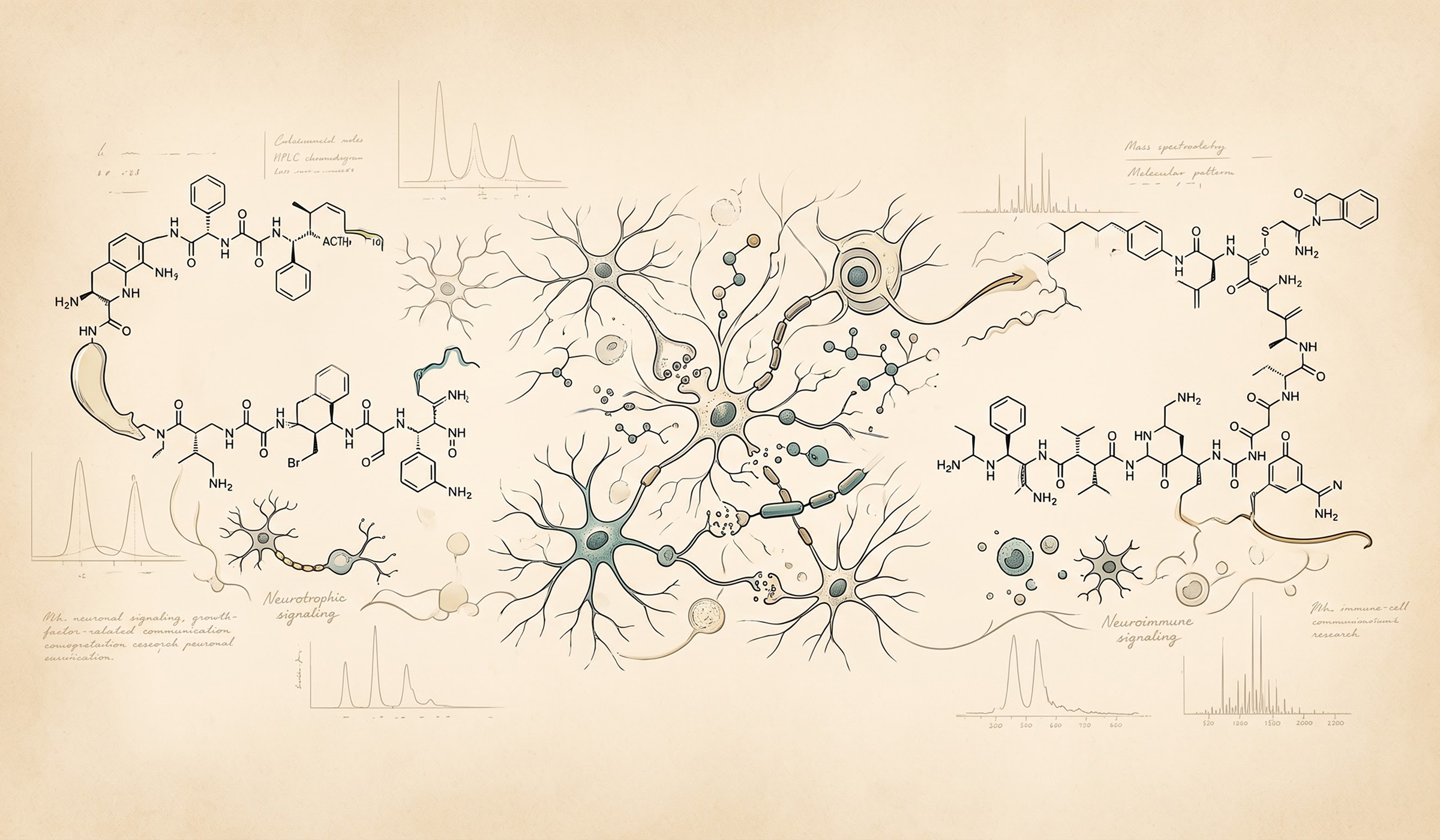
These materials are research-grade reference compounds sold for laboratory research use only. They are not for human or veterinary use.
Semax and selank are two synthetic peptides of Russian origin that are frequently studied side by side in neuropeptide research and are often compared directly. They are frequently grouped together because both are short, stabilized peptides derived from natural sequences and both appear in neurological and behavioral research. Beyond that surface similarity, however, they come from different parent molecules and are studied for different mechanisms.
Semax and selank are registered prescription medicines in some jurisdictions, including Russia, where semax appears on the national Vital and Essential Drugs list. The materials referenced here are research-grade reference compounds for laboratory use only and are not approved medicinal products. This page is subject to counsel review.
| Attribute | Semax | Selank |
|---|---|---|
| Parent molecule | ACTH(4-10) fragment | Tuftsin |
| Representative sequence | Met-Glu-His-Phe-Pro-Gly-Pro | Thr-Lys-Pro-Arg-Pro-Gly-Pro |
| Stabilizing motif | C-terminal Pro-Gly-Pro | C-terminal Pro-Gly-Pro |
| Primary research area | Neurotrophic / neuroprotection | Stress and withdrawal behavioral (animal models) |
| Associated signaling themes | BDNF and neurotrophic pathways | GABAergic and immunomodulatory pathways |
| Verification | HPLC + mass spectrometry, per-lot COA | HPLC + mass spectrometry, per-lot COA |
Semax is a heptapeptide built on the ACTH(4-10) sequence, typically represented as Met-Glu-His-Phe-Pro-Gly-Pro. The C-terminal Pro-Gly-Pro extension is the defining design feature; it is associated in the literature with increased resistance to enzymatic degradation compared with the bare ACTH fragment, which is one reason the analog is studied rather than the natural fragment itself. Semax retains the core of a melanocortin-related sequence while lacking the classical hormonal activity of full-length ACTH.
In research, semax is examined in the context of neurotrophic signaling and neuroprotection in animal and cell models (Kolbaev et al., 2025). Reported themes in the broader literature include effects on brain-derived neurotrophic factor pathways and on systems involved in neuronal survival. These are model-level observations, not statements about human cognition or treatment.
Selank is a heptapeptide analog of tuftsin, a naturally occurring immunomodulatory tetrapeptide (Thr-Lys-Pro-Arg). Selank is typically represented as Thr-Lys-Pro-Arg-Pro-Gly-Pro, again with the stabilizing Pro-Gly-Pro extension. Because its parent, tuftsin, has a background in immune signaling, selank is studied at the intersection of neurological and immune research.
The selank literature includes behavioral studies in animal models. In one such study, selank was reported to attenuate aversive signs in a rat morphine-withdrawal model (Konstantinopolsky et al., 2022), and related work has examined protective effects in an ethanol-withdrawal model (Kolik et al., 2019). As with semax, these are findings in defined experimental systems and are not statements about anxiety, dependence, or any condition in people.
The cleanest way to separate the two peptides is by parent molecule. Semax descends from a fragment of ACTH, a melanocortin-family hormone, and its research sits mainly in neurotrophic and neuroprotection work. Selank descends from tuftsin, an immunomodulatory peptide, and its research sits mainly in stress-response and withdrawal behavioral models. They occupy adjacent corners of the neuropeptide field rather than the same one, which is why comparing them is more about mapping two research areas than ranking two versions of the same thing.
Studies of semax describe effects on neurotrophic signaling pathways in defined cell and animal models, consistent with its investigation as an ACTH(4-10) analog (Kolbaev et al., 2025). The research interest centers on how a stabilized melanocortin-derived fragment influences neuronal survival and plasticity-related signaling in those systems.
Studies of selank describe behavioral endpoints in withdrawal and stress models in animals, along with neuroimmune signaling themes tied to its tuftsin origin (Konstantinopolsky et al., 2022; Kolik et al., 2019). The research interest centers on the behavioral and neuroimmune endpoints observed in those specific models.
Both peptides are short and share the Pro-Gly-Pro stabilizing motif, which is central to why the analogs, rather than the natural parents, are the compounds studied. Short hydrophilic peptides such as these generally dissolve readily in aqueous buffers, though exact behavior depends on the specific sequence. General peptide-stability considerations apply, and lot-specific stability is documented on the Certificate of Analysis rather than as a blanket claim. In any copy or data, the liquid-format product is described with neutral closure language; no route-of-administration framing is used.
The choice follows the research question. A study focused on neurotrophic or neuroprotection endpoints would look to semax; a study focused on withdrawal or stress-related behavior or neuroimmune signaling would look to selank. Parent molecule, associated pathways, and the depth of prior literature for the specific model all inform the decision. Because their research neighborhoods differ, they are complementary tools rather than substitutes.
Both are verified by mass spectrometry for identity and HPLC for purity, with results documented on a lot-specific Certificate of Analysis. Net peptide content is distinct from chromatographic purity and may be reported separately. Reconcile every molecular figure, including sequence and mass, against the COA before use.
Store sealed material cold, shield it from light, and avoid repeated freeze-thaw. Lyophilized material is generally more stable than material in solution. Lot-specific stability is documented on the COA.
Much of the foundational literature for both peptides is in Russian-language journals, so English-language coverage is narrower than for some other neuropeptides, and researchers should account for that when surveying the evidence. Head-to-head comparative studies under identical conditions are uncommon, so cross-study comparisons should be made cautiously.
They come from different parent peptides. Semax is an ACTH(4-10) analog studied mainly in neurotrophic and neuroprotection research; selank is a tuftsin analog studied mainly in stress and withdrawal behavioral models.
Semax is typically represented as Met-Glu-His-Phe-Pro-Gly-Pro and selank as Thr-Lys-Pro-Arg-Pro-Gly-Pro; both carry a stabilizing C-terminal Pro-Gly-Pro. Confirm the exact sequence for a given lot against its COA.
The Pro-Gly-Pro extension is associated with resistance to enzymatic degradation, which is why the stabilized analogs are studied rather than the bare parent fragments.
Both are registered prescription medicines in some jurisdictions, including Russia; the research reference compounds are not approved medicinal products. See the regulatory-status note.
No. All cited work is in animal or cell models and describes mechanism and research outcomes only.
By mass spectrometry for identity and HPLC for purity, documented on a lot-specific Certificate of Analysis.
Much of the foundational research on both peptides was published in Russian-language journals, so English reviews cover only part of the field.
Research-use notice: Semax and selank are research chemicals sold for laboratory research use only. They are not for human or veterinary use. Every finding is reported in the specific research context of the cited study.


