
Cart

Oops, your cart is still empty
Looks like you haven’t added anything yet. Start exploring our products and find what you need.
Research use only. The peptides described here are supplied as research-grade reference materials for laboratory use only, not for human or veterinary use.
Understanding solid-phase peptide synthesis (SPPS), the dominant manufacturing method for research peptides, gives researchers practical insight into the quality drivers, possible impurities, and typical specifications they will see on a certificate of analysis. This article walks through the SPPS workflow, the difference between Fmoc and Boc chemistries, and the post-synthesis purification steps that determine whether a crude peptide becomes a 95 or 98 percent pure research product.
Solid-phase peptide synthesis was introduced by Robert Bruce Merrifield in the 1960s. Anchoring the growing peptide chain to an insoluble support meant that excess reagents and byproducts could be washed away at each step rather than separated by extraction or crystallization, which is what made routine synthesis of defined sequences practical. Essentially all research peptide manufacture descends from that method, a lineage traced in the history of peptide science. The backbone chemistry it assembles is covered in how peptide backbone geometry constrains synthesis, the impurity profile it produces in reading a peptide certificate of analysis, and the harder structural classes in linear, cyclic, branched and stapled peptide classes. Analogue series made this way are interpreted through how structure determines activity in analogue series. Bulk material is listed under raw material specifications and finished compounds in the research peptide catalog.
Method reviews covering the classical approach and its modern variants set out where the technique now stands (Biofabrication, 2025; PMID 41191975), and work on aggregation-prone and disulfide-rich sequences shows where it remains difficult (Chemistry, 2024; PMID 38609334).
Before Merrifield introduced solid-phase peptide synthesis in 1963, peptide synthesis was performed in solution. Each coupling step generated byproducts that had to be separated from the growing peptide before the next coupling could begin. The process was slow, error-prone, and limited to short sequences (Merrifield, 1963; PMID 14048932).
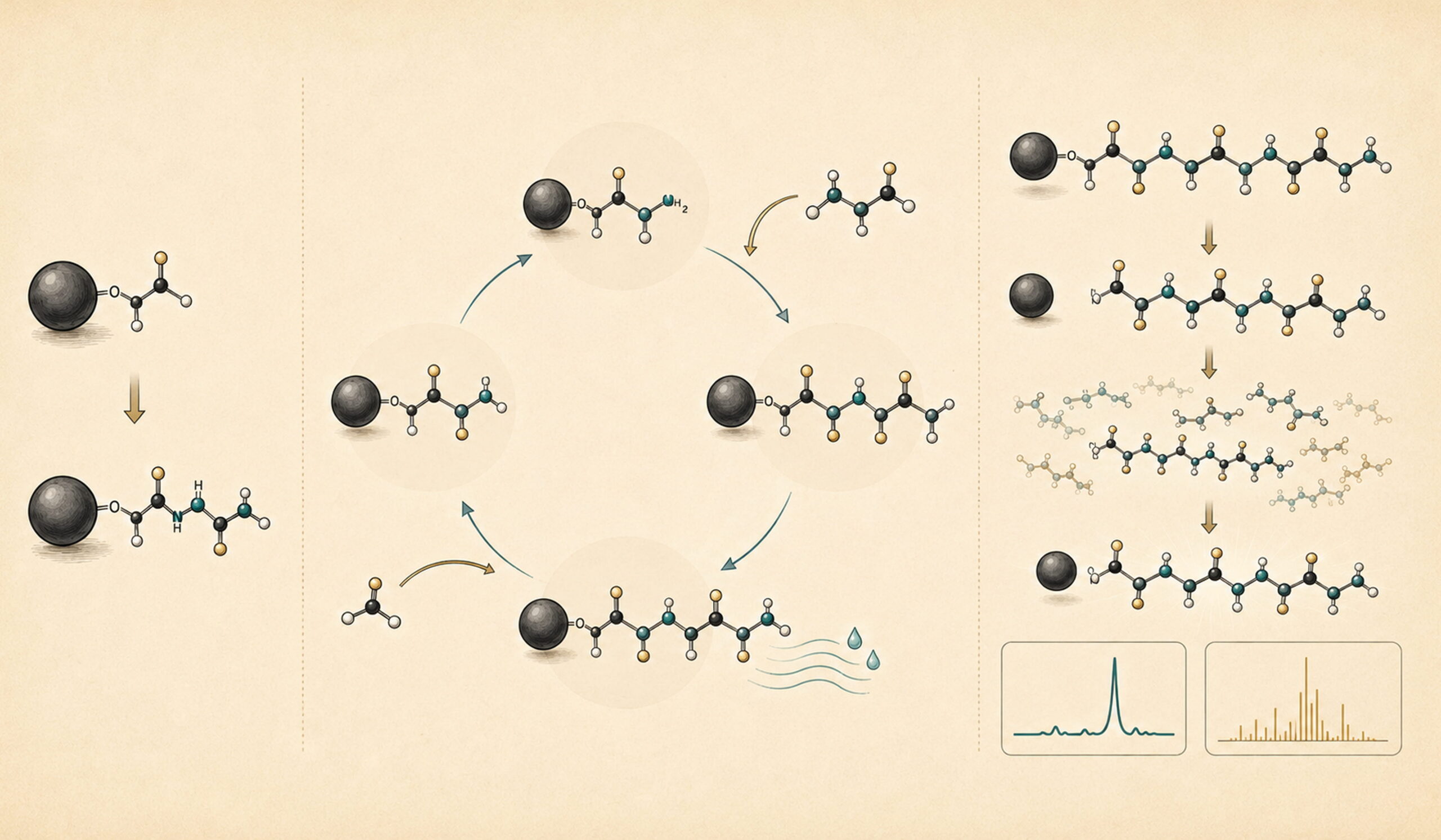
The key innovation of SPPS is anchoring the growing peptide to an insoluble polymer resin. Reagents are added in large excess to drive each coupling to completion, then the resin is washed to remove unreacted reagents and byproducts. The peptide remains attached to the resin throughout the synthesis, accessible for subsequent reactions but easily separated from soluble impurities by simple filtration.
Filtration replaces the painstaking solution-phase purification steps that previously bracketed every coupling. After each step, excess reagents and byproducts are simply rinsed from the resin with solvent (typically dimethylformamide or dichloromethane). This dramatically reduces the time and labor required for each residue addition.
Because each cycle follows the same general pattern (deprotect, wash, couple, wash), SPPS is well suited to automation. Modern peptide synthesizers can perform dozens of cycles in sequence with minimal operator intervention, producing peptides up to approximately 60 to 80 residues with reasonable efficiency.
A single SPPS cycle adds one residue to the growing peptide. The cycle consists of three to four steps depending on the protocol.
The growing peptide carries a temporary protecting group on its alpha-amino nitrogen, preventing the wrong amine from participating in the next coupling. Removal of this protecting group generates the free amine that will react with the next activated amino acid.
In Fmoc synthesis, deprotection uses 20 percent piperidine in DMF for approximately 5 to 10 minutes. The Fmoc group is removed via a beta-elimination mechanism, releasing dibenzofulvene which is captured by piperidine. The reaction is mild enough to leave acid-labile side chain protecting groups intact.
Coupling uses an activator that converts the carboxyl group of the incoming amino acid into a more reactive species. Common activators include HBTU, HATU, TBTU, COMU, and the older DIC/HOBt combination. Each activator has slightly different properties in terms of speed, racemization risk, and tolerance for difficult sequences.
Couplings typically take 30 to 60 minutes. Difficult couplings (when the chain has folded back on itself or when the next amino acid is bulky) may require double coupling, microwave assistance, or use of a more aggressive activator such as HATU.
After the coupling step, any unreacted N-termini are capped with an acetyl group (typically acetic anhydride in DMF). Capped chains are dead ends; they cannot be extended further, so they appear in the final mixture as truncated impurities of known length. This is preferable to leaving them unreacted, where they could be extended in the next cycle and produce single-residue deletion impurities that are very difficult to separate from the target.
The final step is a thorough wash with DMF or DCM to remove all reagents and byproducts before the next deprotection.
Two dominant strategies have emerged for the alpha-amine protection chemistry. The choice between them affects every downstream step.
Fmoc (9-fluorenylmethoxycarbonyl) is the dominant strategy in research peptide manufacturing today. The Fmoc group is removed under mildly basic conditions (piperidine in DMF), while side chain protecting groups (trityl on cysteine and histidine, tBu on serine, threonine, and tyrosine, Pbf on arginine) are acid-labile and are removed at the end of the synthesis.
The orthogonality between alpha-amine and side chain protection is the key advantage. Each cycle’s deprotection only touches the alpha amine. Side chains are protected throughout the synthesis and only revealed at the end during global deprotection.
Boc (tert-butyloxycarbonyl) was the original SPPS strategy and is still used in specialized applications. Boc is removed with TFA, which also slowly cleaves side chain protecting groups. To prevent premature loss of side chain protection, Boc strategy uses benzyl-based side chain groups that resist TFA but cleave with hydrogen fluoride (HF) at the end of the synthesis.
The HF cleavage step requires specialized equipment and safety procedures. Most modern research peptide manufacturers have moved away from Boc to avoid HF.
Boc remains useful for sequences that aggregate or fold during Fmoc synthesis, where the harsher Boc conditions can suppress folding. Boc is also preferred for some peptides that include sensitive functional groups incompatible with Fmoc chemistry. For the vast majority of research peptides, Fmoc is the standard choice.
After all residues are coupled, the peptide must be released from the resin and the side chain protecting groups must be removed.
Most Fmoc syntheses combine resin cleavage and global side chain deprotection into a single step using a TFA-based cocktail. The peptide is released as a free molecule with all native side chain functional groups exposed.
A few specialized approaches use orthogonal protecting groups (alloc, Mtt, Dmab, ivDde) that can be removed selectively while the peptide is still on the resin, enabling on-resin cyclization, lipidation, or other modifications.
A typical cleavage cocktail is 95 percent TFA, 2.5 percent water, and 2.5 percent triisopropylsilane. The TFA cleaves the peptide-resin bond and the side chain protecting groups. Water and triisopropylsilane act as scavengers, trapping reactive cation intermediates that would otherwise alkylate sensitive residues such as tryptophan, methionine, and cysteine.
For peptides containing cysteine, ethanedithiol (EDT) is added (King’s cocktail: TFA, water, triisopropylsilane, EDT in defined ratios). EDT is the most effective scavenger for cysteine alkylation but is malodorous and requires careful handling.
Common Fmoc side chain protecting groups include trityl (cysteine, histidine, asparagine, glutamine), tBu (serine, threonine, tyrosine), Boc-on-side-chain (lysine, tryptophan), Pbf (arginine), and OtBu (aspartate, glutamate). All of these are removed under TFA conditions during global cleavage.
Some downstream modifications require leaving certain side chain protecting groups in place. Selecting orthogonal protection (alloc, Dmab) allows targeted unmasking of one functional group without exposing the rest.
The crude peptide that comes off the resin is a mixture of the target sequence, deletion sequences, truncated sequences, and side products from incomplete deprotection. Purification turns this mixture into a research-grade product.
Typical crude peptide purity ranges from 30 to 70 percent depending on sequence length and difficulty. Common impurities include single-residue deletion sequences (one amino acid missed during coupling), N-terminal acetylated truncations (from the capping step), and side products from incomplete side chain deprotection.
The HPLC chromatogram of a crude peptide typically shows a main peak at the expected retention time plus several smaller peaks corresponding to the impurities described above.
Reversed-phase HPLC is the standard purification method. The peptide is loaded onto a C18 column and eluted with a water-acetonitrile gradient containing 0.1 percent TFA as ion-pairing agent. The TFA neutralizes basic residues and improves peak shape.
Method development typically starts with a broad gradient to scout retention, followed by a narrow gradient around the main peak for production runs. The fraction containing the main peak is collected and verified by analytical HPLC and mass spectrometry before lyophilization.
After collection, the purified peptide solution is lyophilized to remove water and acetonitrile and produce a stable dry powder. Lyophilization conditions (shelf temperature, chamber pressure, drying time) are chosen to minimize aggregation and maintain peptide structure.
A research-grade peptide carries documentation that allows the user to verify identity, purity, and net content.
The most common purity metric is the HPLC area percent at a defined wavelength (typically 220 nm for the peptide bond). Research-grade peptides typically carry purity declarations of 95 percent or higher. For peptides used in sensitive in vitro assays, 98 percent or higher is recommended.
A complete COA includes a chromatogram showing the main peak and any impurities, allowing the user to verify the area integration and assess the impurity profile.
Mass spectrometry confirms the molecular weight of the intact peptide to within a fraction of a Dalton. ESI-MS and MALDI-TOF are the two most common ionization methods. For peptides used in critical experiments, MS/MS fragmentation can verify the amino acid sequence as well, although most research-grade COAs report only the parent ion mass.
A complete COA should report the chemical name, full sequence in one-letter code, theoretical and observed molecular weight, HPLC purity percent, net peptide content (corrected for residual water and counterions), water content by Karl Fischer titration, and acetate or TFA counterion content.
Read more: Peptides: A Comprehensive Research Reference Guide for Lab Scientists
Fmoc deprotection uses mild base (piperidine in DMF), which preserves acid-labile side chain protecting groups and avoids the hydrogen fluoride cleavage required by Boc strategy. The chemistry is operationally simpler, safer, and more compatible with automated synthesizers, which is why Fmoc dominates research peptide manufacturing today.
Unreacted N-termini from an incomplete coupling are capped with an acetyl group in the capping step. Capped chains cannot extend further and appear as truncated impurities of known length, which are typically separable from the target by HPLC. Multiple sequential incomplete couplings reduce overall yield and crude purity.
The standard 20 proteinogenic amino acids are routine in SPPS. Non-standard residues (D-amino acids, methylated amino acids, alpha-aminoisobutyric acid, ornithine, citrulline, and many others) require appropriate protecting group strategies and may have reduced coupling efficiency. Custom synthesis of specialized residues is available from research peptide manufacturers but typically increases cost and lead time.
Crude peptide is the SPPS product immediately after cleavage and lyophilization, with typical purity in the 30 to 70 percent range. Purified peptide has been separated by reversed-phase HPLC to isolate the main peak, yielding 95 percent or higher purity for research-grade products and 98 percent or higher for high-purity research grades.
Synthesis method, coupling reagent choice, and purification quality all affect the impurity profile of the final product. Understanding SPPS helps researchers interpret a COA correctly, evaluate supplier claims, and design appropriate quality control checks before using a peptide in critical experiments.
Solid-phase peptide synthesis builds a peptide one residue at a time on an insoluble support. Because the growing chain is anchored, excess reagents and byproducts are washed away after each coupling and deprotection step rather than separated chemically, which is what makes synthesis of defined sequences routine.
Stepwise synthesis produces characteristic byproducts, chiefly deletion and truncation sequences from incomplete coupling. These are structurally related to the target peptide and appear as the impurities characterized on the certificate, which is why synthesis route and impurity profile are connected.
Research-only disclaimer. The peptides described in this article are sold and discussed for laboratory and research purposes only. They are not intended for human consumption, diagnostic use, or therapeutic application.
Educational notice. This article is for educational and informational purposes only and is intended for licensed researchers and laboratory professionals. The peptides discussed are research chemicals sold for laboratory and research applications. They are not intended for human consumption, diagnostic use, or therapeutic application.


