
Cart

Oops, your cart is still empty
Looks like you haven’t added anything yet. Start exploring our products and find what you need.
Research use only. The structural classes described here apply to research-grade reference peptides supplied for laboratory use only. These materials are not for human or veterinary use.
Peptide structural classification has practical consequences for stability, receptor selectivity, and research applicability. Researchers comparing analogs across the literature, designing SAR experiments, or selecting peptides for in vivo studies all benefit from a clear taxonomy of structural variants. This article surveys the major classes and explains the trade-offs.
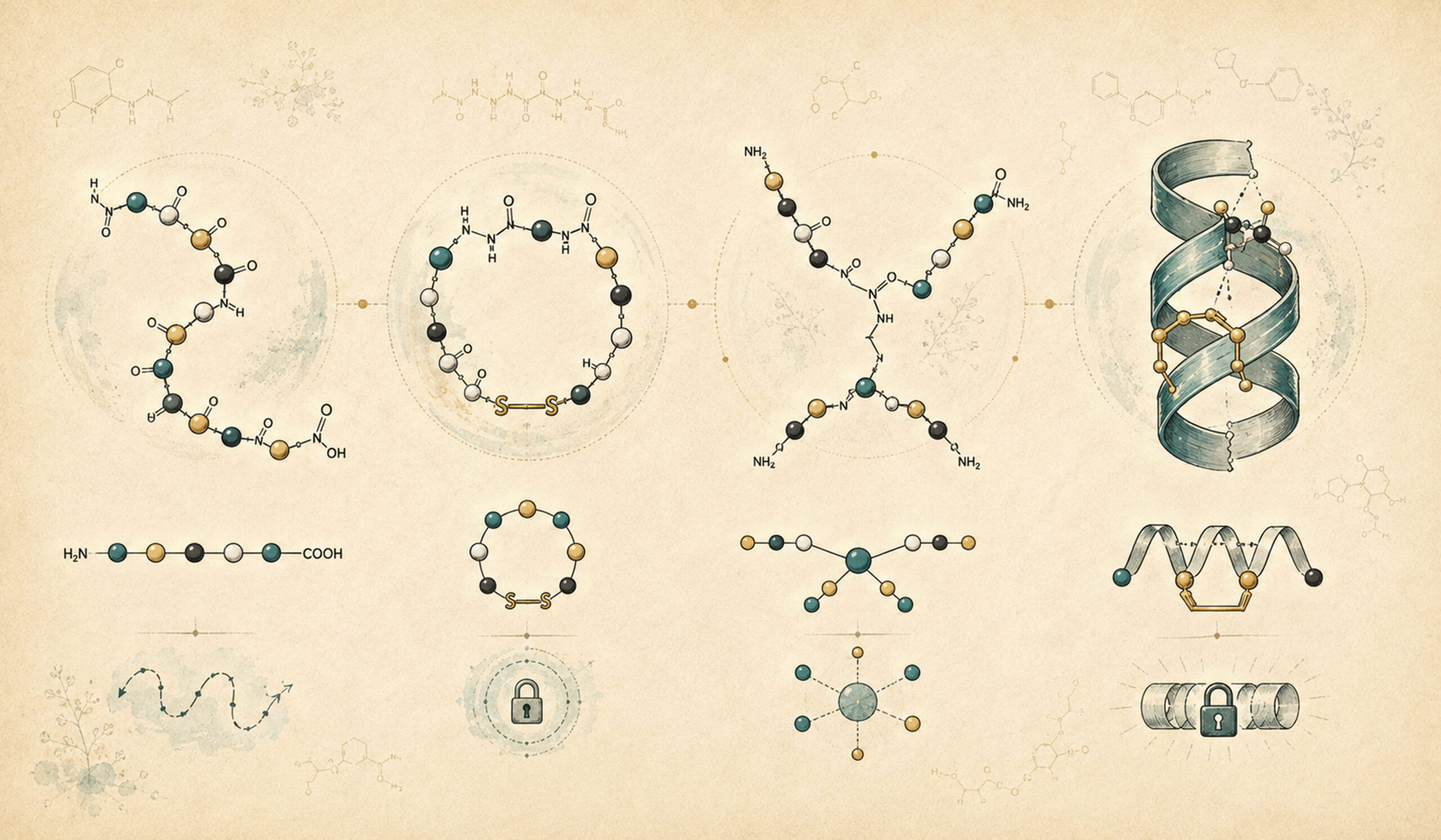
The four classes differ in how the backbone is arranged, and those differences drive stability, protease resistance and how hard the peptide is to make. The table sets them side by side.
| Linear | Cyclic | Branched | Stapled | |
|---|---|---|---|---|
| Backbone arrangement | A single chain with free N and C termini. | The chain closed into a ring, head to tail or through side chains. | A main chain with one or more chains attached at a side chain. | A linear chain with a synthetic cross-link bridging two positions. |
| Conformational freedom | Highest. Many accessible conformations in solution. | Constrained by the ring closure. | Intermediate, depending on branch position and length. | Constrained toward a helical conformation by the staple. |
| Protease resistance | Lowest, with accessible termini and backbone. | Generally higher, since closure removes the free termini exopeptidases act on. | Variable. | Generally higher than the corresponding linear sequence. |
| Synthesis difficulty | Lowest. Standard stepwise solid-phase synthesis. | Higher. Cyclization is an additional step with its own yield and purification burden. | Higher. Orthogonal protection is needed to build the branch. | Highest. Requires non-natural residues and a cross-linking step. |
| Typical research context | The majority of research peptides, including most compounds on this site. | Studied where stability or conformational constraint matters. | Less common, used where multivalency is the point. | Studied where a helical conformation needs to be enforced. |
Cyclization is the most common of these strategies and the macrocyclic peptide literature is where most of the comparative work sits (Angew Chem Int Ed Engl, 2024; PMID 37870189). The backbone chemistry underlying every class is covered in how peptide backbone geometry constrains structure, how those differences translate into activity in how structure determines activity, how each class is actually made in how solid-phase synthesis handles cyclic and stapled peptides, and how class affects behavior in solution in predicting solubility by structural class. Compounds are indexed in the peptide reference library.
Linear peptides are the simplest topology and the largest single class of research peptides. Most growth hormone secretagogues (Ipamorelin, GHRP-2, GHRP-6, Sermorelin, CJC-1295), most healing peptides (BPC-157, KPV), and most bioregulators (Cartalax, Vilon, Livagen, Vesugen) are linear.
A linear peptide has a free alpha-amino group at the N-terminus and a free alpha-carboxyl group at the C-terminus. The chain is built one residue at a time during SPPS, with the C-terminus anchored to the resin and the N-terminus extended in successive coupling cycles.
Common end-group modifications include N-terminal acetylation (replacing the free amine with an acetamide, removing the positive charge) and C-terminal amidation (replacing the free carboxyl with a carboxamide, removing the negative charge). Both modifications improve protease resistance at the termini and adjust the overall charge of the peptide.
Linear peptides are easy to synthesize, easy to characterize, and accommodate a wide range of sequence modifications. They sample a large conformational space in solution, which can be useful for exploratory research where the active conformation is not yet known.
The flexibility that makes linear peptides easy to characterize also makes them susceptible to proteolytic degradation. Aminopeptidases attack the N-terminus, carboxypeptidases attack the C-terminus, and endopeptidases attack internal bonds. Without modification, many linear peptides have circulating half-lives in animal model studies measured in minutes (Werle and Bernkop-Schnürch, 2006; PMID 17034591).
Also read: Peptides: A Comprehensive Research Reference Guide for Lab Scientists
Cyclic peptides close the chain through a covalent linkage, removing one or both free termini and locking some of the conformational freedom of the molecule.
Head-to-tail cyclization joins the alpha-amino group of the N-terminus to the alpha-carboxyl group of the C-terminus, creating a closed backbone loop. The result is a peptide with no free termini and a single dihedral angle removed from the conformational manifold.
Examples include cyclic tetrapeptides studied as histone deacetylase research probes, gramicidin S (a natural cyclic decapeptide antibiotic with antimicrobial mechanism studied in research), and tyrocidine. Synthetic head-to-tail cyclization is typically performed under high-dilution conditions to minimize intermolecular oligomerization.
Side-chain cyclization uses a reactive side chain (most commonly a cysteine, lysine, glutamate, or aspartate) to form a covalent linkage to the backbone or to another side chain. The free termini are typically retained, allowing further chemistry.
A common design uses a lysine side chain amine and a glutamate side chain carboxyl to form an intramolecular amide bond, creating a lactam bridge that locks a particular conformation while leaving the N-terminus and C-terminus free.
Disulfide bridges between cysteine residues are among the most common cyclization motifs in nature. Oxytocin and vasopressin both contain a single intrachain disulfide that cyclizes the first six residues. Conotoxins, which have been studied as research probes for various ion channels, often contain two or three disulfide bridges that lock complex three-dimensional structures (Lewis et al., 2012; PMID 22383759).
Cyclization provides three main benefits. First, the peptide is more resistant to proteolysis because the closed structure presents fewer accessible bonds to peptidases. Second, the locked conformation often pre-organizes the peptide for binding, reducing the entropic penalty on receptor engagement and improving binding affinity. Third, cyclic peptides often show improved selectivity for one receptor subtype over another, because the rigid structure cannot adapt to alternative binding pockets.
Branched peptides carry two or more chains attached to a common core. The core is most often a lysine residue, where the alpha amine and the side chain epsilon amine each provide an attachment point.
A lysine branch point can host two separate peptide chains. The alpha amine extends one chain, and the side chain epsilon amine extends another. Multi-antigenic peptides, used in research immunology to display multiple epitopes on a single molecule, exploit this geometry.
Branched peptides can display different ligand motifs on different arms. This is useful for studying multivalent receptor engagement, where simultaneous binding of two or more sites can produce avidity effects greater than the sum of individual interactions. The design is also useful for exploratory research where two pharmacophores are combined into a single molecule for proof-of-concept studies.
Dendrimers are highly branched polymers where each generation of branching multiplies the number of terminal groups. Peptide dendrimers can present dozens of identical or different peptide motifs on a single molecule, which has applications in antimicrobial research, vaccine design (research context), and drug delivery research (Crespo et al., 2005; PMID 16283819).
Stapled peptides use a hydrocarbon staple to lock an alpha-helical conformation. The strategy was introduced in the early 2000s and has become an important tool for designing peptides that engage intracellular protein-protein interactions.
The most common stapling chemistry uses ring-closing olefin metathesis. Two non-natural amino acids carrying alkene side chains are placed at positions i and i+4 (one helical turn apart) or i and i+7 (two helical turns). After SPPS, ring-closing metathesis joins the two alkenes into a hydrocarbon ring that staples the helix in place (Schafmeister et al., 2000; PMID 11041467).
Alternative stapling chemistries include thioether-based cross-links (using cysteine and an alpha,omega-dihalide reagent), triazole-based cross-links (using click chemistry), and disulfide-based cross-links.
Also Read: Solid-Phase Peptide Synthesis (SPPS): How Research Peptides Are Manufactured?
The hydrocarbon staple constrains the peptide to a high-helical-content conformation in solution. This reduces the entropic penalty on receptor binding, often producing substantial improvements in binding affinity for protein-protein interaction targets where the natural binding partner adopts a helical conformation.
Stapled peptides are more resistant to proteolysis than the corresponding linear sequences because the stable helical conformation makes the backbone less accessible to peptidases. Some stapled peptides also show improved cell penetration in animal model studies, possibly due to the increased lipophilicity of the hydrocarbon staple.
Beyond topology, several chemical modifications expand the design space.
D-amino acids are the mirror images of the standard L-amino acids. They have identical physical properties but different stereochemistry, and most natural proteases recognize only L-residues. Substituting one or more residues with their D-enantiomers improves protease resistance, sometimes dramatically.
The trade-off is that the substitution may also alter binding to a target receptor, since the receptor binding pocket is typically L-selective. D-substitutions are most often used at the N-terminus or C-terminus, where they protect against amino- and carboxypeptidases without disrupting the central binding determinants.
Pseudoprolines are oxazolidine or thiazolidine derivatives of serine, threonine, or cysteine that adopt a proline-like ring structure. When incorporated into a peptide during SPPS, they disrupt secondary structure formation that can stall difficult couplings. Pseudoproline dipeptides are commercially available SPPS building blocks and are widely used to improve crude purity for difficult sequences.
Peptide nucleic acids (PNA) replace the sugar-phosphate backbone of DNA with a peptide-like backbone, producing a hybrid molecule that hybridizes to DNA and RNA with high specificity. PNAs are useful research probes for nucleic acid hybridization studies. Other synthetic backbone alternatives (beta-peptides, peptoids, aza-peptides) have been explored for various research applications.
The choice of structural class depends on the research question.
In general, the order of proteolytic stability is roughly: stapled > cyclic (especially disulfide-rich) > head-to-tail cyclic > side-chain cyclic > linear with end-group modifications > linear without modifications. Specific sequences may deviate from this general order due to local structure or specific protease susceptibility.
Structural rigidity often improves selectivity but may decrease affinity for one or more targets. The relationship is sequence-specific. For research peptides intended to probe a single well-characterized receptor, a constrained structure (cyclic or stapled) is often preferred. For exploratory work on a poorly characterized target, a flexible linear peptide may be a better starting point.
A practical decision tree:
Also read: Browse verified peptide lab reports (COAs)
Cyclic peptides are more resistant to proteolysis, often show improved selectivity for their target receptor, and benefit from a pre-organized binding conformation that reduces the entropic penalty on engagement. The trade-off is more complex synthesis. For research peptides intended for animal model studies, the protease resistance of cyclic forms often outweighs the synthetic effort.
Head-to-tail cyclization connects the C-terminal carboxyl group to the N-terminal amine directly, closing the backbone into a loop with no free termini. Side-chain cyclization links a side chain functional group (cysteine thiol, lysine amine, glutamate carboxyl) to the backbone or to another side chain, creating an internal loop while retaining the free termini.
Yes. Stapled peptides require non-natural amino acids carrying alkene or thiol side chains, plus an additional cross-linking step (typically ring-closing metathesis) after the linear sequence is assembled. The synthesis is more expensive and requires specialized expertise, but the resulting peptides often show dramatically improved stability and receptor binding for protein-protein interaction targets.
Yes. By design, a branched peptide can display different ligand motifs on different arms, enabling simultaneous engagement of multiple receptor subtypes. This is useful for exploratory multivalent receptor research and for proof-of-concept studies that combine two pharmacophores into a single molecule.
D-amino acids are mirror images of the natural L-amino acids. Most proteases recognize only L-residues, so D-substitutions improve protease resistance, sometimes dramatically. The trade-off is potential reduction in receptor affinity if the binding pocket is L-selective, so D-substitutions are most often used at the N-terminus or C-terminus where they protect against amino- and carboxypeptidases without disrupting central binding determinants.
A cyclic peptide has its backbone closed into a ring, either head to tail or through side-chain linkages. Closure removes the free termini that exopeptidases act on and constrains the conformations available, which is why cyclic analogues are studied where stability or conformational constraint matters.
A stapled peptide is a linear sequence carrying a synthetic cross-link between two positions, typically enforcing a helical conformation. It requires non-natural residues and a cross-linking step, making it the most demanding of the common structural classes to synthesize.
Linear peptides have accessible termini and backbone and are the least protease-resistant. Cyclic peptides are generally more resistant because closure removes the free termini. Stapled peptides are generally more resistant than the corresponding linear sequence. Branched peptides vary with branch position.
Research-only disclaimer. The peptides described in this article are sold and discussed for laboratory and research purposes only. They are not intended for human consumption, diagnostic use, or therapeutic application.
Educational notice. This article is for educational and informational purposes only and is intended for licensed researchers and laboratory professionals. The peptides discussed are research chemicals sold for laboratory and research applications. They are not intended for human consumption, diagnostic use, or therapeutic application.


