
Cart

Oops, your cart is still empty
Looks like you haven’t added anything yet. Start exploring our products and find what you need.
Research use only. The peptides discussed on this page are research-grade reference materials for laboratory use only, not for human or veterinary use. This page covers sequence chemistry, not preparation.
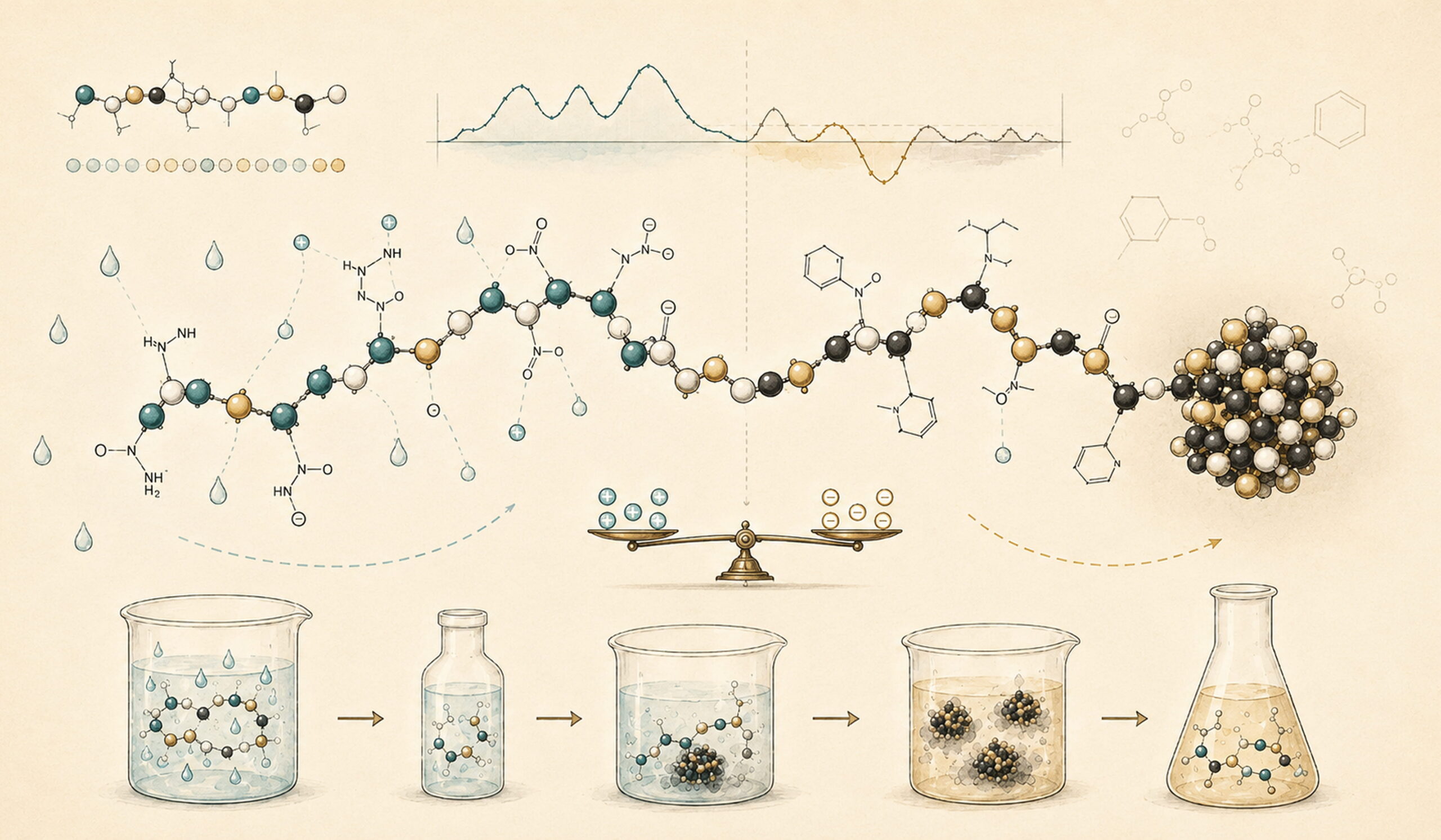
Peptide solubility, determined by amino acid composition, shapes experimental design and reproducibility in research peptide work. A peptide that does not dissolve cleanly will not produce reliable assay results. This article explains how solubility and aggregation behavior follow from sequence chemistry, and which sequence properties predict them.
Also Read: https://peptides.com/blog/what-are-peptides/
Each amino acid residue contributes to the overall solubility of the peptide based on its side chain chemistry.
Hydrophobic residues include leucine, isoleucine, valine, methionine, phenylalanine, tryptophan, alanine, and proline. Their side chains are nonpolar and interact poorly with water. Peptides with high hydrophobic residue content tend to be poorly water soluble.
Tryptophan adds an aromatic character that further reduces water solubility, and it can also drive specific aromatic stacking interactions in solution. Phenylalanine and tyrosine sit between fully hydrophobic and partially polar; tyrosine in particular has a hydrogen bonding hydroxyl that improves water tolerance.
Charged residues (aspartate, glutamate, lysine, arginine, histidine in some pH ranges) and polar uncharged residues (serine, threonine, asparagine, glutamine, tyrosine, cysteine) favor water solubility. Their side chains form hydrogen bonds with water and, for the charged residues, electrostatic interactions with water dipoles.
Arginine and lysine carry positive charges at neutral pH; aspartate and glutamate carry negative charges. The balance of positive and negative charges determines the overall ionic character of the peptide and shapes its solubility profile.
Every peptide has an isoelectric point (pI), the pH at which the net charge is zero. At the pI, peptides have minimal solubility because intermolecular electrostatic repulsion (which normally keeps molecules separated in solution) is at its weakest. Working at pH values one or two units away from the pI usually improves solubility.
The pI can be estimated from the sequence using freely available calculators. For peptides rich in basic residues (lysine, arginine), the pI is high (often 9 to 12), and the peptide is most soluble at neutral or acidic pH. For peptides rich in acidic residues (aspartate, glutamate), the pI is low (often 3 to 5), and the peptide is most soluble at neutral or basic pH.
Several quantitative measures of peptide hydrophobicity have been developed to support sequence-based solubility prediction.
The GRAVY score is the average hydropathy of all residues in the peptide, computed using the Kyte-Doolittle hydropathy scale (Kyte and Doolittle, 1982; PMID 7108955). Negative GRAVY values indicate net hydrophilic character and predict water solubility. Positive GRAVY values indicate net hydrophobic character and predict reduced water solubility.
A GRAVY score below approximately minus 0.4 generally predicts good water solubility. A score above approximately plus 0.5 predicts likely water insolubility.
Beyond a single GRAVY score, the Kyte-Doolittle hydropathy profile shows the local hydrophobicity at each position in the sequence using a sliding window (typically 9 residues). Profiles with prolonged stretches of high hydrophobicity (such as transmembrane segments) indicate sequences that are likely to aggregate in aqueous systems.
Computational predictions are useful starting points but have well-known limitations. They do not account for secondary structure formation (an amphipathic helix may be soluble even if the bulk hydrophobicity is high), they do not account for aggregation propensity (some sequences with moderate GRAVY scores aggregate strongly due to specific beta-sheet formation), and they do not account for the effects of post-translational modifications. Empirical solubility testing is always advisable before designing critical experiments.
Many biologically active peptides are amphipathic, with hydrophobic and hydrophilic residues distributed in a regular pattern that creates separate hydrophobic and hydrophilic faces.
In an alpha helix, residues at positions i, i+3, i+4, and i+7 lie on the same face of the helix. Sequences where hydrophobic residues cluster at i, i+4, i+7 (or similar patterns) form helices with a clear hydrophobic face on one side and a hydrophilic face on the other. Antimicrobial peptides such as LL-37, magainins, and many other natural cationic amphipathic peptides exploit this geometry to interact with bacterial membranes.
Amphipathic peptides can aggregate even when the overall sequence appears reasonably soluble. The mechanism is hydrophobic surface-to-hydrophobic surface interaction between molecules, which produces dimers, oligomers, or larger aggregates with the hydrophobic surfaces buried internally and the hydrophilic surfaces exposed to water. This effect is the basis for self-assembly of amphipathic peptides into nanostructures and is well documented for several research peptide families.
Aggregation is the most common manifestation of poor solubility and one of the most common research peptide handling problems.
Aggregation typically begins as a transient association of hydrophobic surfaces. For peptides prone to beta-sheet formation, the initial association can ripen into ordered beta-aggregates with extensive hydrogen bonding between strands. Once formed, beta-aggregates are difficult to reverse, which is why aggregation propensity is treated as a sequence property to predict rather than a condition to correct.
Size exclusion chromatography (SEC) separates molecules by size and reveals oligomeric or aggregated forms as peaks at higher apparent molecular weight than the monomer. Dynamic light scattering (DLS) measures the size distribution of particles in solution and is sensitive to small populations of larger aggregates. Both methods are routinely used to characterize the aggregation state of research peptides in solution.
Aggregation is the common failure mode for peptides that do not dissolve cleanly, and it is a property of the sequence rather than of handling. Sequences with a high proportion of hydrophobic residues, and particularly those with a strong beta-sheet propensity, tend to associate with one another rather than with the aqueous environment. Net charge close to zero removes the electrostatic repulsion that would otherwise keep molecules apart, which is why sequences near their isoelectric point are the most aggregation-prone. Structural class shapes this behavior too, covered in linear, cyclic, branched and stapled peptide classes, and a worked on-site case is set out in GHK-Cu stability and analytical chemistry.
Prediction from sequence is therefore possible in outline. Calculate net charge at the working pH, look at the balance of hydrophobic to charged residues, and check for extended runs of hydrophobic residues or known aggregation-prone motifs.
Where a sequence is predicted to behave poorly, the parameters used to work with it are defined by the published methodology of the study being followed and by the receiving laboratory’s validated procedures. Reconstitution means returning a lyophilized compound to solution. What the supplied certificate records is explained in reading a peptide certificate of analysis.
| Sequence property | How it is assessed | What it indicates |
|---|---|---|
| Net charge at working pH | Calculated from the sequence and the pKa values of ionizable side chains. | The single most useful predictor. Charge well away from zero favors solubility. |
| Isoelectric point | Calculated from the sequence. | A working pH close to the pI is the condition most associated with poor solubility. |
| Hydrophobic residue fraction | Proportion of Leu, Ile, Val, Phe, Trp, Met and Ala in the sequence. | A high fraction predicts poorer aqueous behavior. |
| GRAVY score | Grand average of hydropathy, calculated across the sequence. | A single summary number for overall hydropathy. Useful for comparing sequences, less useful in isolation. |
| Beta-sheet propensity | Assessed from residue composition and prediction tools. | High propensity is associated with aggregation rather than dissolution. |
| Sequence length | Direct. | Longer sequences have more opportunity for intramolecular structure and for aggregation-prone stretches. |
Material is supplied in lyophilized research vials and listed in the research peptide catalog.
GRAVY (Grand Average of Hydropathy) is a computational score equal to the average hydropathy of all amino acids in the sequence using the Kyte-Doolittle scale. Negative GRAVY values predict net hydrophilic character and good water solubility. Positive GRAVY values predict net hydrophobic character and may require organic cosolvent. The score is a starting point; experimental solubility testing is always advisable.
The isoelectric point is the pH at which the peptide carries zero net charge. At this pH, intermolecular electrostatic repulsion is at its weakest and solubility is at a minimum. Working at pH one or two units away from the pI generally improves water solubility by giving the peptide a net charge.
Aggregation is driven by sequence composition. A high proportion of hydrophobic residues, extended hydrophobic runs, and a strong beta-sheet propensity all favor peptide molecules associating with each other rather than with the aqueous environment. Net charge near zero removes the electrostatic repulsion that would otherwise keep them apart, which is why sequences near their isoelectric point are the most aggregation-prone.
Net charge at the working pH, calculated from the sequence, is the most useful single predictor. The balance of hydrophobic to charged residues and the beta-sheet propensity of the sequence are the next considerations. Sequences with a working pH near their isoelectric point are the most likely to dissolve poorly.
Research-only disclaimer. The peptides described in this article are sold and discussed for laboratory and research purposes only. They are not intended for human consumption, diagnostic use, or therapeutic application.
Educational notice. This article is for educational and informational purposes only and is intended for licensed researchers and laboratory professionals. The peptides discussed are research chemicals sold for laboratory and research applications. They are not intended for human consumption, diagnostic use, or therapeutic application.


