
Cart

Oops, your cart is still empty
Looks like you haven’t added anything yet. Start exploring our products and find what you need.
Research use only. GHK-Cu is supplied as a research-grade reference compound for laboratory use only. It is not for human or veterinary use.
The behavior of GHK-Cu in research depends on proper coordination between the tripeptide backbone and copper(II). Spectroscopic and chemical characterization are therefore essential for verifying identity, confirming copper loading, and understanding storage stability. This article covers the coordination chemistry, characterization methods, and stability considerations for GHK-Cu, complementing the mechanistic detail in the GHK-Cu wound-healing pathway post.
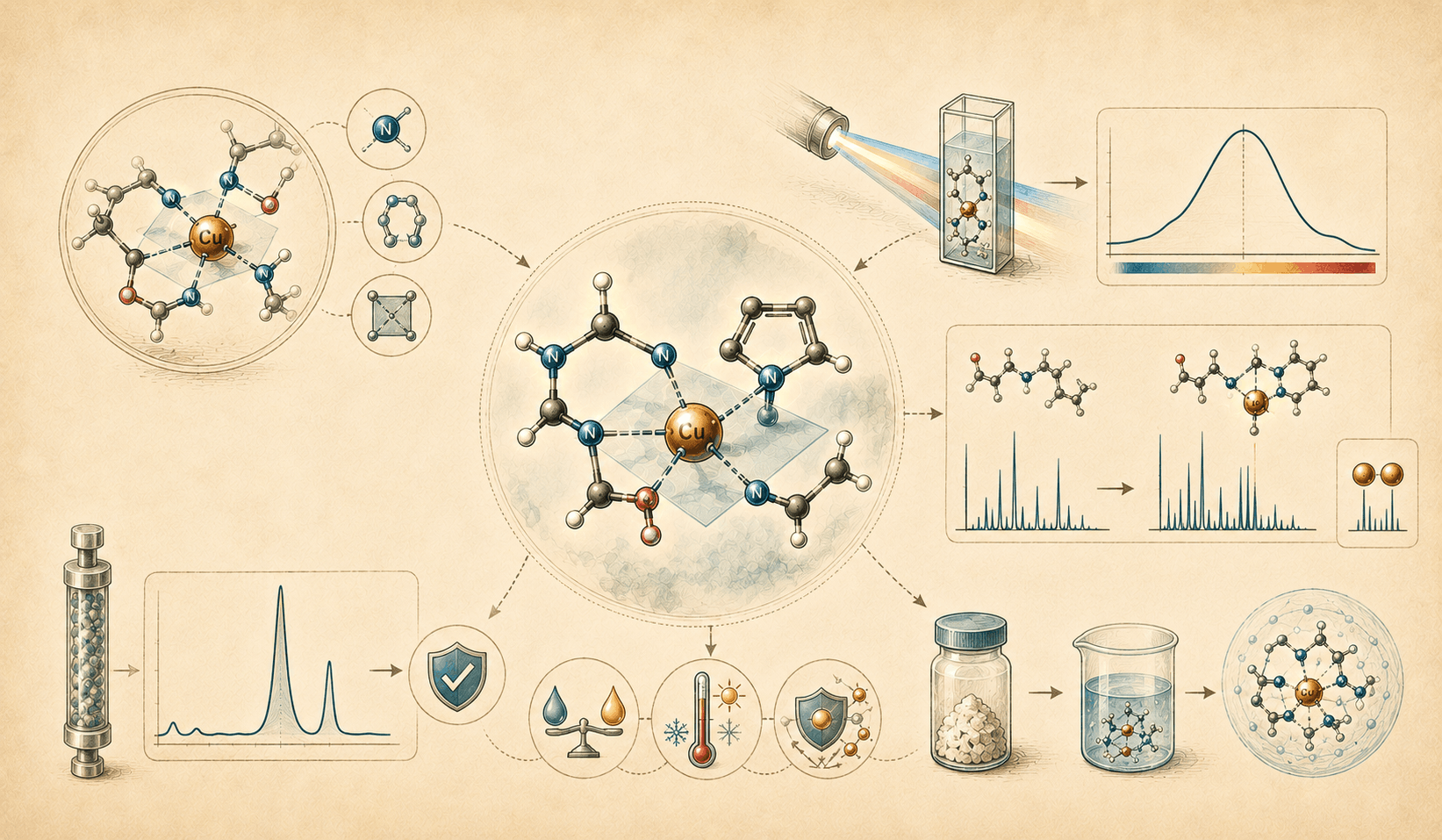
GHK binds copper(II) through a set of donor atoms contributed by the tripeptide: the imidazole nitrogen of the histidine side chain, the deprotonated amide nitrogen of the backbone, and the terminal amine. This tridentate arrangement, completed at the remaining coordination position by solvent or an additional ligand, gives the square-planar or square-pyramidal geometry reported in the structural literature.
The comparison most often drawn is with the DAHK motif from serum albumin, which binds copper through a related but distinct donor set. X-ray and solution structures of both complexes have been determined and the differences in donor arrangement account for their differing affinities and spectroscopic signatures (Chemistry, 2011; PMID 21780203). The original characterization of the complex dates to the early 1980s (Biochem J, 1981; PMID 7340824; Biochemistry, 1982; PMID 6291585), and computational work has since examined the binding in more detail (Comput Biol Chem, 2020; PMID 32371360). Molecular identity data is set out in the GHK-Cu chemical reference data, and sequence-level solubility behavior is covered in predicting peptide solubility from sequence.
The copper complex is distinguishable from free GHK by absorption spectroscopy. The table sets out the features reported in the coordination chemistry literature and what a shift in each indicates.
| Spectroscopic feature | What it arises from | What a change indicates |
|---|---|---|
| Visible-region d-d absorption | Ligand-field transitions of the coordinated Cu(II) center. This band gives the complex its color. | A shift in band position reflects a change in the donor set or geometry around the copper. |
| Ultraviolet charge-transfer absorption | Ligand-to-metal charge transfer, sensitive to the coordinating atoms. | Loss or shift indicates altered coordination, including displacement of the amide nitrogen. |
| Circular dichroism in the d-d region | Chirality of the peptide ligand transmitted to the metal center. | Sign and intensity changes track the coordination mode. |
| Mass spectrometry | Molecular mass of the intact complex, including the copper isotope pattern. | Confirms whether copper is retained in the species being measured. |
Absorption features in the coordination literature are reported against the specific pH, buffer and concentration used, because the coordination equilibrium is pH-dependent. Comparative work on GHK and its synthetic analogues sets out how the donor set changes across pH ranges (Biochim Biophys Acta, 2001; PMID 11325542).
Verifying a copper peptide complex requires more than verifying the peptide. Reversed-phase HPLC establishes chromatographic purity, and mass spectrometry establishes identity, but for a complex the analysis also has to confirm that copper is present in the expected stoichiometry rather than assuming it from the peptide result. Where a certificate reports copper content or elemental analysis, that is the figure establishing the complex rather than the free peptide. Reading a peptide certificate of analysis covers each determination, and the certificates themselves are published in our published lab reports. The pathway literature for this compound is covered in GHK-Cu wound healing pathway research, and related compounds are indexed in the peptide reference library.
GHK-Cu is supplied as a lyophilized powder in a sealed vial. Store the sealed vial frozen at -20 degrees Celsius or colder and shield it from light, since the copper complex has visible-region absorption and photochemical sensitivity is a general consideration for copper coordination compounds. Avoid repeated freeze-thaw cycling of the container, and allow a cold vial to reach room temperature before opening so that atmospheric moisture does not condense onto the powder.
The dry state limits the molecular mobility that would otherwise promote copper dissociation or oxidation, which is why the material is supplied lyophilized. Stability duration for a given lot is documented on its certificate of analysis, and the compound is supplied in GHK-Cu research vials.
Reconstitution means returning a lyophilized compound to solution. Solution conditions for a given experiment are defined by the published methodology of the study being followed and by the receiving laboratory’s validated procedures.
UV-visible spectroscopy is the most practical tool. The complexed form shows a characteristic copper d-d absorption band that is absent for the free peptide and different for free copper. Mass spectrometry provides confirmation, since the copper complex has a distinct mass and the characteristic copper isotope pattern. A complete certificate of analysis should document copper loading.
GHK-Cu can come out of solution under conditions that destabilize the complex or reduce solubility, including certain pH ranges, high concentrations and the presence of competing ligands. Solution conditions for a given experiment are defined by the published methodology being followed. Precipitation is detected by visual inspection and by turbidity measurement.
GHK-Cu refers to the coordination complex of the GHK tripeptide with copper(II). GHK-copper-chloride typically refers to a preparation in which chloride is the counterion associated with the complex. The species described throughout the coordination literature is the peptide-copper complex itself; the counterion primarily affects physical handling and solubility.
The copper(II) center in GHK-Cu has ligand-field transitions that absorb in the visible region, and that absorption is what produces the color of the complex. The band position depends on the donor atoms coordinating the copper, so it shifts if the coordination environment changes.
Reversed-phase HPLC establishes chromatographic purity and mass spectrometry establishes identity, including the copper isotope pattern of the intact complex. Because this is a metal complex rather than a free peptide, the analysis should also confirm copper content, normally by elemental analysis, rather than inferring it.
GHK is the tripeptide glycyl-histidyl-lysine. GHK-Cu is that tripeptide coordinated to a copper(II) ion through the histidine imidazole nitrogen, a backbone amide nitrogen and the terminal amine. The complex has distinct absorption features and different physical behavior from the uncoordinated peptide.
The dry state limits the molecular mobility that promotes copper dissociation and oxidation, so the lyophilized powder is more stable than the same material in solution. Stability duration for a given lot is documented on its certificate of analysis.
Educational notice. This article is for educational and informational purposes only and is intended for licensed researchers and laboratory professionals. GHK-Cu is a research chemical sold for laboratory and research purposes only. It is NOT intended for human consumption, diagnostic use, or therapeutic application.
Research-only disclaimer. GHK-Cu is a research chemical sold for laboratory and research purposes only. It is NOT intended for human consumption, diagnostic use, or therapeutic applicatio.


