
Cart

Oops, your cart is still empty
Looks like you haven’t added anything yet. Start exploring our products and find what you need.
Research use only. GHK-Cu is supplied as a research-grade reference compound for laboratory research use only, not for human or veterinary use. This page summarizes published literature and makes no claim about outcomes in people.
GHK-Cu is the tripeptide glycyl-histidyl-lysine coordinated to a copper(II) ion. The peptide sequence occurs in human plasma and in the extracellular matrix, and the copper complex is the form studied in most of the published work. Research on it concentrates on gene expression associated with matrix remodeling, on collagen synthesis in fibroblast culture, and on copper coordination chemistry.
This article sets out that literature by the type of system it was generated in, because in vitro, animal-model and published human work carry different weight and are frequently blurred together when this compound is summarized elsewhere. The analytical and coordination side is covered in GHK-Cu coordination chemistry and stability. This article is part of a broader review of healing and repair peptides.
GHK is a small tripeptide with the sequence glycine-histidine-lysine. It was first identified by Loren Pickart in the 1970s as a factor in human plasma that influenced the behavior of cultured tissue (Pickart and Margolina, 2018; PMID 29986520).
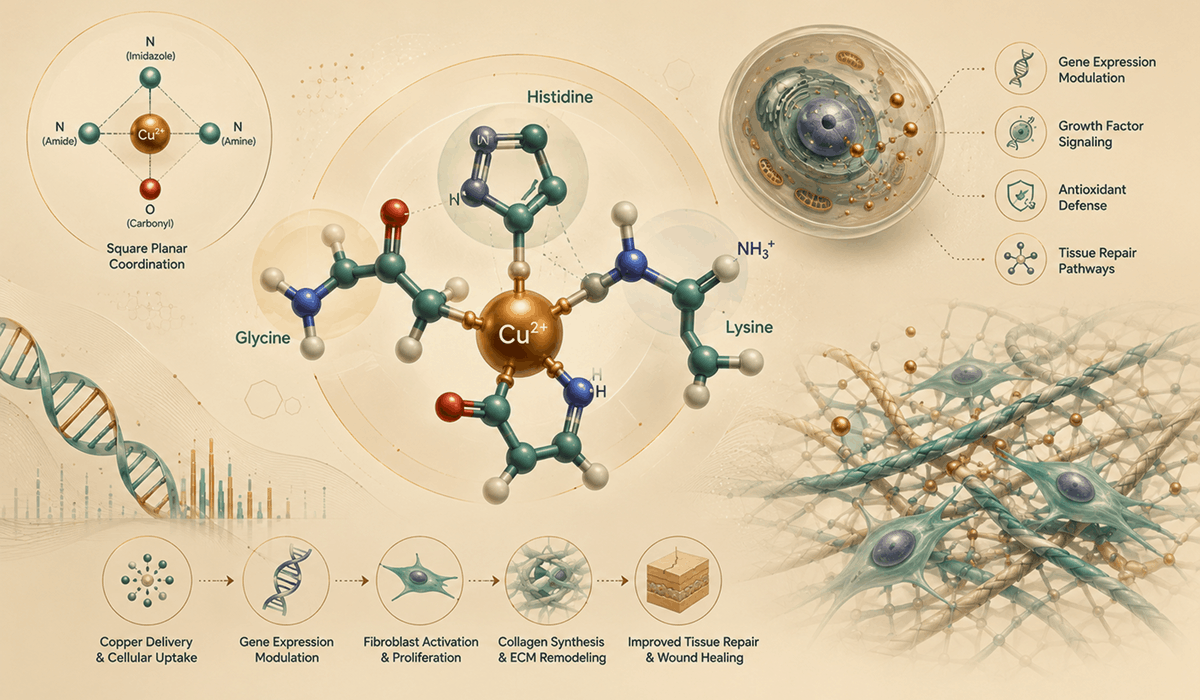
GHK binds copper(II) with high affinity, forming a well-defined coordination complex in which the copper is bound by the terminal amine, the histidine imidazole nitrogen, and a deprotonated amide nitrogen. This produces a square-planar geometry that is characterized spectroscopically. The GHK-Cu spectroscopy and coordination chemistry post covers the metal-binding chemistry in detail.
The free peptide (GHK) and the copper complex (GHK-Cu) are distinct species with different behavior. The copper complex is the biologically relevant form in most of the wound-healing literature, and the copper is not a passive passenger but a functional part of the molecule.
The GHK-Cu complex has specific stability considerations related to copper loading and pH. These are addressed in the companion GHK-Cu coordination chemistry post, which covers the speciation of copper across pH ranges.
One of the most striking features of GHK-Cu in the research literature is its broad effect on gene expression. Transcriptomic studies have reported that GHK modulates the expression of a substantial fraction of the human genome in the direction associated with tissue repair and regeneration (Pickart et al., 2015; PMID 26236730).
GHK-Cu influences pathways associated with growth factor signaling and extracellular matrix remodeling. The copper coordination appears to be important for this activity, which is one reason the complex behaves differently from the free peptide.
Unlike protein growth factors such as VEGF or FGF, which directly bind and activate specific receptor tyrosine kinases, GHK-Cu appears to act through gene expression modulation and copper delivery. The two mechanisms produce overlapping tissue-repair outcomes through different molecular routes. The receptor pharmacology primer provides background on the receptor systems referenced here.
GHK-Cu has documented effects on fibroblast behavior in culture, including effects on proliferation and migration relevant to wound healing (Pickart and Margolina, 2018; PMID 29986520).
A central theme in the GHK-Cu literature is the upregulation of collagen synthesis in cultured fibroblasts and skin models. This effect underlies its extensive study in dermatological research.
GHK-Cu also influences endothelial cell behavior and angiogenesis markers in the research literature, connecting the fibroblast effects to the vascular component of wound healing.
GHK-Cu has been studied in cutaneous wound-closure models across several species. Reported endpoints include epithelialization rate, wound contraction, and collagen deposition (Pickart et al., 2015; PMID 26236730).
The animal-model literature reports effects on collagen deposition and organization consistent with the in-vitro collagen synthesis findings.
GHK-Cu also intersects with the inflammatory and antioxidant components of wound healing, consistent with the antioxidant gene expression effects reported in transcriptomic studies.
GHK-Cu influences the balance of extracellular matrix synthesis and degradation, including effects on matrix metalloproteinases and their tissue inhibitors as reported in the literature. This balance is important for the quality of the healed tissue.
The ratio of collagen types during healing influences the mechanical and structural properties of the repaired tissue, and GHK-Cu’s effects on collagen synthesis connect to this remodeling process.
Copper is not incidental to this literature. It is a cofactor for lysyl oxidase, the enzyme that cross-links collagen and elastin, and the coordination chemistry of the complex determines how copper is held and exchanged, so pathway findings from the wound-healing literature depend on properties established in the coordination literature. Receptor-level context for peptide signaling is covered in receptor pharmacology and peptide binding, and the wider repair cluster in the healing peptides research overview. The compound is supplied in GHK-Cu research vials and as liquid spray preparations, with related compounds indexed in the peptide reference library.
The earliest and most reproducible findings come from fibroblast culture. Stimulation of collagen synthesis in fibroblast cultures by the tripeptide-copper complex was reported in the late 1980s (FEBS Lett, 1988; PMID 3169264), and subsequent work has examined the peptide as a modulator of multiple cellular pathways in skin models (Biomed Res Int, 2015; PMID 26236730). Cell culture establishes that a response occurs in that system and nothing beyond it.
In vivo work in animal models has examined connective tissue accumulation in response to the complex (J Clin Invest, 1993; PMID 8227353), and later material-science work has incorporated the peptide into hydrogel and dressing systems evaluated in animal wound models (Int J Biol Macromol, 2020; PMID 33031852; Biomater Res, 2025; PMID 39902373). In this literature the delivery system and the peptide are studied together, so effects attributed to the construct are not separable from the peptide alone without a matched control.
Published work involving human participants in this field is largely from the cosmetic and dermatological literature rather than from controlled clinical investigation of a medicinal product, and it is limited in size and design. It is described here as published literature. It is not evidence for any product supplied by this site, and no outcome in people is claimed or implied anywhere on this page. A summary reference view is given in the GHK-Cu encyclopedia entry.
A distinct strand of work uses transcriptome analysis rather than a functional endpoint, examining changes in gene expression associated with the peptide (Int J Mol Sci, 2018; PMID 29986520). These are descriptive datasets, and a change in expression is not an outcome. Molecular identity data is set out in the GHK-Cu chemical reference data.
| Study focus | System | Reported observation | Reference |
|---|---|---|---|
| Collagen synthesis | Fibroblast culture | Stimulation of collagen synthesis by the tripeptide-copper complex. | FEBS Lett, 1988; PMID 3169264 |
| Connective tissue accumulation | Animal model, in vivo | Stimulation of connective tissue accumulation in an experimental wound setting. | J Clin Invest, 1993; PMID 8227353 |
| Tissue remodeling | Review of the tripeptide literature | Synthesis of the remodeling literature up to that point. | J Biomater Sci Polym Ed, 2008; PMID 18644225 |
| Cellular pathway modulation | Skin regeneration models | The peptide described as a modulator of multiple cellular pathways. | Biomed Res Int, 2015; PMID 26236730 |
| Gene expression | Transcriptome analysis | Changes in gene expression associated with the peptide, reported descriptively. | Int J Mol Sci, 2018; PMID 29986520 |
| Delivery systems | Animal wound models with hydrogels and dressings | The peptide evaluated within a material construct rather than in isolation. | Int J Biol Macromol, 2020; PMID 33031852; Biomater Res, 2025; PMID 39902373 |
GHK-Cu, BPC-157, and TB-500 act through distinct mechanisms. GHK-Cu delivers copper and modulates gene expression; BPC-157 acts through growth factor receptor and nitric oxide signaling; TB-500 sequesters actin. This mechanistic divergence means the three are complementary research tools rather than interchangeable compounds.
Studies that combine GHK-Cu with other healing peptides are addressed in the healing peptide blend co-administration methodology post, framed strictly in animal-model research terms.
GHK-Cu is fundamentally a copper coordination complex, and the copper is a functional part of the molecule rather than an accessory. The metal coordination is central to the gene expression and signaling effects reported in the literature. BPC-157 and TB-500 are peptide-only compounds that act through receptor signaling and actin binding respectively, mechanisms that do not require a coordinated metal.
GHK-Cu appears to act through modulation of gene expression and delivery of copper, which influence the same downstream pathways that growth factors engage. Rather than binding and activating a receptor directly as a protein growth factor would, GHK-Cu shifts the transcriptional program of the cell toward tissue repair. The two mechanisms converge on overlapping outcomes through different routes.
The free peptide and the copper complex are distinct species with different behavior. Much of the wound-healing literature concerns the copper complex (GHK-Cu), where the copper is functionally important. Researchers should be clear about which species they are studying, since the copper coordination changes the molecule’s properties.
GHK-Cu is supplied as a lyophilized complex in a sealed vial. Store the sealed vial frozen at -20 degrees Celsius or colder, shield it from light, and avoid repeated freeze-thaw cycling of the container. Stability duration for a given lot is documented on its certificate of analysis, and the coordination chemistry behind that behavior is covered in the GHK-Cu coordination chemistry and stability article.
Combination studies involving GHK-Cu appear in the research literature. Experimental design for co-administration studies, including the controls needed to interpret combination effects, is covered in the healing peptide blend co-administration methodology post.
GHK-Cu is the tripeptide glycyl-histidyl-lysine coordinated to a copper(II) ion. The peptide sequence occurs in human plasma and the extracellular matrix, and the copper complex is the form used in most published research on matrix remodeling and collagen synthesis.
Published work describes stimulation of collagen synthesis in fibroblast culture, connective tissue accumulation in animal models, and changes in gene expression associated with matrix remodeling. Findings are reported against the specific system used and are not interchangeable between cell culture, animal models and human literature.
Copper is a cofactor for lysyl oxidase, the enzyme that cross-links collagen and elastin, and the coordination chemistry of the complex determines how the copper is held and exchanged. The pathway literature depends on properties established in the coordination chemistry literature.
Stimulation of collagen synthesis in fibroblast culture was reported in the late 1980s and has been examined repeatedly since. These are cell-culture observations, and they establish that a response occurs in that system rather than an outcome in any organism.
Educational notice. This article is for educational and informational purposes only and is intended for licensed researchers and laboratory professionals. GHK-Cu is a research chemical sold for laboratory and research purposes only. It is NOT intended for human consumption, diagnostic use, or therapeutic application. All scientific claims are referenced to primary peer-reviewed literature.
Research-only disclaimer. GHK-Cu is a research chemical sold for laboratory and research purposes only. It is NOT intended for human consumption, diagnostic use, or therapeutic application.


