
Cart

Oops, your cart is still empty
Looks like you haven’t added anything yet. Start exploring our products and find what you need.
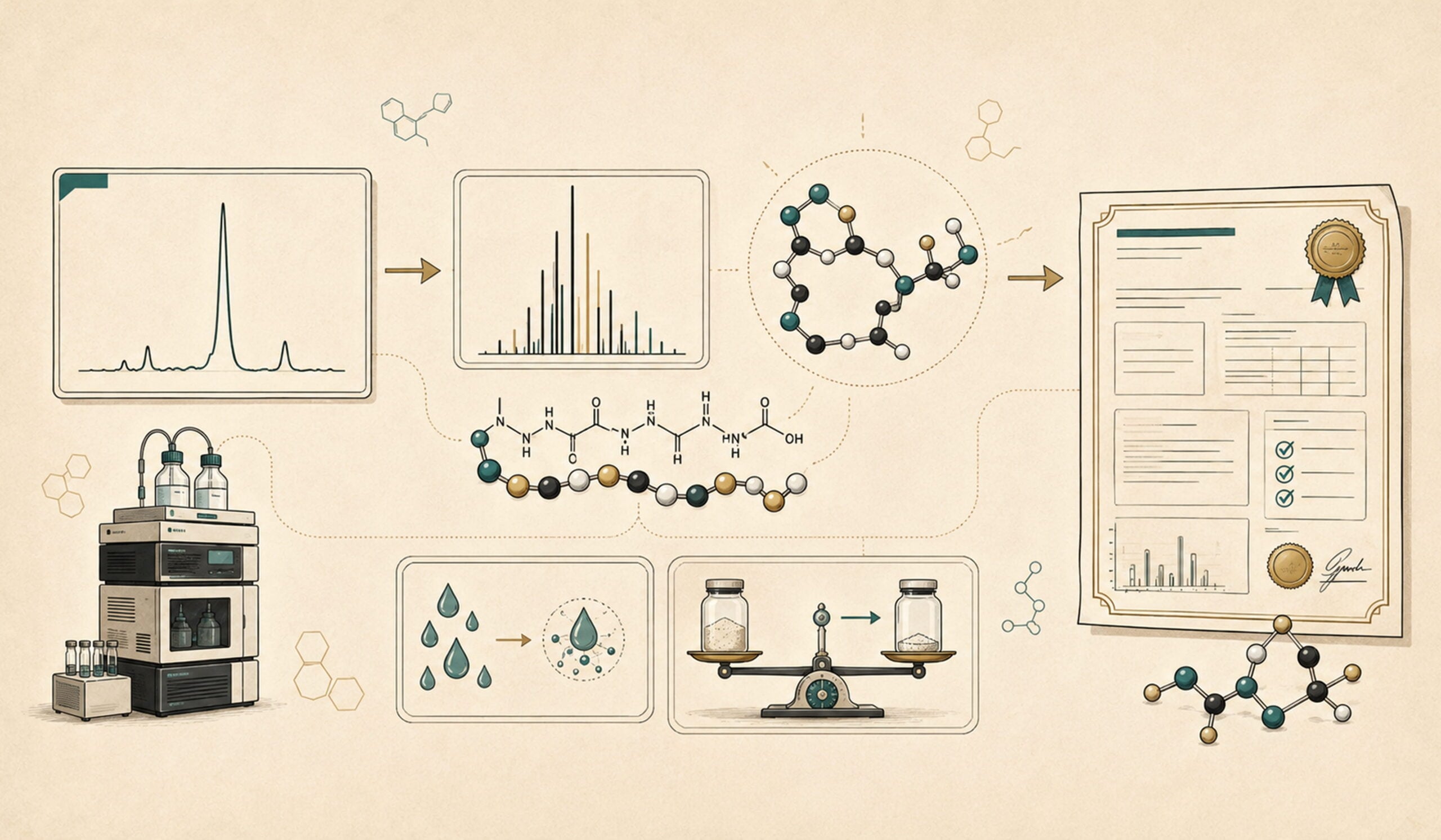
Research use only. The peptides documented by the certificates described here are research-grade reference compounds for laboratory use only, not for human or veterinary use. This guide explains how to read analytical documentation and does not describe preparation or use.
A peptide certificate of analysis, or COA, is the analytical record for one manufactured lot. It states what the material was determined to be, how much of the sample is that material, and which methods produced those determinations. A COA describes the lot it was measured on and nothing else, which is the single most important thing to understand about the document. The certificates for material supplied here are published in our published lab reports.
This guide walks through each section of a research peptide COA, explains what the analytical methods do and do not establish, and sets out the checks worth running before a certificate is accepted at face value.
A COA answers two separate questions that are easy to conflate. Identity asks whether the material is the intended molecule. Purity asks what proportion of the sample that molecule represents. Different methods answer each, and a certificate that reports only one of them is incomplete.
| Question | What answers it | What it does not tell you |
|---|---|---|
| Is this the right molecule | Mass spectrometry, comparing observed mass against the mass calculated from the sequence. Peptide mapping or sequencing where reported. | How much of the sample is that molecule. A correct mass is compatible with a low-purity sample. |
| How much of the sample is that molecule | Reversed-phase HPLC, reported as area percent under defined conditions. | What the remainder is. HPLC purity is a chromatographic measure, not a mass balance. |
| How much of the labeled mass is peptide | Net peptide content, together with water content and counter-ion content. | Nothing about identity or chromatographic purity. These are independent determinations. |
| What the impurities are | Impurity profiling by LC-MS, where the certificate reports it. | Present on many certificates only as a total, without characterization. |
The distinction between chromatographic purity and mass balance is where most misreadings begin. A peptide can be 98 area percent by HPLC and still be well under 98 percent peptide by mass, because water and counter-ion are part of the weighed material but do not appear as chromatographic impurities. Where those impurities come from is a function of the synthesis route, covered in how solid-phase synthesis shapes the impurity profile.
| Reversed-phase HPLC | Mass spectrometry | |
|---|---|---|
| What it measures | Relative peak area of the main component against all detected components | Mass-to-charge ratio of the ionized molecule |
| What it establishes | Chromatographic purity under the stated conditions | Molecular identity, by agreement with the calculated mass |
| What it cannot establish | Identity. A single sharp peak says nothing about which molecule it is. | Purity. Identity confirmation does not quantify the sample. |
| Method detail that changes the result | Column chemistry, gradient, mobile phase, detection wavelength, sample load | Ionization mode, instrument resolution, whether the reported mass is average or monoisotopic |
| Why the method conditions matter | Two laboratories can report different purity for the same lot under different gradients. A figure without its method is not comparable. | An average mass compared against a monoisotopic calculation produces an apparent mismatch that is an arithmetic artifact, not a defect. |
| Reference standard | USP General Chapter <621> Chromatography | USP General Chapter <736> Mass Spectrometry |
Read the two together. Identity without purity, or purity without identity, leaves half the question open.
The sections below appear on most research peptide certificates. Work through them in order, checking each against the others rather than reading any single figure in isolation.
The certificate should name the compound, state the lot or batch number, and give the date of analysis. The lot number is what ties the document to the physical vial. A certificate without a lot number cannot be matched to material and is not usable as documentation.
Usually a short statement such as white to off-white lyophilized powder. Its value is as a first check on arrival: material that does not match its own description is a reason to stop and query the lot before it enters an experiment.
Reported as area percent, and it should be accompanied by the method conditions and ideally by the chromatogram itself. Check that the stated purity is consistent with the trace: a certificate claiming high purity beside a chromatogram showing substantial secondary peaks is an internal contradiction worth raising.
Purity figures belong to the lot they were measured on. A figure quoted as a general property of a product, rather than as the result for a specific certificate, does not describe the material in hand.
The certificate reports the observed mass and, in a well-prepared document, the calculated mass for comparison. Confirm which convention is being used. Average mass and monoisotopic mass differ, and for a peptide of a few thousand daltons that difference is large enough to look like a failure when the two are compared against each other by mistake.
Where sequence confirmation is offered, it will usually be peptide mapping or a sequencing result. Peptide mapping remains the standard approach for confirming sequence in a manufactured product (Int J Mol Sci, 2025; PMID 41155256).
Water content is determined by Karl Fischer titration and reported as a percentage by mass. Its function on the certificate is mass balance: lyophilized peptides are hygroscopic, and the water present is part of the weighed material without being peptide. Water content is therefore one of the terms that converts a weighed quantity into an actual quantity of peptide, alongside net peptide content and counter-ion content. Material is supplied in lyophilized research vials, and the dry form is the reason water content is reported at all.
Net peptide content states what proportion of the material by mass is peptide, as distinct from water, counter-ion and any residual salts. It is typically determined by amino acid analysis or by nitrogen determination. Two certificates can report the same HPLC purity and different net peptide content, and the difference is real material.
Amino acid analysis is the reference approach for this determination and is described in USP General Chapter <1057>. Where a certificate omits net peptide content, the weighed mass cannot be converted into a peptide quantity, and any calculation that depends on it carries that uncertainty. Sequence chemistry also sets how a peptide behaves in solution, covered in predicting peptide solubility from sequence.
Synthetic peptides are usually isolated as salts, most commonly trifluoroacetate from reversed-phase purification, sometimes acetate or hydrochloride after exchange. The counter-ion contributes to the weighed mass and can also affect physical behavior of the material. Consensus work on how trifluoroacetate should be analyzed and reported has been published in response to inconsistent practice across suppliers (Pharmaceuticals, 2025; PMID 40872554), and formulation work has shown that counter-ion identity is process-dependent rather than fixed (Pharmaceutics, 2019; PMID 31569515).
Residual solvent testing reports solvents remaining from synthesis and purification, against limits set in ICH Q3C and USP General Chapter <467>. Not every research peptide certificate includes it. Where it appears, it is an analytical result about the manufactured lot. Bulk material carries the same determinations, listed under raw material specifications.
Where reported, impurity profiling characterizes what the non-target material is rather than only how much of it there is. Structurally related peptide impurities, such as deletion and truncation sequences from synthesis, are the common finding and can be identified by LC-MS approaches (Anal Bioanal Chem, 2022; PMID 35840670). The presence of characterized impurities on a certificate is a sign of a more thorough analytical package, not a defect.
Most certificates from established suppliers are clean. The checks below are the ones worth running when something looks wrong, and each is answerable from the document itself.
A certificate failing one of these is a question to ask the supplier. A certificate failing several is a document that has not been produced from actual analysis of the lot.
There is no single mandated format for a research peptide certificate, so the analytical package differs. Some certificates carry identity, purity, water, net peptide content, counter-ion and an impurity profile. Others carry purity and a mass and nothing further. The practical consequence is that certificates are not directly comparable across suppliers, and a shorter certificate is not evidence of worse material, only of a smaller analytical package. A worked on-site example of this level of documentation is set out in BPC-157 structure, stability and analytical purity.
Published work on commercial synthetic peptides has documented impurity content varying substantially between sources, which is the underlying reason the documentation matters (Clin Vaccine Immunol, 2008; PMID 18077621). Compounds supplied with published certificates are listed in the research peptide catalog.
| Standard | Covers |
|---|---|
| USP General Chapter <621> Chromatography | Chromatographic methods, including the reversed-phase HPLC determinations reported as purity. |
| USP General Chapter <736> Mass Spectrometry | Mass spectrometric methods used for identity confirmation. |
| USP General Chapter <921> Water Determination | Karl Fischer titration, the method behind the water content figure. |
| USP General Chapter <1057> Biotechnology-Derived Articles: Amino Acid Analysis | Amino acid analysis, the reference approach for net peptide content. |
| USP General Chapter <467> Residual Solvents | Residual solvent limits and determination. |
| ICH Q3C Impurities: Guideline for Residual Solvents | The international guideline underlying residual solvent limits. |
| ICH Q6B Specifications | The framework for what a specification and its acceptance criteria should contain. |
A peptide certificate of analysis is the analytical record for one manufactured lot. It states what the material was determined to be, what proportion of the sample is that material, and which methods produced those results. A COA describes only the lot it was measured on.
Read identity and purity as separate questions. Mass spectrometry confirms the molecule by comparing observed against calculated mass. Reversed-phase HPLC reports what proportion of the sample is that molecule, under stated method conditions. Water content, net peptide content and counter-ion content together determine how much of the weighed mass is peptide.
HPLC purity is the relative peak area of the main component against all detected components, under a specific set of chromatographic conditions. It is a chromatographic measure, not a mass balance, and it establishes nothing about identity. A figure reported without its method conditions cannot be compared against another figure.
Net peptide content is the proportion of the material by mass that is peptide, as distinct from water, counter-ion and residual salts. It is usually determined by amino acid analysis. Two lots with the same HPLC purity can have different net peptide content, and the difference is real material.
Lyophilized peptides are hygroscopic, so water is part of the weighed material without being peptide. Water content, determined by Karl Fischer titration, is one of the terms that converts a weighed mass into an actual quantity of peptide, alongside net peptide content and counter-ion content.
Synthetic peptides are usually isolated as salts. Trifluoroacetate is the most common, arising from reversed-phase purification, with acetate or hydrochloride appearing after exchange. The counter-ion contributes to the weighed mass and its identity is process-dependent, so it is reported per lot.
No. Mass spectrometry establishes identity, not purity. A sample can give the correct mass and still contain substantial non-target material, because identity confirmation does not quantify the sample. Purity is a separate determination, normally by reversed-phase HPLC.
There is no single mandated format for a research peptide certificate, so the analytical package varies. Some carry identity, purity, water, net peptide content, counter-ion and an impurity profile; others carry only purity and a mass. Certificates are therefore not directly comparable across suppliers.
Educational notice. This article is for educational and informational purposes only and is intended for licensed researchers and laboratory professionals. All scientific claims are referenced to primary peer-reviewed literature.
Research-only disclaimer. The peptides documented by the certificates described here are research-grade reference compounds for laboratory use only, not for human or veterinary use. This guide explains how to read analytical documentation and does not describe preparation or use.


