
Cart

Oops, your cart is still empty
Looks like you haven’t added anything yet. Start exploring our products and find what you need.
These materials are research-grade reference compounds sold for laboratory research use only. They are not for human or veterinary use.
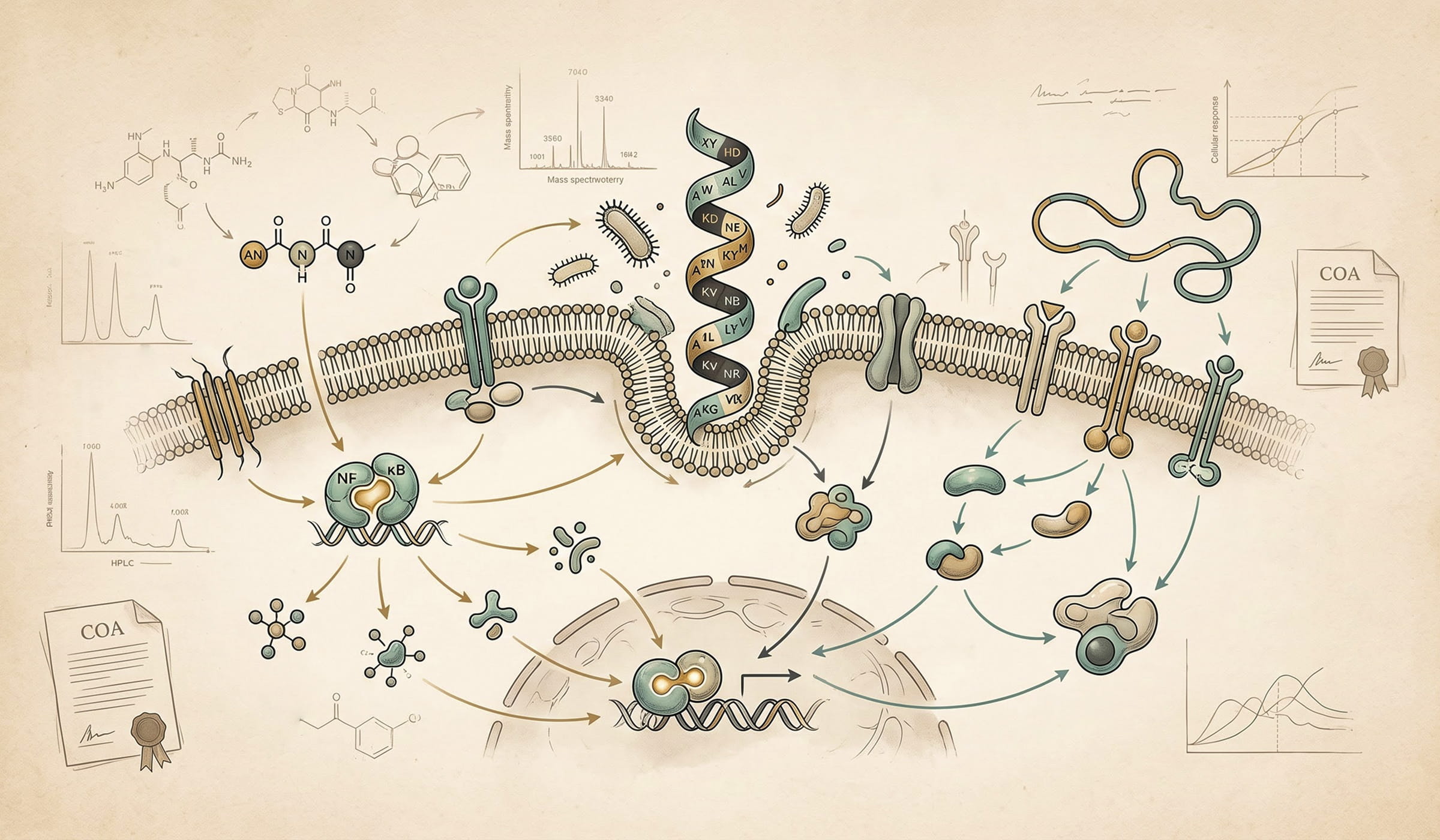
Inflammation is one of the most active areas of peptide research, and several peptides from different families recur in it. They are studied in cell-based inflammation assays and animal models for their effects on inflammatory signaling pathways such as NF-kB, and on immune-cell behavior. This overview maps which peptides appear in that literature, explains the recurring mechanisms, and links to each compound’s reference page. It describes research findings and does not describe treatments for people.
Inflammation research with peptides examines effects on inflammatory signaling pathways, immune-cell function, and tissue responses in defined models. Because inflammation is a shared biological process, peptides from repair, host-defense, and melanocortin-derived families all appear here, which is why the area is best approached as a cross-family research theme rather than a single class.
| Compound | Family / origin | Inflammation-research association |
|---|---|---|
| KPV | Melanocortin-derived tripeptide | NF-κB signaling in intestinal-inflammation models |
| LL-37 | Human cathelicidin | Host-defense and immunomodulatory activity |
| BPC-157 | Gastric pentadecapeptide | Tissue-protective effects in gastrointestinal models |
NF-kB is a central transcription-factor pathway in inflammation. KPV, a melanocortin-derived tripeptide, is studied for effects on this pathway in intestinal-inflammation models, where its uptake and anti-inflammatory signaling have been reported (Dalmasso et al., 2008).
LL-37, the human cathelicidin, is studied as a host-defense peptide with immunomodulatory roles, bridging antimicrobial and inflammation research (Vandamme et al., 2012).
BPC-157 appears in gastrointestinal and tissue-repair models with reported cytoprotective effects that intersect with inflammatory processes (Seiwerth et al., 2021).
Research uses cell-based inflammation assays and animal models, with endpoints such as cytokine signaling, NF-kB activity, immune-cell recruitment, and tissue-level responses. Because the peptides come from different families, the specific assays vary, but the shared thread is inflammatory-pathway biology.
Each compound is verified by HPLC for purity and mass spectrometry for identity, documented on the per-lot Certificate of Analysis. Identity data differ by compound and should be read from each COA.
Store sealed material cold, shield it from light, and avoid repeated freeze-thaw. Lot-specific stability is documented on the COA; current lot reports are on the Lab Reports page.
All of this work is in cell and animal models, and inflammatory-pathway findings in those systems do not establish outcomes in people. Because the peptides come from different families, cross-compound generalizations should be avoided; each is best interpreted within its own primary literature.
KPV, LL-37, and BPC-157 are common examples, each from a different family.
NF-kB signaling and host-defense mechanisms are recurring themes in models.
A melanocortin-derived tripeptide studied for anti-inflammatory signaling, including effects on NF-kB in intestinal models.
No. They are research-model observations, not statements about treating inflammation in people.
Because inflammation is a shared biological process that these peptides intersect with in research, even though they belong to different classes.
By HPLC and mass spectrometry, documented on the per-lot Certificate of Analysis.
Sealed, cold, shielded from light, avoiding repeated freeze-thaw; lot-specific stability is on the COA.
Research-use notice: The peptides described here are research chemicals sold for laboratory research use only. They are not for human or veterinary use. Every finding is reported in the specific research context of the cited study.


