
Cart

Oops, your cart is still empty
Looks like you haven’t added anything yet. Start exploring our products and find what you need.
Research use only. BPC-157 is supplied as a research-grade reference compound for laboratory research use only. It is not for human or veterinary use, and nothing on this page describes a route of administration.
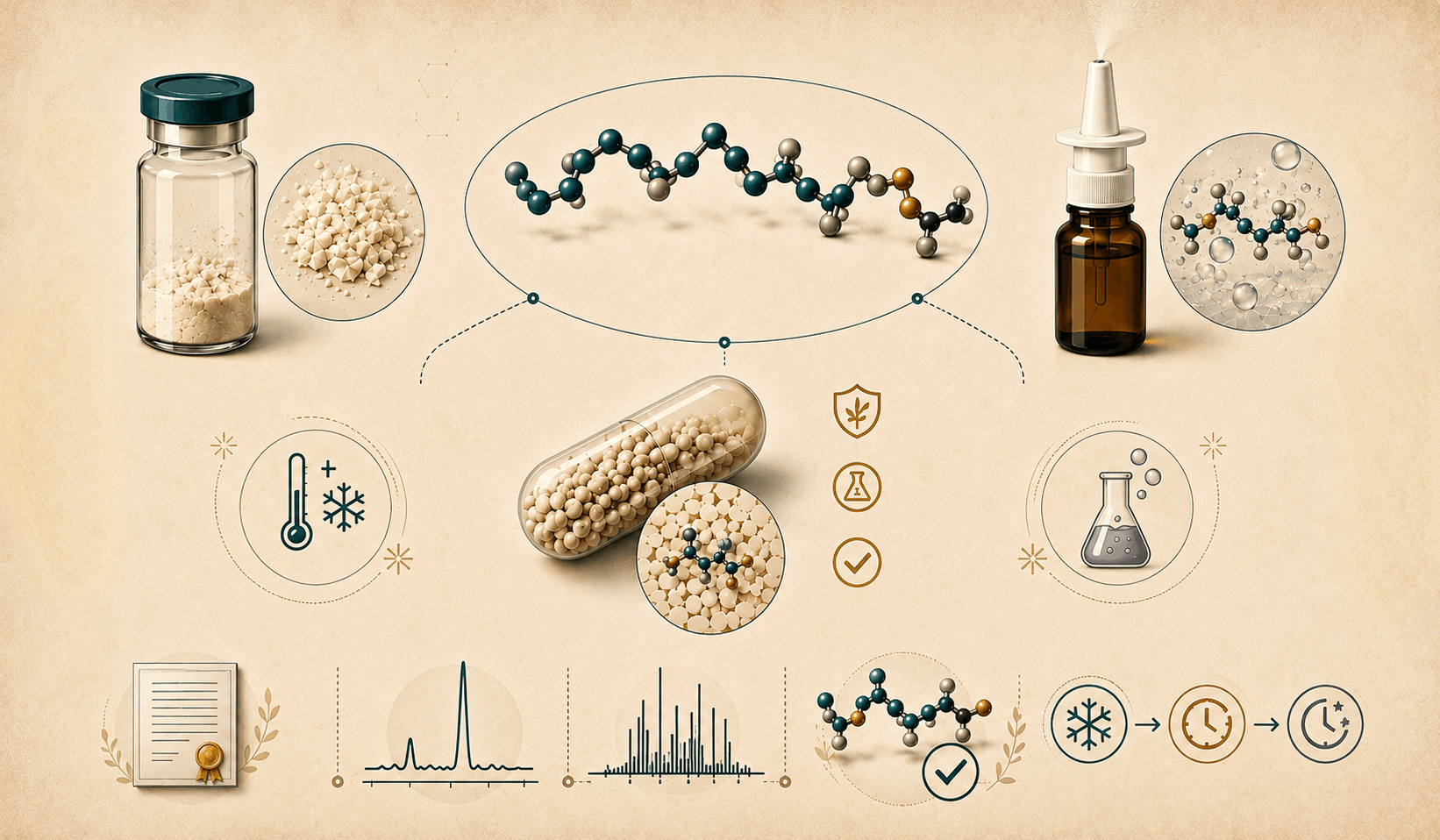
Researchers encountering BPC-157 will find it referenced in several physical formats: lyophilized powder in sealed vials, capsule preparations, and liquid spray preparations, among others. These formats differ in their physical chemistry, their stability, and how they are handled in the laboratory. This article explains those differences in a research context, so that a researcher can understand what each format is and what the practical handling and quality considerations are.
The focus throughout is on the chemistry and handling of the material, not on how any format might be administered. BPC-157 is a research chemical, and this article does not address human use. For the compound’s chemistry and background, see the BPC-157 reference page.
The physical format of a research peptide affects three practical variables: stability (how long the material remains within specification), handling (how it is stored, reconstituted, and measured), and analytical verification (how identity and purity are confirmed). A researcher choosing or receiving a particular format should understand these variables to preserve material quality and experimental reproducibility. The format does not alter the covalent structure of the peptide itself; BPC-157 is the same 15-residue molecule (sequence GEPPPGKPADDAGLV) regardless of how it is packaged.
The most common research format for BPC-157 is a lyophilized powder in a sealed glass vial. Lyophilization (freeze-drying) removes water by sublimation under vacuum, producing a dry powder that is far more stable than the same peptide in solution (Wang, 2000; PMID 10967427).
The lyophilized vial is the reference point for stability. Stored sealed at low temperature, lyophilized peptides retain identity and purity for extended periods, because the dry state slows the hydrolytic and oxidative reactions that degrade peptides in solution (Manning et al., 2010; PMID 20143256). Reconstitution is performed in the laboratory, and the resulting solution has a much shorter usable life than the powder. General handling principles for lyophilized peptides, including solvent selection and aliquoting, are covered in the peptide solubility discussion.
A lyophilized vial should arrive with a certificate of analysis documenting purity and identity. The guide to reading a peptide certificate of analysis explains the sections to check, and lot-specific third-party reports are published on the lab reports page.
BPC-157 reference material is supplied in more than one physical format. The formats differ in how the material is presented, how it is stored, and what the analytical documentation covers. The table sets out those differences.
| Format | Physical form | Sealed-material storage | Analytical considerations |
|---|---|---|---|
| Lyophilized vial | Freeze-dried powder in a sealed glass vial. | Store frozen at -20 degrees Celsius or colder, shielded from light, avoiding repeated freeze-thaw cycling of the container. | Identity by mass spectrometry, purity by reversed-phase HPLC, water and counter-ion content on the lot certificate. |
| Capsule | Solid unit-dose format containing the compound with excipients. | Store per the product label, shielded from light and moisture. | Content determination covers the compound within the finished unit rather than the raw material alone. |
| Liquid spray | Solution in a spray-top bottle. | Store per the product label. | Concentration and stability in solution are documented for the finished product; the analysis is of a formulated solution rather than a dry powder. |
| Raw material | Bulk powder. | Store frozen at -20 degrees Celsius or colder, shielded from light. | Full analytical package on the manufactured lot. |
Stability duration for any format is documented on the certificate of analysis for the specific lot rather than stated as a general figure. The formats map to lyophilized research vials, capsule and tablet preparations, liquid spray preparations and raw material specifications.
Lyophilization removes water by sublimation under vacuum. The resulting dry powder is more stable than the same peptide in solution because the hydrolysis and aggregation pathways that operate in water are suppressed in the dry state. That is why analytical reference material is supplied lyophilized and why the certificate of analysis is generated on the dry lot.
Reconstitution means returning a lyophilized compound to solution. Parameters for a given experiment are defined by the published methodology of the study being followed and by the receiving laboratory’s validated procedures. What the certificate records is explained in reading a peptide certificate of analysis, the underlying chemistry in BPC-157 structure and stability, and the stocked material is listed under BPC-157 research vials.
The descriptor that appears throughout the published literature refers to reported stability in gastric juice in the original characterization work. It is a property observed in a biological medium and it describes the molecule as studied, not the shelf stability of the supplied reference material, which is governed by the physical form the material is shipped in.
BPC-157 also appears as a component of research blend materials that combine it with other healing peptides. Examples supplied as research materials include copper-peptide and thymosin-containing blends. These are documented on their own reference pages, and the analytical and stability considerations for a blend are more complex than for a single peptide, because the stability of each component and their compatibility must both be verified. Reference detail for these materials is available on the BPC-157 reference page and the associated on-site pages.
Regardless of format, the identity and purity of the peptide are confirmed the same way: reversed-phase HPLC for purity and mass spectrometry for identity, documented on a certificate of analysis. The format changes the matrix and the stability, not the analytical target. The guide to reading a peptide certificate of analysis applies to any format.
A sealed lyophilized powder is the most stable format, because the hydrolysis and aggregation pathways that operate in water are suppressed in the dry state. Solution-phase formats are documented for stability as finished products on their own certificates. Formats that combine the peptide with a matrix (capsules, blends) require verification that the matrix does not compromise the peptide over the intended storage period.
For any format, researchers should retain the certificate of analysis and the lot-specific third-party report. Current reports are published on the lab reports page.
BPC-157 in any format is a research chemical intended for laboratory research use only. It is not an approved drug, and no format changes that status. Marketing or describing any format as suitable for human use would cross the line into a therapeutic claim, which is prohibited for a research chemical. The regulatory landscape for research peptides covers the framework, and this article is educational rather than legal advice.
Lyophilization removes water, which dramatically slows the hydrolytic and oxidative reactions that degrade peptides in solution. A sealed lyophilized powder stored cold is therefore the most stable and longest-lived format, which is why it is the standard research presentation. The powder is reconstituted in the laboratory when needed.
It is a description of a physicochemical property. BPC-157 was characterized from gastric juice and is reported in the literature to resist degradation under gastric-juice conditions that would break down many peptides. This gastric stability is why the compound is often named a stable gastric pentadecapeptide. It is a research property of the molecule, not a statement about human ingestion.
No. BPC-157 is the same 15-residue peptide (sequence GEPPPGKPADDAGLV) regardless of whether it is a lyophilized powder, part of a capsule matrix, or dissolved in a solution. What changes between formats is the excipient matrix, the stability profile, and the handling, not the covalent identity of the molecule.
Identity and purity are confirmed the same way for any format: reversed-phase HPLC for purity and mass spectrometry for identity, documented on a certificate of analysis, with lot-specific third-party reports. The certificate-of-analysis guide explains what to check, and quality documentation should be retained for every lot regardless of format.
BPC-157 reference material is supplied as a lyophilized powder in sealed vials, as a solid unit-dose capsule format, as a solution in a spray-top bottle, and as bulk raw material. The formats differ in physical presentation, storage and what the analytical documentation covers.
Lyophilization removes water by sublimation under vacuum. The dry powder is more stable than the same peptide in solution because hydrolysis and aggregation pathways that operate in water are suppressed, which is why analytical reference material is supplied dry.
Educational notice and compliance framing. This article is for educational and informational purposes only and is intended for licensed researchers and laboratory professionals. BPC-157 is a research chemical sold for laboratory and research purposes only. It is NOT intended for human consumption, diagnostic use, or therapeutic application. The formats described below are discussed in terms of their physical chemistry, stability, and laboratory handling. Nothing in this article describes or recommends a route of human administration, a dose, or any human use, and no statement should be read as guidance for taking BPC-157.
Research-only and compliance disclaimer. BPC-157 is a research chemical sold for laboratory and research purposes only. It is NOT intended for human consumption, diagnostic use, or therapeutic application. The formats described in this article are discussed only in terms of physical chemistry, stability, and laboratory handling. Nothing here describes, recommends, or implies a route of human administration, a dose, or any human use.


