
Cart

Oops, your cart is still empty
Looks like you haven’t added anything yet. Start exploring our products and find what you need.
Research use only. Both compounds referenced here are research-grade reference materials for laboratory research use only, not for human or veterinary use. This page compares published animal-model literature.
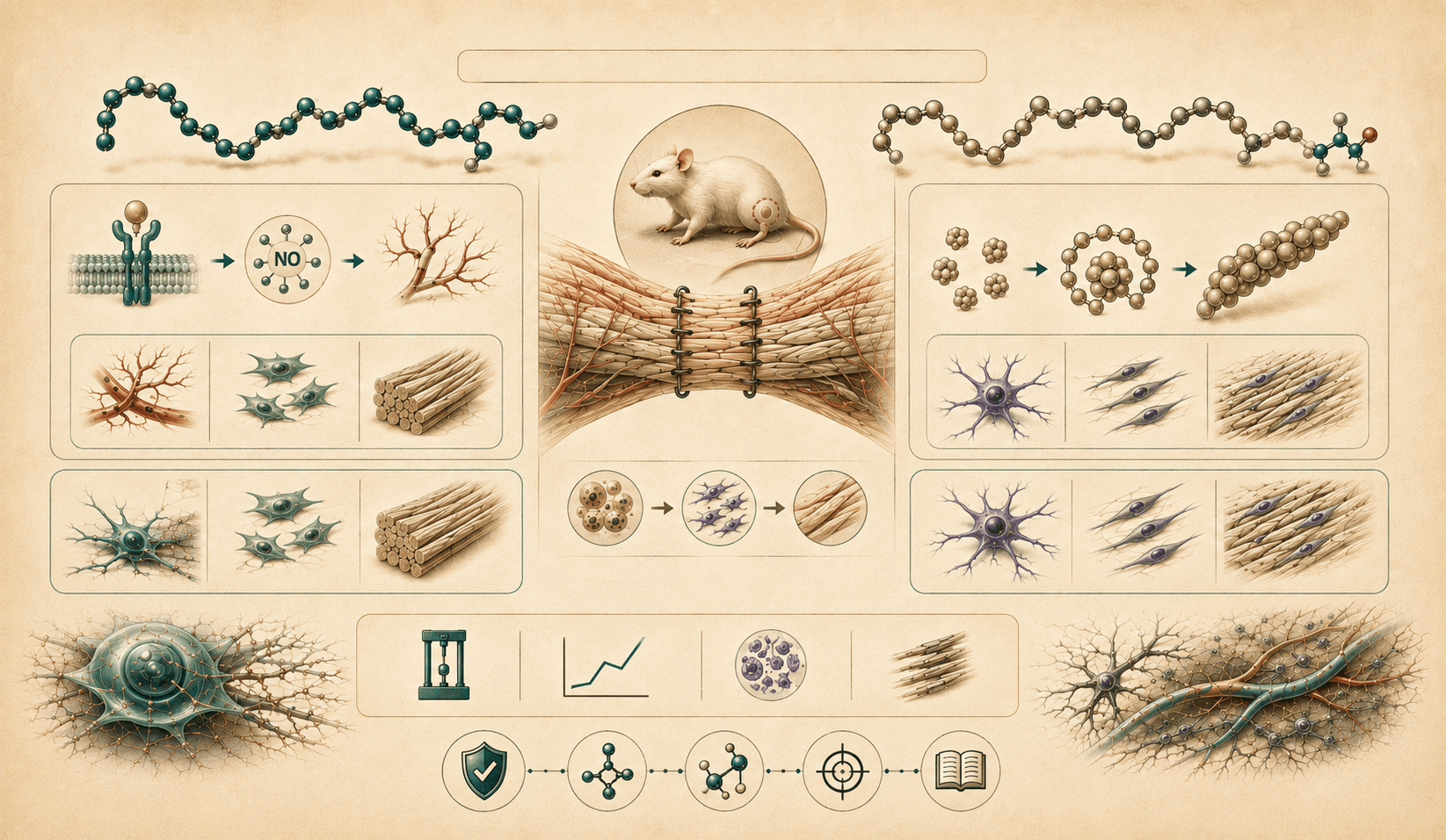
Tendon-repair models are among the most studied contexts for healing peptides in the research literature. BPC-157 and TB-500 have each been examined in tendon-injury designs, yielding distinct mechanistic and outcome profiles. This citation-based review compares the two compounds specifically in tendon-repair animal models, framing every comparison in research-model terms.
This is a research-methodology comparison, not selection guidance for personal use. It is part of the broader review of healing and repair peptides and draws on the mechanistic detail in the BPC-157 mechanism and TB-500 actin-binding posts.
The workhorse of tendon-repair research is the surgical transection model, most commonly performed on the Achilles tendon of rats or mice. The tendon is transected and repaired, and healing is followed over a defined timeline. This standardized model allows comparison across studies and laboratories.
Tendon healing proceeds through overlapping stages: an inflammatory phase (days 0 to 7), a proliferative phase (days 3 to 21) with fibroblast infiltration and collagen deposition, and a remodeling phase (weeks to months) during which collagen matures and mechanical strength recovers. Different mechanisms are expected to affect different phases.
The primary functional endpoint is biomechanical: tensile strength (maximum load to failure) and elastic modulus (stiffness) of the healing tendon, measured at defined timepoints. These endpoints quantify functional recovery.
Histology characterizes collagen organization, cellularity, and tissue architecture. Immunohistochemistry quantifies growth factors, cytokines, and matrix proteins. Together these methods characterize the tissue-level response underlying the biomechanical outcomes.
BPC-157 has been studied in tendon models with reported effects on tendon fibroblast behavior and healing outcomes. In-vitro work by Chang and colleagues reported that BPC-157 promoted tendon fibroblast outgrowth, cell survival, and migration, with associated changes in growth factor receptor expression (Chang et al., 2011; PMID 21030672).
The tendon findings for BPC-157 are consistent with its broader mechanistic profile involving growth factor receptor signaling (including VEGFR2) and the nitric oxide system (Hsieh et al., 2017; PMID 27847966). The angiogenic component of this mechanism is relevant to tendon healing, which depends on adequate vascularization.
The musculoskeletal review by Seiwerth and colleagues catalogs the tendon, ligament, muscle, and bone literature for BPC-157 and discusses its relationship to angiogenic growth factors (Seiwerth et al., 2018; PMID 29998800). A separate review by Gwyer and colleagues focuses specifically on the musculoskeletal soft-tissue healing literature (Gwyer et al., 2019; PMID 30915550).
TB-500 acts by sequestering monomeric actin, which supports the fibroblast migration central to the proliferative phase of tendon healing. This mechanism is documented in the broader Thymosin Beta-4 literature (Goldstein et al., 2012; PMID 22074294).
The cell-migration and wound-closure effects of Thymosin Beta-4 (Malinda et al., 1999; PMID 10469335) provide the mechanistic rationale for its study in tissue-repair models, including tendon. The TB-500 actin-binding pathway post covers the underlying biology.
Because TB-500 acts primarily on cell migration, its expected contribution is concentrated in the proliferative phase, when fibroblast infiltration drives matrix deposition. This is a mechanistic prediction rather than a claim of superiority.
The two compounds are studied in overlapping tendon-model literature but they are different molecules with different proposed mechanisms, set out in BPC-157 mechanism of action research and TB-500 actin binding and tissue repair research, and both sit in the wider cluster covered in the healing peptides research overview. The table sets the comparison out directly.
| BPC-157 | TB-500 (thymosin beta-4) | |
|---|---|---|
| Origin | Synthetic 15-residue peptide corresponding to a partial sequence of a protein described as isolated from human gastric juice. | Synthetic material corresponding to thymosin beta-4, an endogenous 43-residue peptide of the beta-thymosin family. |
| Proposed mechanism | Pathway-level effects in angiogenic and nitric oxide signaling. No high-affinity receptor established. | Sequestration of monomeric actin, influencing the polymerizable actin pool. No high-affinity receptor established. |
| Tendon-model evidence | Rodent tendon models examining fibroblast behavior and healing readouts. | Rodent models across dermal, cardiac and other tissues, with tendon work part of a wider repair literature. |
| Typical endpoints | Biomechanical testing, histology, immunohistochemistry for pathway markers. | Migration and angiogenesis readouts, histology, functional recovery measures. |
| Main limitation | Most published work originates from one research program, so publication breadth exceeds independent replication. | Nomenclature confusion across thymosin beta-4, TB-500 and the Ac-SDKP fragment makes cross-study comparison error-prone. |
Very little of this literature compares the two compounds head to head in the same experiment. Most comparison is made by the reader, across separate studies that used different models, endpoints and analysis. That is a materially weaker basis for a conclusion, because differences in model details and measurement can account for apparent differences between compounds.
Where a paper reports both compounds in the same design, it is the stronger evidence and is identified as such here. Where the comparison is being assembled across papers, this page says so plainly rather than presenting the result as though it came from one experiment.
Tendon-repair findings in rodent models describe those models. Extrapolation to other species is not supported by this literature, and extrapolation to people is outside what any of these studies address. Model choice, injury type, timing of assessment and the endpoint measured all shape the result, and studies differ on all four. Both compounds are supplied as reference material, under BPC-157 research vials and TB-500 research vials, and related compounds are indexed in the peptide reference library.
Studies that test both peptides head-to-head in the same tendon model with identical endpoints are limited in the published literature. This scarcity of direct comparisons is itself an important observation: much of the comparative reasoning in this space is necessarily indirect.
When direct comparisons are unavailable, researchers reason across separate studies that use similar models and endpoints. This approach is weaker than a direct comparison because differences in model details, study parameters, and measurement can confound the comparison. Any conclusion drawn this way should be qualified accordingly.
When comparing across studies, the reader should attend to effect sizes, the number of animals per group, the timepoints measured, and the statistical methods. A statistically significant difference at one timepoint may not persist at another, given the phased nature of tendon healing.
The central mechanistic distinction is that BPC-157 appears to act through growth factor receptor and nitric oxide signaling, while TB-500 acts through actin sequestration. These mechanisms affect different aspects of the healing cascade, which is why the two peptides are not expected to produce identical outcome profiles.
The mechanistic difference suggests that the two peptides may be most informative at different phases and with different endpoints. A study focused on early fibroblast migration might be more sensitive to TB-500 effects, while a study focused on vascularization might be more sensitive to BPC-157 effects. These are hypotheses to be tested, not established conclusions.
Choose endpoints that match the mechanistic hypothesis: biomechanical strength for functional recovery, histology for collagen organization, immunohistochemistry for the specific signaling pathway of interest.
Dose and route are study-design decisions governed by the research protocol and institutional animal care and use committee review. Researchers should base these decisions on the primary literature for the specific model rather than on cross-model extrapolation.
Studies that co-administer BPC-157 and TB-500 are addressed in the healing peptide blend co-administration methodology post, framed strictly in animal-model research terms.
Head-to-head studies that test both peptides in the same model with identical endpoints are limited in the published literature. Most comparative reasoning in this space is indirect, drawing on separate studies that use similar models. This limitation should be kept in mind when evaluating comparative claims, and conclusions should be qualified accordingly.
The published literature does not support a universal ranking. The two peptides act through different mechanisms that are expected to affect different phases of healing and different endpoints. Any claim that one is consistently faster would require direct comparative studies that are largely absent from the current literature.
The decision should follow the mechanistic hypothesis. If the study focuses on fibroblast migration, TB-500’s actin-binding mechanism is directly relevant. If the study focuses on vascularization or growth factor signaling, BPC-157’s mechanism is more relevant. Endpoint selection and model choice follow from this reasoning. This is study-design guidance, not human-use guidance.
Co-administration of the two peptides appears in some animal-model literature. Experimental design for such studies, including controls needed to interpret combination effects, is covered in the healing peptide blend co-administration methodology post.
They are different molecules with different proposed mechanisms. BPC-157 is a synthetic 15-residue peptide studied for pathway-level effects in angiogenic and nitric oxide signaling. TB-500 corresponds to thymosin beta-4, a 43-residue endogenous peptide whose defining property is sequestration of monomeric actin.
Very little published work compares the two in the same experiment. Most comparison is assembled by the reader across separate studies using different models and endpoints, which is a weaker basis for a conclusion than a matched head-to-head design.
Educational notice and compliance framing. This article is for educational and informational purposes only and is intended for licensed researchers and laboratory professionals. BPC-157 and TB-500 are research chemicals sold for laboratory and research purposes only. They are NOT intended for human consumption, diagnostic use, or therapeutic application. All comparisons below are framed strictly in terms of published animal-model research. Nothing in this article is guidance for human use, and no statement should be read as a claim that either compound treats any human condition.
Research-only disclaimer. BPC-157 and TB-500 are research chemicals sold for laboratory and research purposes only. They are NOT intended for human consumption, diagnostic use, or therapeutic application. Every comparison in this article is framed in terms of published animal-model research and is not guidance for human use.


