
Cart

Oops, your cart is still empty
Looks like you haven’t added anything yet. Start exploring our products and find what you need.
Research use only. TB-500 is supplied as a research-grade reference compound for laboratory research use only. It is not for human or veterinary use.
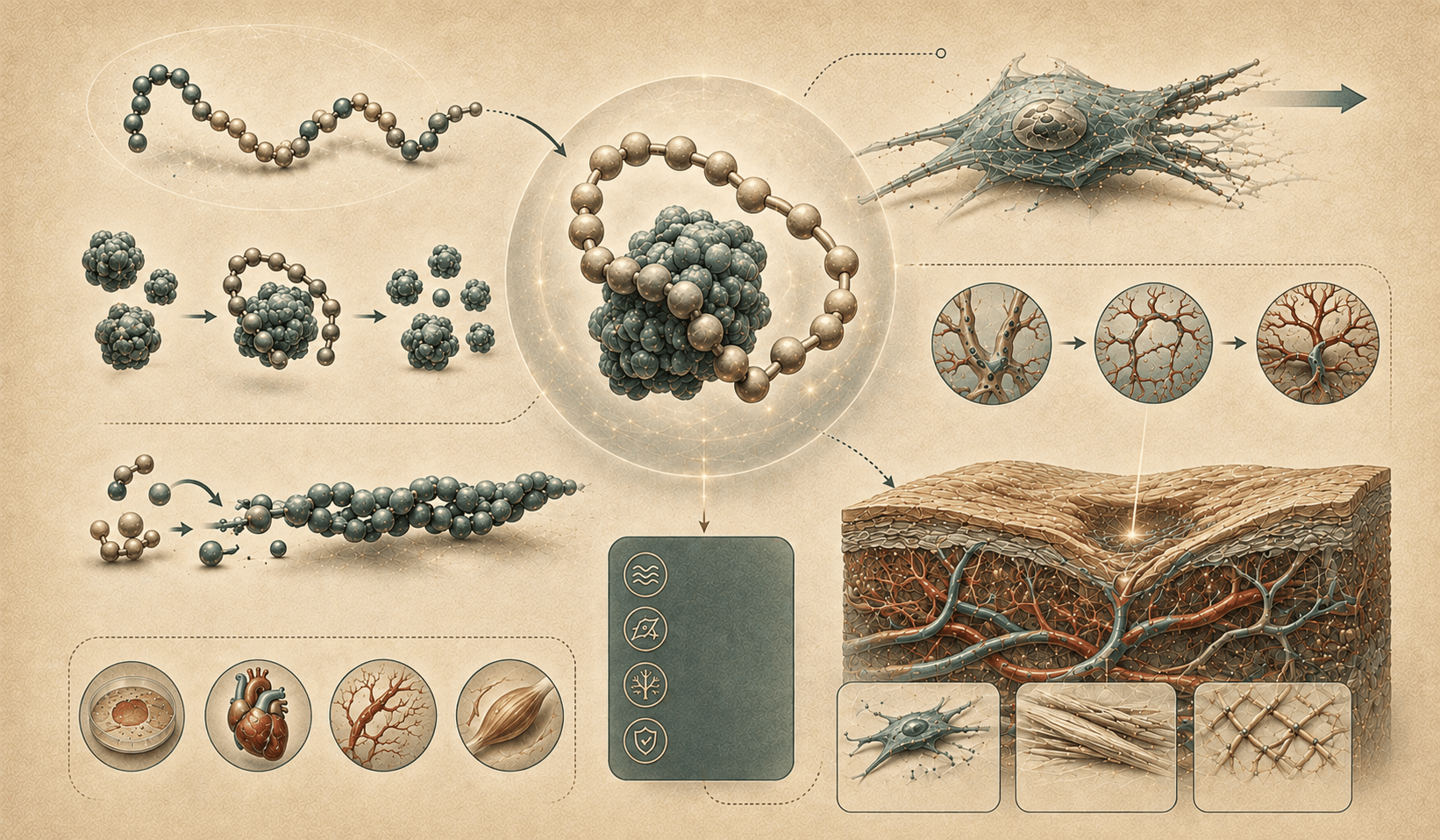
TB-500 corresponds to the actin-binding region of Thymosin Beta-4, a naturally occurring 43-amino-acid peptide that binds and sequesters actin monomers, regulating cell motility and tissue remodeling across multiple organ systems in published preclinical research. This article synthesizes the TB-500 literature, tracing the research pathway from in-vitro actin biochemistry to in-vivo tissue outcomes.
This article is part of a broader review of healing and repair peptides.
Three names appear across this literature and they describe different things. Thymosin beta-4 is the endogenous 43-residue peptide, one of the beta-thymosin family, and it is the molecule almost all the primary research is conducted on. TB-500 is the designation used for synthetic research material. Ac-SDKP is a four-residue N-terminal fragment of thymosin beta-4 with its own separate literature and its own reported activities.
The practical consequence is that a paper reporting thymosin beta-4 results is not automatically a paper about the same preparation, and Ac-SDKP results are not thymosin beta-4 results. Work on the fragment is reported separately and the distinction is maintained in careful sources (Expert Opin Biol Ther, 2015; PMID 26098610). Molecular identity data is set out in the TB-500 chemical reference data, with a summary view in the TB-500 encyclopedia entry, and the wider family is compared in TB-500 compared with thymosin beta-15.
| Name | What it refers to |
|---|---|
| Thymosin beta-4 | The endogenous 43-residue peptide, a member of the beta-thymosin family. The subject of most primary research. |
| Tb4 or Tbeta4 | Abbreviations for thymosin beta-4 used across the literature. |
| TB-500 | The designation used for synthetic research material corresponding to this sequence. |
| Ac-SDKP | An N-terminal tetrapeptide fragment of thymosin beta-4, with a separate literature and separate reported activities. |
| Beta-thymosins | The wider family, including thymosin beta-10 and beta-15, which differ in sequence and tissue distribution. |
Thymosin Beta-4 is a 43-residue peptide highly conserved across mammalian species. It is one of the most abundant intracellular peptides in many cell types. The beta-thymosin family includes several related peptides, of which Thymosin Beta-4 is the most studied (Goldstein et al., 2012; PMID 22074294).
Thymosin Beta-4 binds monomeric (G) actin in an approximately 1:1 complex. By sequestering G-actin, it maintains a reservoir of unpolymerized actin that the cell can draw on for rapid cytoskeletal remodeling. This is the central biochemical function of the peptide and the basis for its effects on cell motility.
Thymosin Beta-4 is largely unstructured in free solution but adopts a more defined conformation upon binding actin. This coupled folding and binding is a common feature of intrinsically disordered peptides that engage protein partners. The peptide bond architecture post covers conformational behavior in peptides.
At 43 residues, Thymosin Beta-4 has a molecular weight of approximately 4963 Daltons, placing it at the larger end of the research peptide range covered in the peptide vs protein vs polypeptide discussion.
By buffering the pool of monomeric actin, Thymosin Beta-4 influences the rate and location of actin filament assembly. This regulation is important for the leading-edge dynamics that drive cell migration.
The documented effect of Thymosin Beta-4 on cell migration is one of the most consistent findings in the literature and underlies its study in wound-healing contexts (Malinda et al., 1999; PMID 10469335).
Unlike small-molecule actin drugs that either stabilize (phalloidin) or depolymerize (cytochalasin) filaments, Thymosin Beta-4 acts by sequestering monomers, a gentler and more physiological form of regulation. This distinction matters when comparing the peptide to pharmacological actin tools in the research literature.
The table below sets out the properties and findings as they are described in the cited literature, with the model system stated for each. The N-terminal fragment has its own reference page, the TB-500 fragment 17-23 entry.
| Feature | What the literature describes | Reference |
|---|---|---|
| Actin sequestration | Binding of monomeric G-actin, holding it unavailable for polymerization and thereby influencing the polymerizable pool. | Ann N Y Acad Sci, 2007; PMID 17468232 |
| Post-translational modification | Modified forms of thymosin beta-4 have been described and characterized separately from the parent peptide. | Ann N Y Acad Sci, 2010; PMID 20536447 |
| Cell migration | Effects on migration reported across cell types, with the actin-regulating role as the proposed basis. | Cancer Invest, 2013; PMID 23320791 |
| Dermal models | Effects reported in rodent dermal models, including burn wound models. | Biochim Biophys Acta, 2014; PMID 25230158; Vitam Horm, 2016; PMID 27450738 |
| Hepatic stellate cells | Regulatory role described in hepatic stellate cell biology. | Vitam Horm, 2016; PMID 27450733 |
| Ac-SDKP fragment | The N-terminal fragment reported with its own effects, distinct from the parent peptide. | Expert Opin Biol Ther, 2015; PMID 26098610 |
Scratch-wound and Boyden chamber migration assays are standard in-vitro methods for characterizing the cell-migration effects of Thymosin Beta-4. These assays quantify the closure of a cell-free gap or the transit of cells across a membrane.
Thymosin Beta-4 has been studied in myoblast and endothelial cell systems, where its effects on migration and tube formation connect to the muscle and vascular literature discussed below.
Endothelial tube-formation assays demonstrate the pro-angiogenic activity of Thymosin Beta-4 (Malinda et al., 1999; PMID 10469335), linking in-vitro biochemistry to the angiogenesis findings in animal models.
Thymosin Beta-4 accelerates dermal wound closure in rodent models, an effect attributed to its combined pro-migration and pro-angiogenic activity (Malinda et al., 1999; PMID 10469335).
The cardiac literature is among the strongest for Thymosin Beta-4. A landmark study by Bock-Marquette and colleagues reported effects on cardiomyocyte survival, migration, and cardiac repair after coronary artery ligation in mice, with signaling through integrin-linked kinase and Akt (Bock-Marquette et al., 2004; PMID 15565145).
TB-500 appears in musculoskeletal repair research alongside BPC-157. The BPC-157 vs TB-500 tendon-repair review compares the two peptides in this specific model type using citation-based evidence.
The pro-angiogenic activity of Thymosin Beta-4 supports neovascularization during tissue repair, a process central to effective wound healing.
Thymosin Beta-4 interacts with vascular signaling pathways, and its angiogenic effects have been studied in the context of endothelial growth factor signaling. These interactions connect the actin-binding mechanism to the vascular outcomes observed in animal models.
Migration and angiogenesis are reported together across much of this literature but they are separate readouts. Migration findings follow reasonably directly from the actin-regulating role. Angiogenesis findings are reported in animal and cell models and are described as associated effects rather than as a defined receptor-mediated pathway, since no high-affinity receptor for thymosin beta-4 has been established. Results are reported against the specific model used, and dermal, cardiac and hepatic models are not interchangeable. Tendon-model work is set against BPC-157 in BPC-157 and TB-500 in tendon repair models.
Published animal-model studies define their own experimental parameters, and those parameters differ between models, species and endpoints. Study design decisions of this kind are governed by the protocol of the individual study and by institutional animal care and use committee review, and they are documented in the methodology of the paper. For any given model, the primary publication is the correct source.
As a hydrophilic peptide, thymosin beta-4 distributes into aqueous compartments and, like most peptides, has a limited circulating half-life that study designs account for. The compound is supplied as lyophilized material under TB-500 research vials and lyophilized research vials, with related compounds indexed in the peptide reference library.
TB-500 acts by binding and sequestering monomeric actin, directly influencing the cytoskeletal machinery of cell migration. BPC-157 acts through the nitric oxide system and growth factor receptor signaling. The two are mechanistically distinct: TB-500 works at the level of the cytoskeleton, while BPC-157 works at the level of receptor-mediated signaling. The BPC-157 vs TB-500 review covers the comparison.
Thymosin Beta-4, the parent peptide of TB-500, was originally isolated from thymic tissue during research on thymic factors, which is the source of the thymosin name. It was later found to be widely distributed in many cell types rather than being thymus-specific, but the historical name persists.
Platelet-derived growth factor (PDGF) and fibroblast growth factor (FGF) are protein growth factors that bind cell-surface receptor tyrosine kinases and trigger proliferation and migration through receptor signaling. TB-500 acts intracellularly by regulating the actin monomer pool. The two mechanisms converge on cell migration but operate through fundamentally different molecular routes.
Cell migration assays (scratch-wound and Boyden chamber) are the standard functional readouts, since cell migration is the best-characterized effect. Endothelial tube-formation assays are used for the angiogenesis endpoint. These assays are typically combined with biochemical measures of actin dynamics.
Yes, co-administration of TB-500 with other healing peptides appears in some animal-model literature. The healing peptide blend co-administration methodology post reviews the experimental design considerations for such studies, framed strictly in research terms.
TB-500 is the designation used for synthetic research material corresponding to thymosin beta-4, an endogenous 43-residue peptide of the beta-thymosin family. The defining biochemical property described in the literature is sequestration of monomeric actin.
Thymosin beta-4 is the endogenous peptide and the subject of most primary research. TB-500 is the designation used for synthetic research material corresponding to that sequence. Ac-SDKP is a separate N-terminal fragment with its own literature, and it is not interchangeable with either.
Thymosin beta-4 binds monomeric G-actin and holds it in a form unavailable for polymerization. It therefore acts as a regulator of the pool of polymerizable actin within the cell rather than as an enzyme or a receptor ligand, and this sequestering role organizes the beta-thymosin literature.
Ac-SDKP is an N-terminal tetrapeptide fragment of thymosin beta-4. It has a separate published literature and separate reported activities, and results reported for the fragment should not be read as results for the parent peptide.
Citation note: All PubMed identifiers in this article were verified against PubMed records on 2026-07-23.
Educational notice. This article is for educational and informational purposes only and is intended for licensed researchers and laboratory professionals. TB-500 is a research chemical sold for laboratory and research purposes only. It is NOT intended for human consumption, diagnostic use, or therapeutic application. All scientific claims are referenced to primary peer-reviewed literature.
Research-only disclaimer. TB-500 is a research chemical sold for laboratory and research purposes only. It is NOT intended for human consumption, diagnostic use, or therapeutic application.


