
Cart

Oops, your cart is still empty
Looks like you haven’t added anything yet. Start exploring our products and find what you need.
Research use only. Both compounds referenced here are research-grade reference materials for laboratory research use only, not for human or veterinary use.
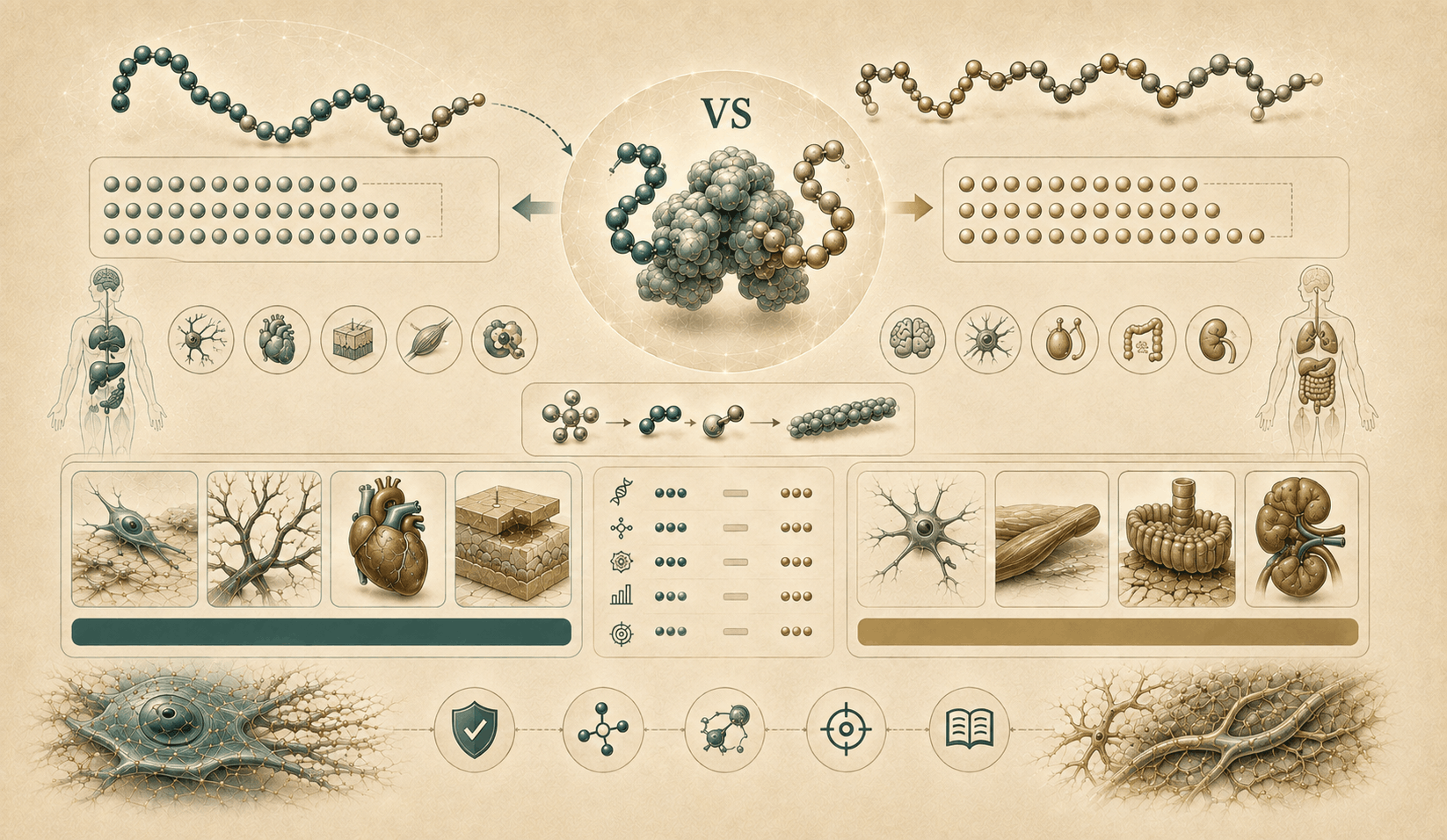
Thymosin Beta-4 (the parent of TB-500) and Thymosin Beta-15 are structurally related members of the beta-thymosin family. They share actin-binding properties yet differ in sequence, tissue distribution, and documented research outcomes. This article compares the two peptides through the lens of published research, to help laboratory scientists understand where each fits in the literature.
This comparison is framed in research-context terms, discussing binding affinity, tissue distribution, and animal-model findings rather than selection guidance for any human use. It is part of the broader review of healing and repair peptides and complements the TB-500 actin-binding mechanism post.
Thymosin beta-4 and thymosin beta-15 are members of the same small peptide family, defined by a shared actin-binding motif and by sequence similarity across a short polypeptide. The parent compound is covered in TB-500 actin binding and tissue repair research, and how sequence differences translate into activity differences in how peptide structure determines activity.
| Family member | Distinguishing features in the literature | Research context |
|---|---|---|
| Thymosin beta-4 | The most studied member. Sequesters monomeric actin. The molecule underlying TB-500 research material. | Repair and migration models across multiple tissues. |
| Thymosin beta-10 | Sequence-related, with a distinct tissue distribution reported in the family literature. | Studied largely in developmental and cell-biology contexts. |
| Thymosin beta-15 | Reported with a distinct expression pattern and studied in cell-motility contexts. | Cell migration and motility literature. |
| Ac-SDKP | N-terminal tetrapeptide fragment of thymosin beta-4, with a separate literature. | Studied separately from the parent peptide. |
Family-level reviews set out the shared and distinguishing features across these members (Ann N Y Acad Sci, 2007; PMID 17468232), and comparative work on their roles in migration is where most of the cross-member analysis sits (Cancer Invest, 2013; PMID 23320791).
Thymosin beta-4 is the endogenous peptide. TB-500 is the designation used for synthetic research material corresponding to that sequence. Ac-SDKP is an N-terminal fragment with its own literature. Results reported for one are not results for another. Molecular identity data is set out in the TB-500 chemical reference data, the compound is stocked under TB-500 research vials, and related compounds are indexed in the peptide reference library.
Both Thymosin Beta-4 and Thymosin Beta-15 are members of the beta-thymosin family and share a conserved actin-binding motif. They differ at multiple positions in their sequences, and these differences underlie their distinct tissue distributions and binding properties. Thymosin Beta-4 is 43 residues; the beta-thymosins are generally similar in length.
The sequence differences produce modest differences in molecular weight and net charge, which influence solubility and handling. Both are hydrophilic peptides that dissolve readily in aqueous buffers, as discussed in the peptide solubility prediction post.
The beta-thymosins are evolutionarily conserved, reflecting the fundamental role of actin regulation in eukaryotic cells. Thymosin Beta-4 is highly conserved across mammals (Goldstein et al., 2012; PMID 22074294).
Both peptides bind monomeric G-actin, maintaining a reservoir of unpolymerized actin. The shared actin-binding motif is responsible for this common function, and it is the basis for the cell-migration effects documented for Thymosin Beta-4.
The beta-thymosins are selective for monomeric G-actin over filamentous F-actin, which is central to their sequestering function. This selectivity distinguishes them from actin-binding proteins that cap or sever filaments.
Detailed comparative binding-constant data for Thymosin Beta-4 versus Thymosin Beta-15 are limited in the published literature. Researchers requiring precise comparative affinity data should consult primary biochemical studies for the specific experimental conditions of interest.
Thymosin Beta-4 is one of the most abundant intracellular peptides and is widely distributed across many cell types, which is consistent with its general role in actin regulation and its broad research literature.
Thymosin Beta-15 has a more restricted tissue-distribution profile in the published literature. This tissue restriction is one basis for the differing research contexts in which the two peptides appear.
The tissue-distribution differences map onto the research literature: Thymosin Beta-4 dominates the general wound-healing and cardiac literature, while Thymosin Beta-15 appears in more tissue-restricted contexts.
Cell migration assays (scratch-wound and Boyden chamber) are the standard functional readouts for beta-thymosins. Thymosin Beta-4 has the more extensive migration-assay literature. Direct head-to-head comparative migration data are less common and should be sought in primary sources.
Thymosin Beta-4 has documented endothelial tube-formation and myoblast effects. Comparative studies with Thymosin Beta-15 in these systems are more limited.
Thymosin Beta-4 has the stronger animal-model literature in cutaneous wound closure (Malinda et al., 1999; PMID 10469335) and cardiac repair (Bock-Marquette et al., 2004; PMID 15565145). Comparative animal-model data directly contrasting the two peptides are limited, which is itself an important observation for researchers evaluating the evidence base.
Any comparison of tolerability should be drawn from the specific animal-model studies in question. Researchers should not extrapolate safety conclusions across models or to human contexts, since these compounds are research chemicals not intended for human use.
Combination studies involving beta-thymosins are addressed in the healing peptide blend co-administration methodology post, which covers experimental design for co-administration studies framed strictly in animal-model research terms.
Both bind monomeric actin, but they differ in tissue distribution and in the depth of the available research literature. Thymosin Beta-4 (TB-500) has the broader and better-characterized literature across wound healing, cardiac repair, and angiogenesis, while Thymosin Beta-15 appears in more tissue-restricted contexts. The choice for a study is driven by the tissue system and endpoints of interest and by the availability of relevant prior literature.
Combination studies of beta-thymosins are possible in experimental designs, but they are less common than single-peptide studies. Co-administration research is covered in the healing peptide blend co-administration methodology post.
Thymosin Beta-4 (TB-500) is more widely available as a research chemical, reflecting its larger research literature and demand. Availability of Thymosin Beta-15 is more limited. Availability should not be interpreted as an endorsement of any particular use; both are research chemicals for laboratory use only.
The beta-thymosins sequester monomeric actin, distinguishing them from actin-binding proteins that cap, sever, or crosslink filaments, and from small-molecule actin drugs that stabilize or depolymerize filaments. Within the beta-thymosin family, the members differ mainly in tissue distribution and the depth of their research literature.
Tissue-specificity claims should be grounded in the specific animal-model or expression studies that report them, and the tissue distribution of each peptide provides a biological rationale. Researchers should look to the primary literature for the model and endpoint of interest rather than treating tissue-specificity as a general property.
The beta-thymosins are a small family of related peptides sharing an actin-binding motif, including thymosin beta-4, beta-10 and beta-15. They differ in sequence detail and reported tissue distribution, and results for one member do not transfer to another.
Both are beta-thymosins with related sequences and a shared actin-binding motif, but they are reported with different expression patterns and are studied in different research contexts. Thymosin beta-4 is the more extensively studied member and is the molecule underlying TB-500 research material.
Educational notice. This article is for educational and informational purposes only and is intended for licensed researchers and laboratory professionals. The peptides discussed are research chemicals sold for laboratory and research purposes only. They are NOT intended for human consumption, diagnostic use, or therapeutic application. This comparison is framed strictly in terms of published research and is not purchase guidance for personal use.


