
Cart

Oops, your cart is still empty
Looks like you haven’t added anything yet. Start exploring our products and find what you need.
These materials are research-grade reference compounds sold for laboratory research use only. They are not for human or veterinary use.
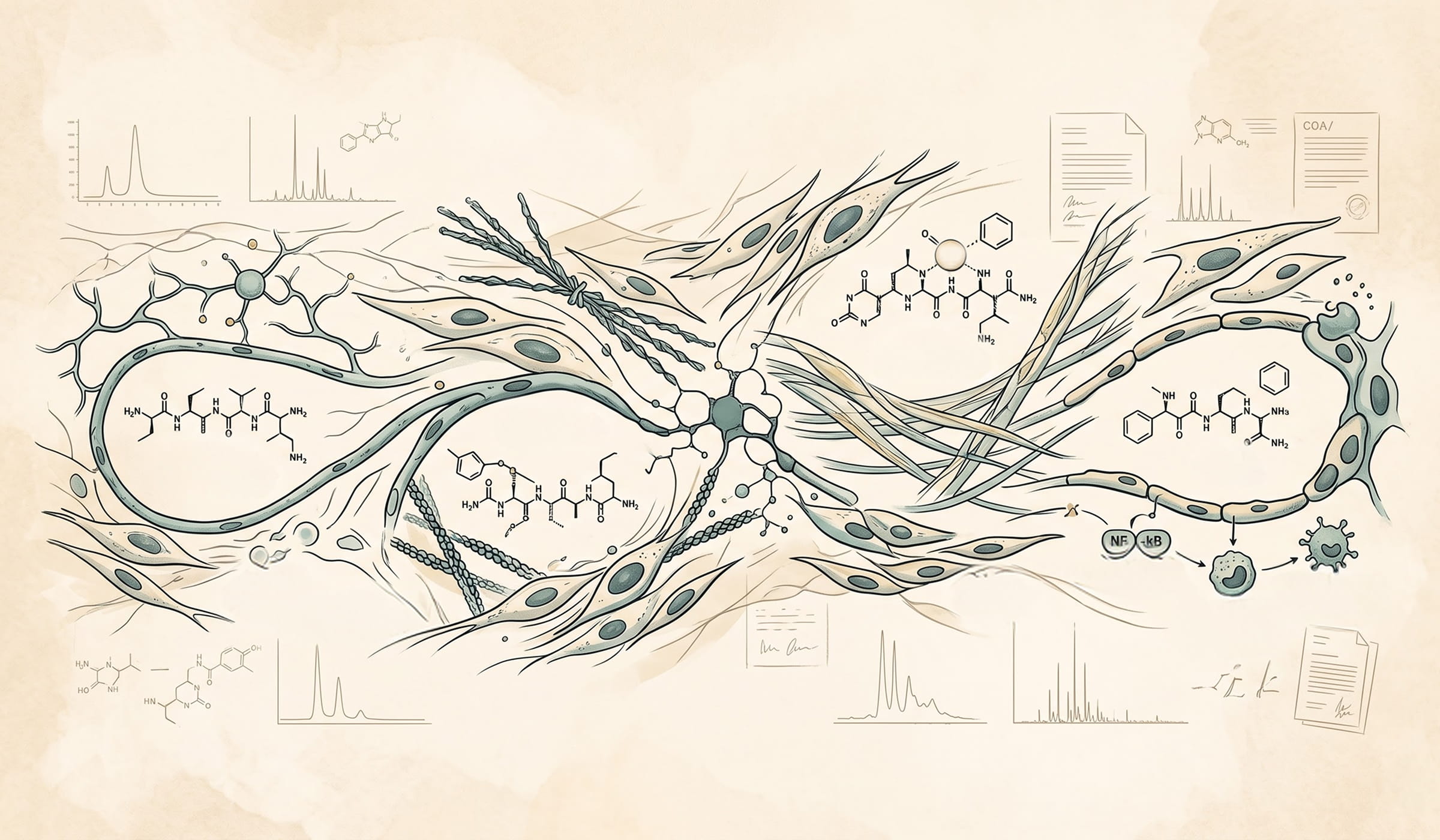
Tissue repair is one of the largest and most active bodies of peptide research literature, and a handful of peptides recur across it. Each is associated with a different repair-related pathway in animal and cell models, from angiogenesis to actin dynamics to matrix biology. This pillar guide maps the area, explains the distinct mechanisms, and links to each compound’s reference page and to the direct comparison articles.
Tissue-repair research with peptides examines angiogenesis, cell migration, extracellular-matrix biology, and cytoprotection in defined models. Because repair is a multi-step biological process, peptides that act on different parts of it are studied together under this umbrella, which is why the area spans several families.
| Compound | Associated pathway | Reference |
|---|---|---|
| BPC-157 | Angiogenic and cytoprotective effects | Reference page |
| TB-500 | Actin sequestration; cell migration | Reference page |
| GHK-Cu | Collagen and matrix biology | Reference page |
| KPV | Anti-inflammatory signaling | Reference page |
BPC-157 is studied for angiogenic and cytoprotective effects across tendon, muscle, and gastrointestinal models (Seiwerth et al., 2021). Its reported stability and breadth across soft-tissue systems are recurring themes.
TB-500, through the actin-sequestering activity of thymosin beta-4, is studied for cell migration and repair, with thymosin beta-4 described as a multifunctional regenerative peptide (Goldstein et al., 2012).
GHK-Cu contributes a matrix-focused thread, studied for collagen and extracellular-matrix biology in skin and connective-tissue models (Pickart and Margolina, 2018).
KPV, a melanocortin-derived tripeptide, is studied for anti-inflammatory signaling, including effects on NF-kB in intestinal models (Dalmasso et al., 2008), which intersects with repair through the resolution of inflammation.
Research uses cell-migration assays, tissue-repair animal models, and biochemical mechanism studies, with endpoints such as wound closure in models, angiogenic markers, matrix components, and inflammatory signaling. Because the peptides act on different steps, they are sometimes examined together to cover multiple aspects of repair.
Each compound is verified by HPLC for purity and mass spectrometry for identity, documented on the per-lot Certificate of Analysis. Identity data differ by compound and should be read from each COA.
Store sealed material cold, shield it from light, and avoid repeated freeze-thaw. Lot-specific stability is documented on the COA; current lot reports are on the Lab Reports page.
All of this work is in animal and cell models, and repair findings there do not establish outcomes in people. Some of the literature, particularly for BPC-157, is concentrated within a small number of research groups, which is worth weighing when assessing the strength of the evidence.
BPC-157, TB-500, GHK-Cu, and KPV are common examples, each linked to a different pathway.
Angiogenesis and cytoprotection, actin-regulated cell migration, collagen and matrix biology, and inflammatory-pathway modulation, in models.
Because both feature in soft-tissue repair research but act through different mechanisms.
No. They are research-model observations and are not statements about outcomes in people.
No. They come from different families and overlap only in the tissue-repair research context.
By HPLC and mass spectrometry, documented on the per-lot Certificate of Analysis.
Sealed, cold, shielded from light, avoiding repeated freeze-thaw; lot-specific stability is on the COA.
Research-use notice: The peptides described here are research chemicals sold for laboratory research use only. They are not for human or veterinary use. Every finding is reported in the specific research context of the cited study.


