
Cart

Oops, your cart is still empty
Looks like you haven’t added anything yet. Start exploring our products and find what you need.
Research use only. The compounds covered here are research-grade reference materials supplied for laboratory research use only. None is for human or veterinary use, and this page summarizes published model-system literature only.
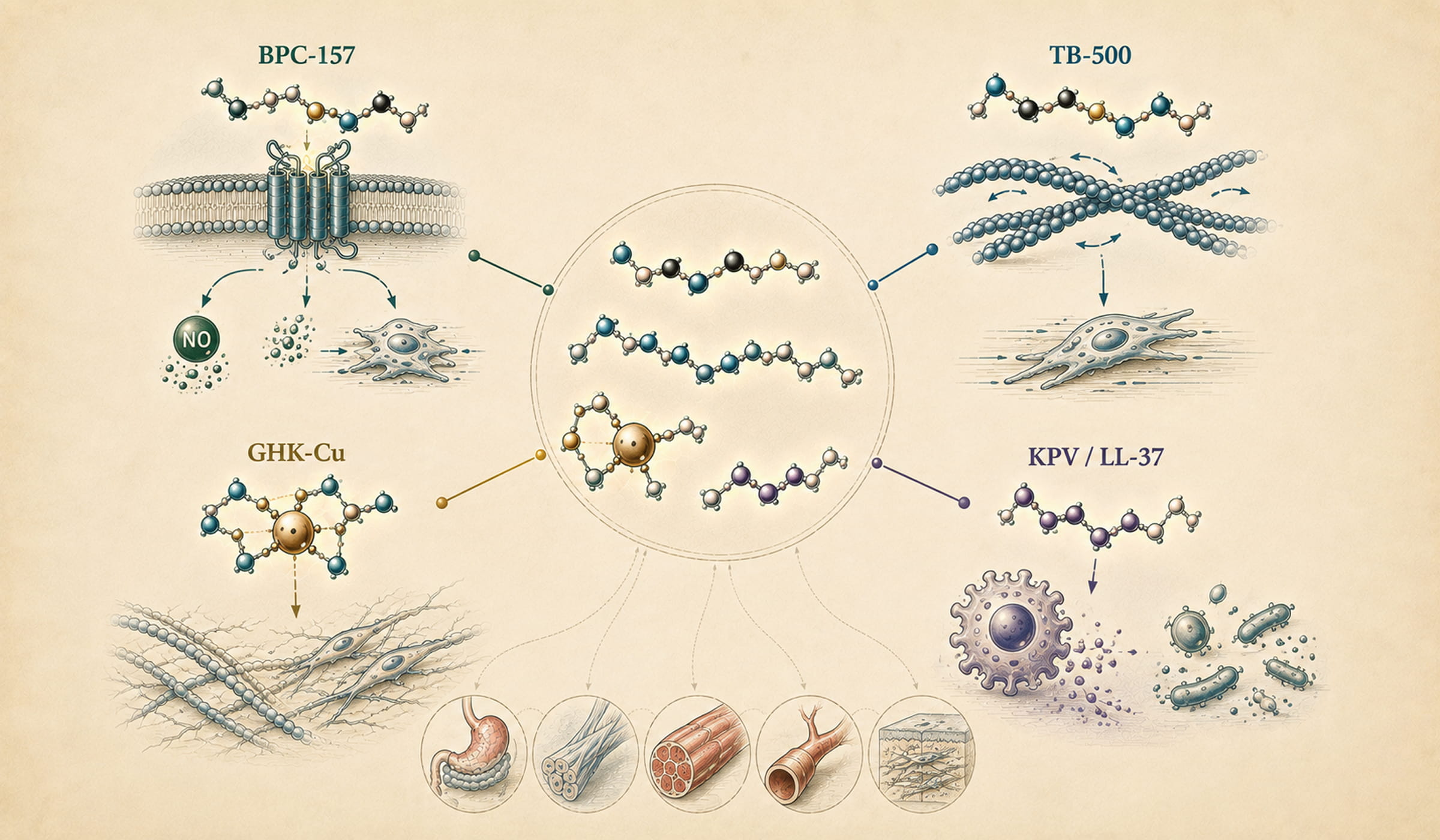
The peptide science literature on tissue repair and wound-healing mechanisms spans decades of in-vitro and animal-model research, with four compounds dominating the academic landscape: BPC-157, TB-500 (Thymosin Beta-4), GHK-Cu, and KPV. This review synthesizes peer-reviewed findings on each peptide across mechanism, pharmacology, and comparative animal-model data, with the goal of providing laboratory professionals a single reference for understanding the research context around these frequently studied molecules.
Each section connects to a detailed article for readers who need a deeper investigation, and every scientific claim is anchored to a primary source on PubMed or a peer-reviewed journal.
Tissue-repair peptides occupy a distinctive niche in the research literature. Unlike classical growth factors, which are large proteins that are difficult to synthesize and handle, these compounds are short peptides accessible by solid-phase peptide synthesis and stable enough for routine laboratory use. This combination has made them attractive subjects for mechanistic and preclinical study.
The healing peptide field draws on two research traditions. The Thymosin peptides (including Thymosin Beta-4, the parent of TB-500, and Thymosin Alpha 1) emerged from US research on thymic factors beginning in the 1960s and 1970s, work associated with Allan Goldstein and colleagues (Goldstein et al., 2012; PMID 22074294). BPC-157 emerged from research on gastric protective compounds led by Predrag Sikiric and colleagues in Croatia (Sikiric et al., 2017; PMID 29358856). GHK-Cu was first described by Loren Pickart in the 1970s as a factor in human plasma that influenced tissue behavior (Pickart and Margolina, 2018; PMID 29986520).
Healing peptides fall into several mechanistic classes:
The receptor pharmacology primer provides background on the receptor systems referenced throughout this review.
Preclinical tissue-repair research relies heavily on animal models because wound healing is an integrated physiological process that cannot be fully reconstituted in cell culture. Cutaneous wound-closure models, tendon and ligament transection models, and muscle-injury models are the workhorses of the field. Rodent models (rat and mouse) dominate for reasons of cost, standardization, and the availability of genetically defined strains.
All four peptides reviewed here are unscheduled research chemicals in the United States and are sold for laboratory research use only. None is an approved drug for any indication in the United States. The BPC-157 regulatory status reference and the US regulatory landscape overview cover the compliance context in detail.
undefined
BPC-157 is among the most extensively studied of the tissue-repair peptides, with a preclinical literature that spans gastrointestinal, musculoskeletal, and vascular injury models.
BPC-157 is a synthetic pentadecapeptide (15 amino acids, sequence GEPPPGKPADDAGLV) corresponding to a partial sequence identified within a protein in human gastric juice, from which the name Body Protection Compound derives. As a linear peptide with no cysteine residues, it lacks disulfide bonds and is synthesized readily by standard Fmoc solid-phase peptide synthesis. The BPC-157 structure, stability, and synthesis article covers these physicochemical properties.
The molecular mechanism of BPC-157 remains an active research question. The published literature implicates several pathways, including interaction with the nitric oxide system, modulation of growth factor receptor signaling (including the VEGFR2-Akt-eNOS pathway reported in endothelial studies), and effects on the expression of genes involved in cytoprotection (Chang et al., 2011; PMID 21030672; Hsieh et al., 2017; PMID 27847966). The BPC-157 mechanism of action article reviews these pathways in detail.
BPC-157 has been studied across a range of rodent injury models. Reported findings in the literature include effects on tendon fibroblast outgrowth and migration in vitro (Chang et al., 2011; PMID 21030672), effects in models of muscle injury, and cytoprotective effects in gastrointestinal models that gave rise to the original interest in the compound. A comprehensive review by Seiwerth and colleagues catalogs the animal-model literature (Seiwerth et al., 2018; PMID 29998800).
BPC-157 is described in the research literature as relatively stable in aqueous solution and in gastric juice, a property that distinguishes it from many peptides. The BPC-157 structure, stability, and synthesis and pentadecapeptide stability and storage articles examine the stability literature.
TB-500 is a synthetic peptide corresponding to the actin-binding region of Thymosin Beta-4, a naturally occurring 43-residue peptide with a well-documented role in cell migration and tissue repair.
Thymosin Beta-4 is the major G-actin sequestering peptide in mammalian cells. By binding monomeric actin, it maintains a pool of unpolymerized actin available for rapid cytoskeletal remodeling. This mechanism underlies its documented effects on cell migration, a process central to wound healing (Goldstein et al., 2012; PMID 22074294). The TB-500 actin-binding pathway article covers the actin biology in depth.
Thymosin Beta-4 has been studied extensively in cardiac injury models. A landmark study by Bock-Marquette and colleagues reported effects on cardiomyocyte survival and migration following coronary artery ligation in mice (Bock-Marquette et al., 2004; PMID 15565145). Skeletal muscle and dermal injury models have also been reported in the literature.
Thymosin Beta-4 promotes angiogenesis and endothelial cell migration in research models (Malinda et al., 1999; PMID 10469335). These angiogenic and cell-migration effects are the basis for its study in dermal wound-closure models.
Thymosin Beta-15 is a related member of the beta-thymosin family with distinct tissue distribution and a separate research literature. The TB-500 vs Thymosin Beta-15 comparison article reviews the comparative pharmacology of these two beta-thymosins.
GHK-Cu is a copper-binding tripeptide with one of the deepest research literatures among the healing peptides, particularly in dermatology and extracellular matrix biology.
GHK (glycyl-L-histidyl-L-lysine) binds copper(II) with high affinity through the terminal amine, the histidine imidazole, and the deprotonated amide nitrogen, forming a well-characterized square-planar coordination complex. This coordination chemistry is central to the biological behavior of the molecule and is characterized by UV-visible and electron paramagnetic resonance spectroscopy (Pickart and Margolina, 2018; PMID 29986520). The GHK-Cu spectroscopy and coordination chemistry article covers the metal-binding chemistry in detail.
GHK-Cu influences the expression of a large number of genes in cultured cells, including genes involved in extracellular matrix remodeling, antioxidant defense, and tissue regeneration. Transcriptomic studies have reported that GHK modulates a substantial fraction of the human genome in the direction associated with tissue repair (Pickart et al., 2015; PMID 26236730).
GHK-Cu has an extensive dermatological research literature focused on collagen synthesis, extracellular matrix remodeling, and antioxidant gene expression in cultured fibroblasts and skin models. The GHK-Cu wound-healing pathway article reviews this literature.
The GHK-Cu complex is characterized by distinctive spectroscopic signatures that allow researchers to confirm copper loading and complex integrity. The GHK-Cu spectroscopy and coordination chemistry article covers characterization methods.
Two additional peptides round out the healing-peptide research landscape: KPV, an anti-inflammatory tripeptide derived from alpha-melanocyte-stimulating hormone, and LL-37, the sole human cathelicidin antimicrobial peptide.
KPV (lysine-proline-valine) is the C-terminal tripeptide of alpha-melanocyte-stimulating hormone (alpha-MSH). It retains the anti-inflammatory activity of the parent hormone while lacking the pigmentary activity. In research models, KPV modulates the NF-kB inflammatory signaling pathway and reduces proinflammatory cytokine expression (Dalmasso et al., 2008; PMID 18061177; Kannengiesser et al., 2008; PMID 18092346). The KPV tripeptide NF-kB pathway article provides a full mechanistic review.
LL-37 is the only human cathelicidin, a 37-residue amphipathic peptide with broad antimicrobial activity and immunomodulatory roles. It disrupts bacterial membranes and engages Toll-like receptor signaling in immune cells (Vandamme et al., 2012; PMID 23246832). The LL-37 cathelicidin antimicrobial mechanism article reviews the antimicrobial and immune-signaling literature.
KPV, LL-37, and Thymosin Alpha 1 all intersect with immune signaling, though through distinct mechanisms. The Thymosin Alpha 1 immune modulation evergreen post covers the immunomodulatory literature on the thymic peptide side.
The immunomodulatory peptides in this group are studied in infection and inflammation models. LL-37 in particular is studied in the context of antimicrobial resistance research, where host-defense peptides are of interest as templates for novel antimicrobial strategies.
Understanding how these peptides differ mechanistically is essential for interpreting the literature.
The four peptides engage distinct molecular targets. TB-500 binds monomeric actin directly. GHK-Cu coordinates copper and influences gene expression. KPV modulates the NF-kB pathway downstream of melanocortin signaling. BPC-157 appears to act through the nitric oxide system and growth factor receptor pathways, though its primary receptor, if one exists, has not been definitively identified. This mechanistic diversity means the peptides are not interchangeable and should not be treated as a single pharmacological class.
The animal-model literature shows tissue-type patterns. Thymosin Beta-4 has the strongest cardiac literature. BPC-157 has the strongest gastrointestinal and musculoskeletal literature. GHK-Cu has the strongest dermatological literature. These patterns reflect both the underlying biology and the historical direction of each research program.
Pharmacokinetic data vary across the peptides. As small linear peptides, most have short circulating half-lives in animal models unless the study design accounts for this through repeated administration or formulation. The pentadecapeptide stability and storage article covers stability considerations relevant to study design.
Some recent studies investigate co-administration of two or more healing peptides in animal models. This is an area of active methodological development. The healing peptide blend co-administration methodology article reviews the experimental design considerations for such studies, framed strictly in animal-model research terms.
Practical handling and study design considerations apply across the healing-peptide class.
undefined
Healing-peptide research uses standard molecular and cell biology assays. ELISA and Western blot quantify protein and signaling markers. Wound-closure imaging (scratch assays in vitro, planimetry in vivo) quantifies the tissue-repair endpoints. Histology and immunohistochemistry characterize tissue-level changes.
Research-grade healing peptides should carry a complete certificate of analysis documenting HPLC purity (typically 95 percent or higher), mass spectrometry confirmation of identity, water content by Karl Fischer titration, and endotoxin testing where relevant. The reading a peptide certificate of analysis article covers COA interpretation.
Compliance and sourcing considerations are important for any laboratory working with these compounds.
All four peptides are unscheduled research chemicals in the United States. None is FDA-approved for any therapeutic indication. Regulatory status differs internationally, and researchers should verify local requirements. The BPC-157 regulatory status reference covers the regulatory landscape for the most-discussed compound in this group in detail.
Some peptides in the broader research space share names with branded therapeutics. None of the four healing peptides reviewed here has an FDA-approved branded counterpart, which simplifies the regulatory framing somewhat compared to peptide classes such as the GLP-1 family. The peptides are nonetheless research chemicals, not therapeutics.
Sourcing from suppliers that provide complete COAs, transparent manufacturing documentation, and clear research-use labeling is best practice. The glossary of research peptide terminology defines the quality terms that appear in supplier documentation.
Researchers should retain COAs, follow institutional policies, and consult their institutional review board or animal care and use committee as appropriate for protocols involving these compounds.
BPC-157 is a 15-residue pentadecapeptide whose mechanism appears to involve the nitric oxide system and growth factor receptor signaling, with a preclinical literature concentrated in gastrointestinal and musculoskeletal models. TB-500 corresponds to the actin-binding region of the 43-residue Thymosin Beta-4 and acts by sequestering monomeric actin to support cell migration, with a preclinical literature concentrated in cardiac and dermal models. The BPC-157 vs TB-500 tendon-repair review provides a citation-based comparison in one specific model type.
GHK-Cu is a tripeptide-copper coordination complex with distinct metal-binding chemistry and a mechanism centered on gene expression modulation and extracellular matrix remodeling. This makes it mechanistically distinct from the actin-binding TB-500 and the receptor-pathway-modulating BPC-157, even though all three appear in wound-healing research contexts.
Rodent models (rat and mouse) dominate the preclinical healing-peptide literature because of cost, standardization, and the availability of defined strains. Common designs include cutaneous wound-closure models, tendon and ligament transection models, and muscle-injury models. Larger animal models (rabbit, dog) appear in specialized orthopedic literature.
Yes, co-administration of two or more healing peptides appears in some recent animal-model literature, although most foundational studies isolate single compounds to characterize their individual mechanisms. The healing peptide blend co-administration methodology post reviews the experimental design considerations for such studies.
A complete COA should report HPLC purity (95 percent or higher is standard for research grade), mass spectrometry confirmation of the amino acid sequence, water content by Karl Fischer titration, and endotoxin testing where relevant. The reading a peptide certificate of analysis guide walks through each section.
All four peptides are unscheduled research chemicals in the United States, sold for laboratory research use only, and none is FDA-approved for any indication. International regulatory status varies. The BPC-157 regulatory status reference covers the framework in detail. This information is educational and is not legal advice.
Solid-phase peptide synthesis (SPPS) is the standard method. BPC-157, TB-500, GHK, and KPV are all accessible via Fmoc SPPS. The solid-phase peptide synthesis post covers the methodology.
undefined
Educational notice. This article is for educational and informational purposes only and is intended for licensed researchers and laboratory professionals. The peptides discussed are research chemicals sold for laboratory and research applications. They are not intended for human consumption, diagnostic use, or therapeutic application. All scientific claims are referenced to primary peer-reviewed literature.
Research-only disclaimer. BPC-157, TB-500, GHK-Cu, KPV, and LL-37 are research chemicals sold for laboratory and research purposes only. They are NOT intended for human consumption, diagnostic use, or therapeutic application. All scientific claims are based on peer-reviewed literature, with PubMed identifiers provided for verification. Researchers should consult their institutional review board and applicable regulations before designing protocols.


