
Cart

Oops, your cart is still empty
Looks like you haven’t added anything yet. Start exploring our products and find what you need.
Research use only. KPV is supplied as a research-grade reference compound for laboratory research use only. It is not for human or veterinary use.
KPV (lysine-proline-valine) is the C-terminal tripeptide of alpha-melanocyte-stimulating hormone (alpha-MSH). In research models it modulates the NF-kB inflammatory signaling pathway and suppresses proinflammatory cytokine production, making it a mechanistically distinct member of the healing-peptide family. This article reviews the KPV literature, focusing on NF-kB pathway modulation, cytokine suppression, and animal-model findings.
KPV is one of the most intensively studied anti-inflammatory fragments of alpha-melanocyte-stimulating hormone. This article is part of a broader review of healing and repair peptides.
KPV is the C-terminal tripeptide of alpha-melanocyte-stimulating hormone, comprising lysine, proline and valine. That relationship is the organizing fact for the whole literature: research interest in the tripeptide began from observations that the anti-inflammatory activity attributed to alpha-MSH was retained by its C-terminal fragment, which meant a three-residue sequence could be studied in place of the full hormone.
Work on alpha-MSH and related peptides in immune contexts set that framing (Ann N Y Acad Sci, 2000; PMID 11268347; Ann N Y Acad Sci, 2003; PMID 12851308), and the dimeric analogue (CKPV)2 has been examined separately in endotoxin-challenge models (J Surg Res, 2006; PMID 16413580). Melanocortin receptor pharmacology is the wider context, though the fragment’s activity is not straightforwardly explained by receptor binding alone, a distinction covered in receptor pharmacology and peptide binding. A summary view of the compound is given in the KPV encyclopedia entry, and this compound sits in the wider repair and inflammation cluster covered in the healing peptides research overview.
KPV is a three-residue peptide, Lys-Pro-Val. Its short length makes it unusual among the compounds covered on this site: at three residues there is no secondary structure to speak of, and structure-activity work reduces to the identity and order of the three side chains. The proline residue constrains backbone conformation, which is the one structural feature of note in a peptide this size. Molecular identity data is set out in the KPV chemical reference data, and how sequence changes alter activity is covered in how peptide structure determines activity.
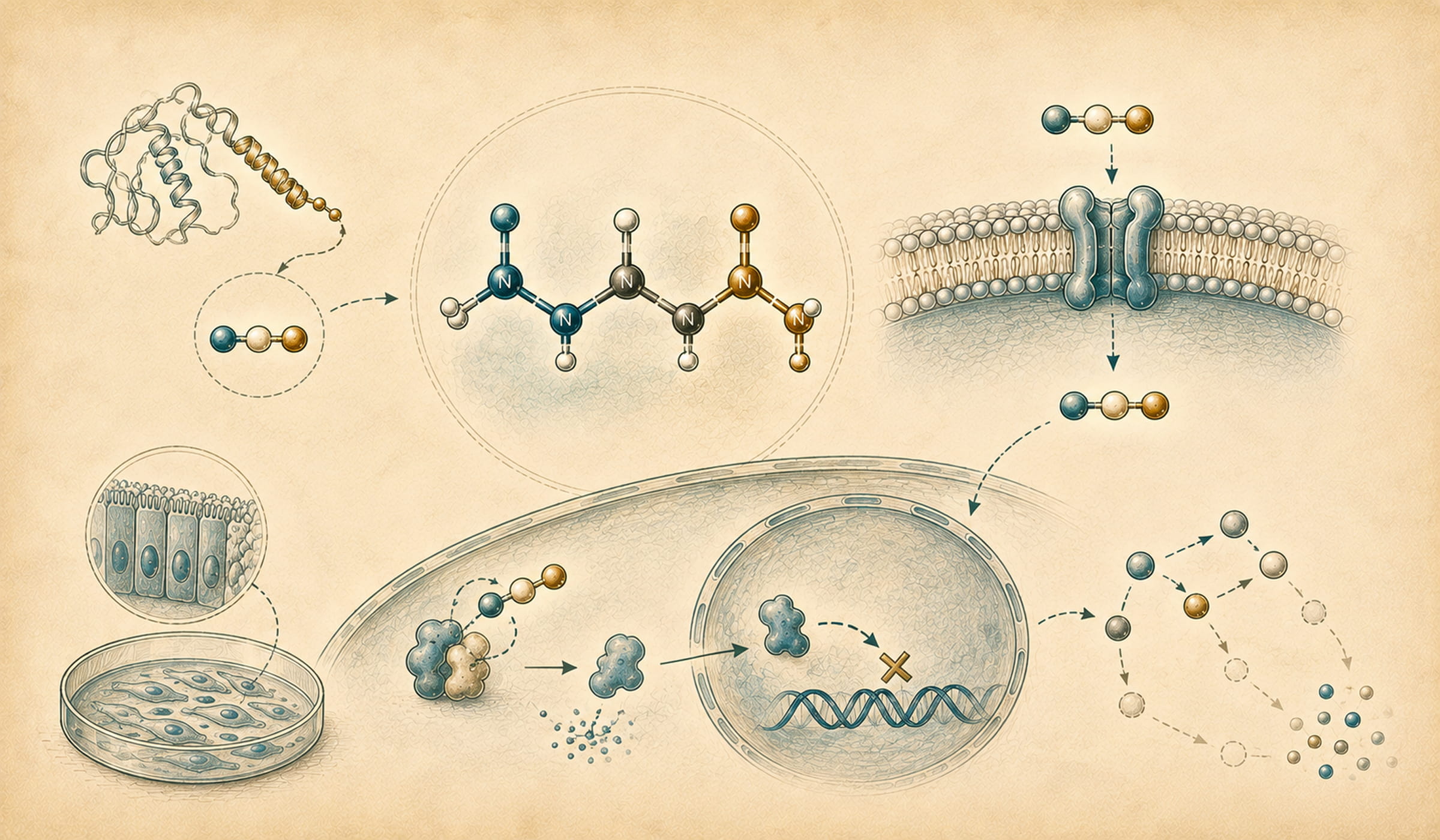
The transport mechanism is the most distinctive part of this literature. PepT1 is a di- and tripeptide transporter expressed in intestinal epithelium, and published work reported that KPV is taken up through PepT1 and that this uptake is associated with reduced inflammatory readouts in intestinal models (Gastroenterology, 2008; PMID 18061177). Companion work in murine inflammation models examined the same tripeptide from the melanocortin angle (Inflamm Bowel Dis, 2008; PMID 18092346).
Two features make this mechanistically interesting. A transporter-mediated route means uptake depends on transporter expression rather than on passive permeability, so the response is tissue-dependent by construction. And the same transporter has been studied in wider disease-model contexts (Cell Mol Gastroenterol Hepatol, 2016; PMID 27458604), with later material-science work using PepT1 as a targeting route for delivery systems (Biomater Sci, 2019; PMID 31408067; Biomater Sci, 2021; PMID 34846053).
KPV consists of three amino acids: lysine, proline, and valine. It corresponds to the C-terminal tripeptide (residues 11 to 13) of alpha-melanocyte-stimulating hormone (alpha-MSH), a 13-residue peptide hormone with roles in pigmentation and inflammation.
Alpha-MSH has well-documented anti-inflammatory activity in addition to its pigmentary role. Research established that the C-terminal KPV tripeptide retains much of the anti-inflammatory activity of the full hormone while lacking the melanocortin receptor-mediated pigmentary activity (Dalmasso et al., 2008; PMID 18061177). This makes KPV an attractive minimal fragment for studying the anti-inflammatory mechanism.
As a short tripeptide containing a basic lysine residue and a conformationally constraining proline, KPV is small, water soluble, and readily synthesized. Its short length makes it economical to produce, consistent with the availability of the compound as a research chemical.
NF-kB (nuclear factor kappa B) is a central transcription factor controlling the expression of many proinflammatory genes. In the resting state, NF-kB is held inactive in the cytoplasm by inhibitory IkB proteins. Inflammatory stimuli such as tumor necrosis factor alpha (TNF-alpha) and bacterial lipopolysaccharide (LPS) trigger phosphorylation and proteasomal degradation of IkB, releasing NF-kB to translocate to the nucleus and activate transcription.
Once in the nucleus, NF-kB drives the expression of proinflammatory mediators including TNF-alpha, interleukin-6 (IL-6), interleukin-8 (IL-8), and cyclooxygenase-2 (COX-2). Suppressing NF-kB activity therefore reduces the output of this entire proinflammatory program.
The research literature reports that KPV interferes with the NF-kB signaling pathway, reducing the nuclear activity of NF-kB and the downstream expression of proinflammatory cytokines (Dalmasso et al., 2008; PMID 18061177; Kannengiesser et al., 2008; PMID 18092346).
A notable feature of KPV in the intestinal literature is its uptake through the di- and tripeptide transporter PepT1, which allows the peptide to enter epithelial cells and act intracellularly on the NF-kB pathway (Dalmasso et al., 2008; PMID 18061177). This transporter-mediated uptake is an unusual and well-characterized route of cellular entry for a research peptide.
The reported effect of KPV is anti-inflammatory rather than broadly immunosuppressive, which is one reason it is studied as a targeted probe of the NF-kB pathway rather than a general immune suppressant.
In cell-culture models, KPV reduces the release of proinflammatory cytokines from stimulated monocytes and macrophages, measured by ELISA. These assays are the standard functional readout for the anti-inflammatory effect.
KPV has been studied in intestinal epithelial models, where the PepT1-mediated uptake is relevant, and its effects on adhesion molecule expression and inflammatory signaling have been characterized.
KPV is one of many tools used to probe the NF-kB pathway. Small-molecule IKK inhibitors and other pathway inhibitors provide complementary approaches. KPV’s distinguishing features are its peptide nature, its derivation from a natural hormone, and its transporter-mediated uptake.
KPV has been studied in animal models of intestinal inflammation, where reductions were reported in inflammatory markers and tissue damage (Kannengiesser et al., 2008; PMID 18092346; Dalmasso et al., 2008; PMID 18061177). These intestinal models are the best-developed animal-model context for KPV.
The animal-model literature reports reductions in proinflammatory cytokine levels and improvements in tissue-level inflammatory endpoints, consistent with the proposed NF-kB mechanism.
Because excessive inflammation can impair wound healing, an anti-inflammatory peptide such as KPV is of interest in wound-healing research where the goal is to modulate the inflammatory phase. This positions KPV differently from the pro-proliferative and pro-angiogenic mechanisms of GHK-Cu and TB-500.
Studies that combine KPV with other healing peptides are addressed in the healing peptide blend co-administration methodology post, framed strictly in animal-model research terms.
The pathway readout across this literature is NF-kB signaling and the cytokine expression downstream of it. Reported observations are reductions in inflammatory signaling readouts in the specific cell and animal models used. As with the rest of the peptide literature on this site, these are model-system observations and they do not describe an outcome in people. Related immune-side work is covered in LL-37 antimicrobial mechanism research. The compound is supplied in KPV research vials, and related compounds are indexed in the peptide reference library.
KPV is the C-terminal tripeptide (lysine-proline-valine) of alpha-melanocyte-stimulating hormone, a 13-residue hormone. Research established that this minimal fragment retains much of the anti-inflammatory activity of the parent hormone while lacking the melanocortin receptor-mediated pigmentary activity, making it a useful minimal probe of the anti-inflammatory mechanism.
The intestinal literature reports that KPV enters cells through the PepT1 di- and tripeptide transporter and acts intracellularly on the NF-kB signaling pathway, rather than acting solely through a classical cell-surface receptor. This transporter-mediated uptake is a distinctive and well-characterized feature of KPV.
KPV is one of several tools for probing the NF-kB pathway. Small-molecule IKK inhibitors act at the level of the kinase that phosphorylates IkB, while antibody-based approaches neutralize specific cytokines. KPV is distinguished by its peptide nature, its derivation from a natural hormone, and its transporter-mediated cellular uptake. It is best understood as a mechanistic research probe rather than a benchmark inhibitor.
KPV, BPC-157, and TB-500 act through different mechanisms (NF-kB modulation, growth factor and nitric oxide signaling, and actin binding respectively), which is the rationale for combination studies in some research designs. The healing peptide blend co-administration methodology post covers the experimental design and controls needed to interpret such combinations.
KPV is a three-residue peptide, Lys-Pro-Val, corresponding to the C-terminal tripeptide of alpha-melanocyte-stimulating hormone. Published research examines it in intestinal inflammation models, where uptake through the PepT1 transporter and effects on NF-kB signaling readouts are the reported findings.
Published work describes uptake through PepT1, a di- and tripeptide transporter expressed in intestinal epithelium. Because the route is transporter-mediated rather than passive, uptake depends on transporter expression and is therefore tissue-dependent.
Published cell and animal studies report reductions in NF-kB signaling readouts and downstream cytokine expression in the specific models used. These are model-system observations and do not describe an outcome in people.
Citation note: All PubMed identifiers in this article were verified against PubMed records on 2026-07-23.
Educational notice. This article is for educational and informational purposes only and is intended for licensed researchers and laboratory professionals. KPV is a research chemical sold for laboratory and research purposes only. It is NOT intended for human consumption, diagnostic use, or therapeutic application. All scientific claims are referenced to primary peer-reviewed literature.
Research-only disclaimer. KPV is a research chemical sold for laboratory and research purposes only. It is NOT intended for human consumption, diagnostic use, or therapeutic application.


